Alhambra
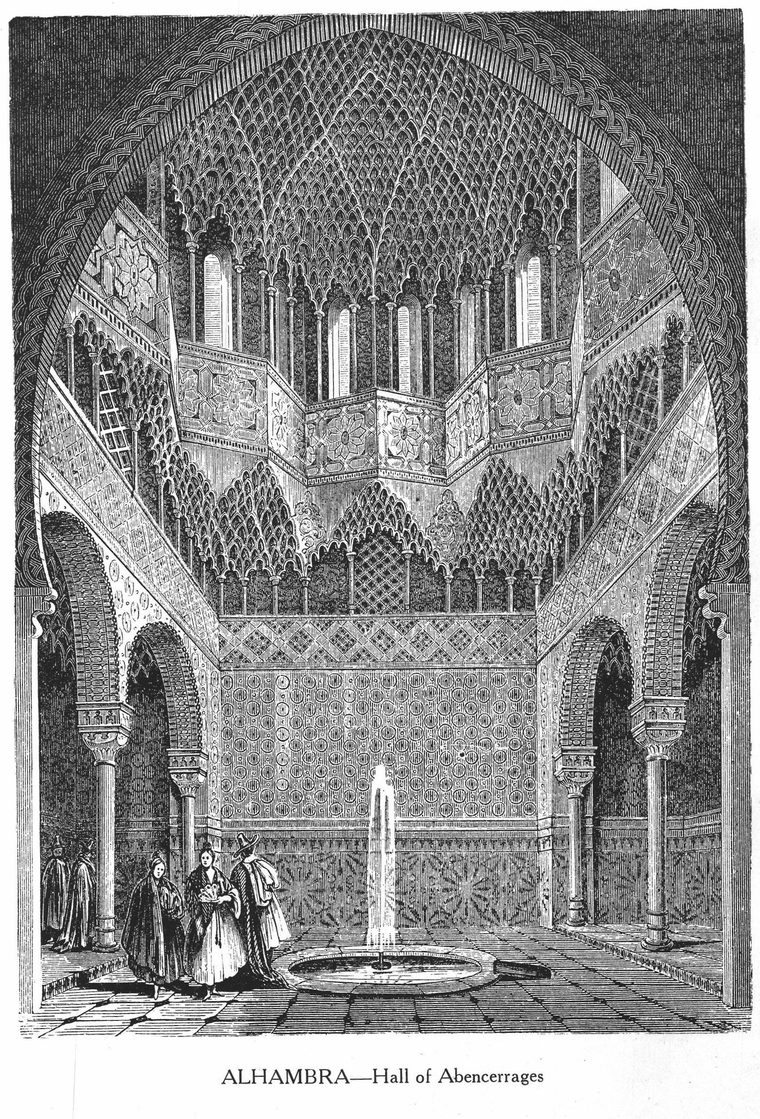
the ancient palace and fortress of the Moorish kings of Granada. The name, meaning the red, is derived from the red, sun dried bricks used in the construction of the outer walls. The Alhambra is situated on elevated ground overlooking the city of Granada, Spain, and commands a magnificent view of mountains, rolling hills, and valleys. It was constructed by the Moors about one hundred and fifty years before the discovery of America. It was taken from the Moors by Ferdinand and Isabella in 1492. A massive outer wall pierced by gateways and flanked by thirteen towers incloses an area of thirty-five acres. Although fallen into neglect, the gardens are still described as well wooded, and as intersected by shady walks, revealing charming waterfalls and cooling fountains. Singing birds and sweet scented flowers add to the delight of the traveler. A number of government buildings were contained in this area, the chief of which was the Royal Palace. The name Alhambra is applied properly to the entire fortress. The palace of the Alhambra was called by the Moors, Alcazar. This palace consisted of numerous halls and buildings arranged chiefly about two rectangular courts.
The Court of the Fish Pond is about one hundred and forty feet long by seventy-four broad. It receives its name from a pond in the center full of gold fish. The doorways, windows, rows of pillars, light arches, and colonnades about this court have the lightness and grace of palm trees. It is hardly proper to describe their beauty in the present tense, for an earthquake in 1821 and a fire in 1890 have left little of this court to admire. The Court of Lions, somewhat smaller, derives its name from a white alabaster fountain in the center, supported by twelve lions. When this fountain was in order a jet of water rose from its center, fell back into the basin and was discharged through the mouths of the twelve marble lions. The court is entirely surrounded by an arcade or low gallery resting on one hundred and twenty-four white marble columns. The floor is paved with colored tiles, and the walk beneath the gallery with white marble. The arches, galleries, filigree walls, and the light domes of the roof are composed of open tiling, adorned with stucco work of wonderful lightness and grace. Arches and ceilings seem to hang like cobwebs or gauze in the shape of foliage and arabesques.
Of the many halls that of the Ambassadors is perhaps the most imposing. It is thirty-seven feet square with an arched ceiling seventy-five feet in height. This was the grand reception room where the Moorish monarch sat enthroned on state occasions, such as the reception of foreign ambassadors. The walls are covered with delicate stucco work, the ceiling is inlaid with diversified work of white, blue, and gold, imitating stars set in the heavens. So wondrously is marble, brick, and stucco fashioned and put together, that, seen from the end of a vista, the combination of pillars, arches, windows, and walls has the appearance of lace curtains hung and looped in graceful fashion. Doorways, arches, domes, colonnades, fountains, filigree work, trellised windows, blue, brown, red, and gold colorings, sparkling fountains, soft couches, and the lightness and grace of it all, make the Alhambra a veritable fairyland that stands unapproached in the history of architecture. It is a magic group of palaces, possible only to the same order of minds that created the Arabian Nights' Entertainments. Washington Irving's Alhambra is considered an excellent account.
See Moors; Architecture