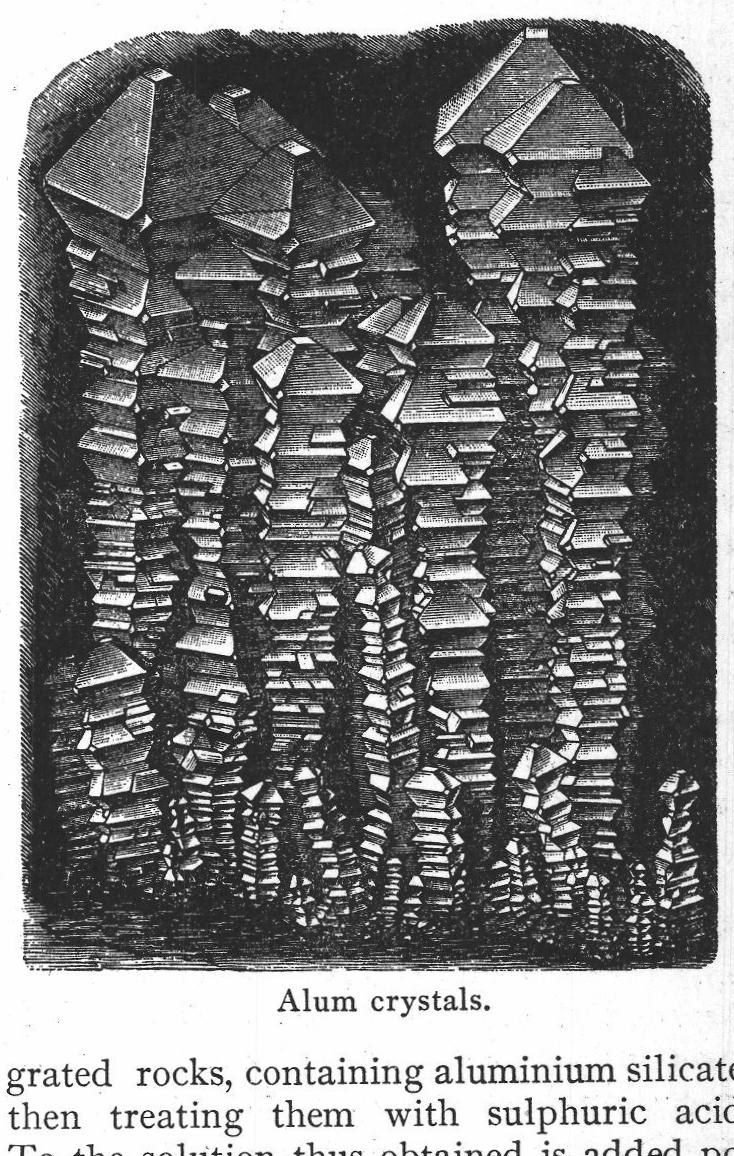
Alum
a substance which is essentially a double sulphate of aluminium and some other element, especially an alkali metal, combined with 24 molecules of water. Ammonium takes the place of an alkali metal in forming one of the alums. The most important alums of commerce are potassium alum and ammonium alum. Potassium alum, the well-known common alum, is made by roasting certain easily disintegrated rocks, containing aluminium silicate, then treating them with sulphuric acid. To the solution thus obtained is added potassium sulphate, and the alum is crystallized out. The crystals are large, white, and transparent, and are soluble in about ten parts of water, giving an acid reaction to the solution. When heated strongly, they lose their water of crystallization and form a substance known as "burnt alum." Alum is strongly astringent, and produces a puckering sensation when applied to the lining of the mouth.
All alums crystallize from solution very perfectly, forming exceedingly pure crystals. Largely on account of this property the alums are extensively useful in the arts. Alum is used in the tanning of leather, in the preparation of size to be used in the manufacture of paper, and as the basis of the mordant or material used for making a permanent dye in the coloring of cloth. It is also one of the essential ingredients in many of the artificial yeasts, or so-called baking powders. The use of alum for the purpose of improving the appearance of inferior or slightly damaged flour was at one time commonly practiced in Europe, both by millers and bakers. Now, however, it is rarely if ever used for this purpose. The presence of notable quantities of alum or alum residue in bread is likely due to the use of an alum baking powder. Alum is sometimes added to the salt solution used to produce hardness and crispness in pickles. It has been occasionally mentioned as a preservative, but its use for that purpose has not found a wide application. Alum is employed to some extent as a medicine. It is an antidote in acute cases of lead poisoning, and, on account of its astringent action, it is applied to slight cuts to check the flow of blood. Very large doses produce symptoms of poisoning. The white of a raw egg is an effective antidote, as, in coagulating, it combines with the alum and permits of its removal from the stomach by the aid of an emetic.