Ant
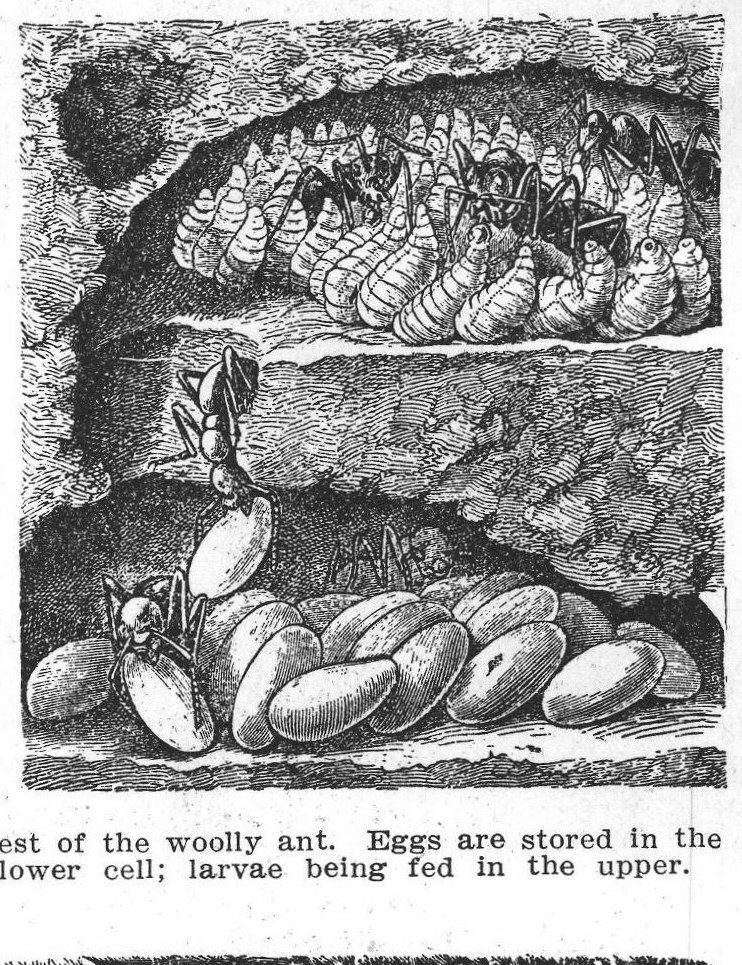
a family of insects allied to bees and wasps. Ants are not mistaken readily for other insects; but scientists rely on a lens-shaped scale or segment to be found at the waist or peduncle of the true ant. Ants are social, living in communities. The males and females are winged. The workers are undeveloped females. They are wingless. The reader is referred to the article on the BEE for comparative information. The ant queen is not jealous. Several may live in the same community, hence no regular swarming takes place. In the season of haying the males and females of many thousand communities come out and fly together, giving the impression that flying ants are a species by themselves. After the pairing season is over, they all fall to the earth. The males die and the females drop their wings and seek entrance to ant hills, where they are welcomed by the workers, or else they start new nests. The eggs of the ant are so small that they can scarcely be seen with the naked eye. The queens drop them carelessly in the runways. The eggs are seized upon by the workers, and shifted about to the driest and warmest parts of the nest. The tiny, white, footless larvae are fed usually by the workers with rich honeydew. The "ants' eggs," which the excited workers may be seen lugging away on the disturbance of their nest, are not eggs but are cocoons or pupae; that is to say, ants in the third stage about to burst the white membrane and come out fully developed.
There are many species of ants. The common, small brown ant that throws up a ring of particles of earth about its burrow is quite a remarkable ant in its way. Ants live usually on flesh or vegetable food and many species, if not all, are fond of flower sweets; but this particular ant makes a regular custom of following plant lice, or aphids, for the sake of the honeydew or sweet juice which these insects give out from their bodies. This ant even cares for the eggs of the aphid over winter, and apparently herds the adult aphids. An ant approaches an aphid, fondles it affectionately with its antennae, and, when the pleased animal gives off honeydew through the tubercles of its body, the ant proceeds to suck it up greedily. Ants found running up and down the stems of weeds, cornstalks, house plants, and trunks of trees or garden vegetables, are, in all probability, on the way to or from their peculiar "milk cows."
The carpenter ant is a large, black ant found in logs and half rotten timbers, in which it cuts extensive galleries. The queen goes off into a cell alone and rears her young, feeding them on food stored in her body.
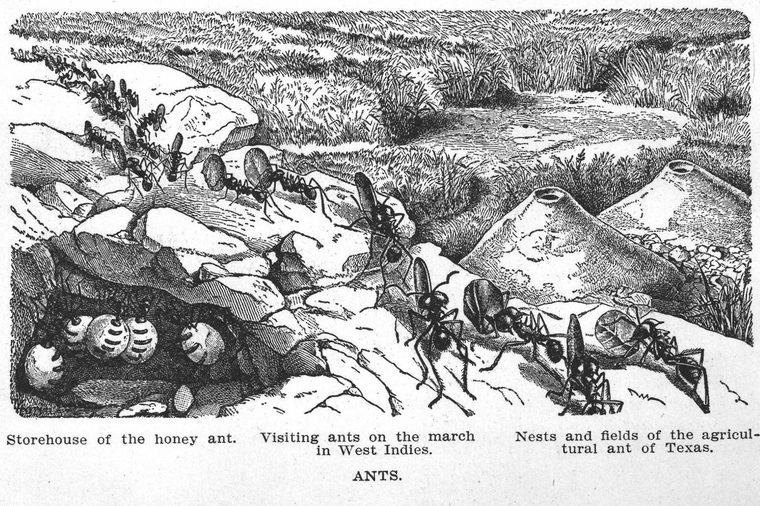
The honey ant community includes peculiar individuals that stay in chambers and receive the honey collected by their associates until they grow to enormous size. In time of scarcity these vat-like ants regurgitate this honey for the benefit of their now hungry fellows.
The slave-holding ant has a rusty red head and foreparts, with brownish legs and abdomen. It makes its nest under flat stones and logs. It has a curious habit of making slaves, not unlike that practiced by ancient nations. Scouts are sent out to locate the nest of a colony of independent slave ants, a darker red-legged ant that prefers to live alone and unmolested. When the scouts have reported, the slave makers sally out in full and orderly array to storm the nest of their neighbors. The adult ants defend themselves fiercely, for if overcome, they are bitten to death. Their larvae and pupae, maggots and cocoons, are taken home by the conquerors and matured into slaves.
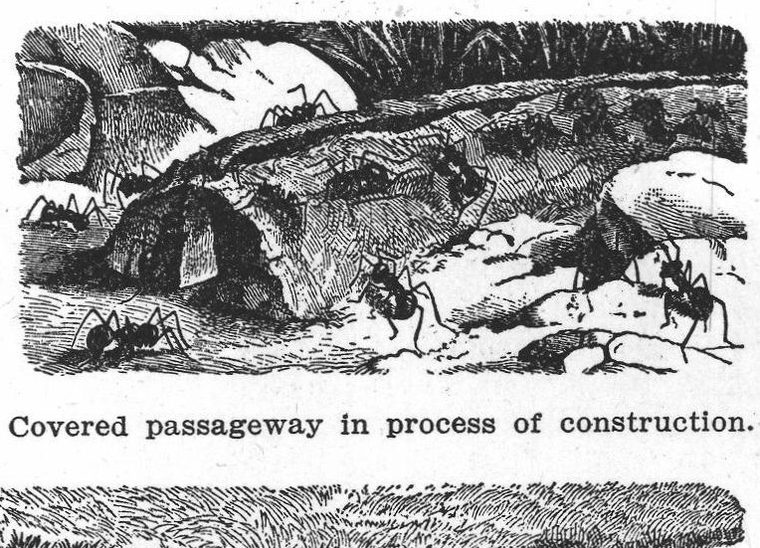
One of our common ants is the mound builder that constructs mounds of sticks, straw, and dirt. These ants have commodious underground quarters. They construct pathways leading in all directions along which they tug, carry, and push seeds, insects, and leaves many times their own weight.
The agricultural ant of Texas establishes paths leading in every direction from the home. It destroys all vegetation near the nest, with the exception of certain seed-bearing grass. This it cuts down when ripe, carrying the seed into its burrows for winter food.
The so-called leaf-cutting ant is an agricultural pest in Central America. An invasion of these ants is as much to be feared in a lemon or orange grove as a flight of Rocky Mountain locusts in a wheat field. Instead of bloom, fragrance, and promise of fruit, in a few days, or even hours, not a vestige of leaf or bud is to be seen.
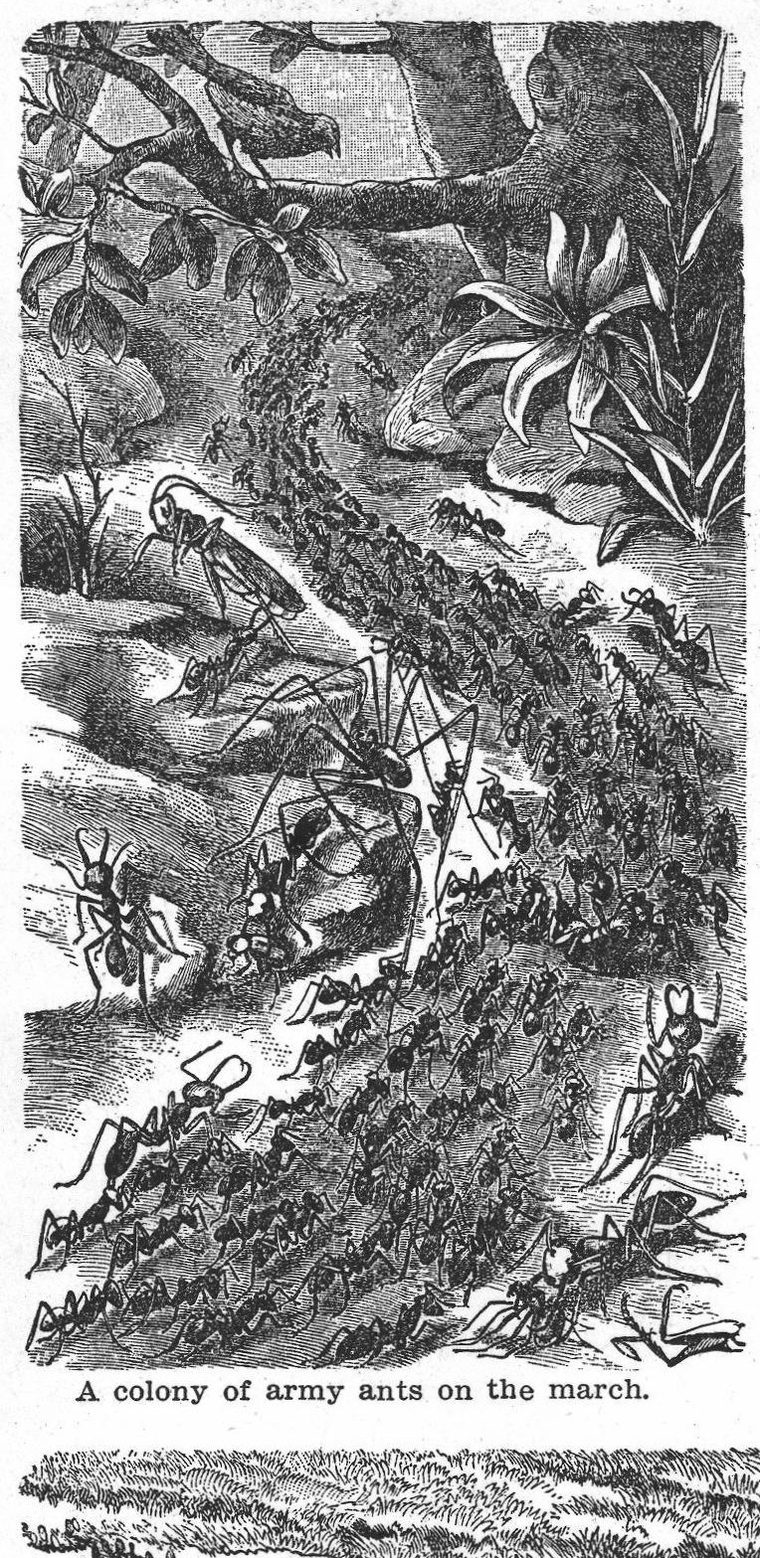
The telegraph poles of the Panama Railway are of iron. The army ants of that region destroy a cedar pole over night. Du Chaillu, the African traveler, describes a column of army ants that occupied twelve hours in passing before him. Wild animals flee before them. They pick the bones of the largest animal in a few hours.
It has been thought that ants communicate ideas by means of their antennae. When one ant meets another, they cross antennae, apparently by way of giving information. At all events a messenger has some means of throwing a camp into a high state of excitement.
The ant has long had the respect of naturalists and philosophers and has an enviable place in literature, well summarized by Solomon, "Go to the ant, thou sluggard; consider her ways and be wise."
See Termites; Bee; Wasp; Anteater; Aphid