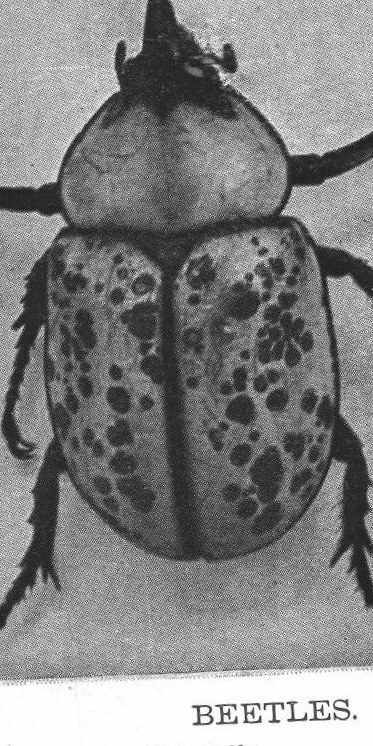
Beetle
a large order of insects, including eighty American families and 11,000 species. Beetle may be distinguished from bugs by the wings. Both bugs and beetles have two pairs of wings. The forward or outer pair of the bug are horny with gauzy tips that overlap on the back. The outer pair of the beetle are heavy and horny throughout, and meet in a straight line along the back. In fact the horny outside wing covers of the beetle are not wings at all, but horny scales under which a pair of fine, thin wings are folded with occasional vestiges of front wings. When the beetle desires to fly it raises its wings, and sails away, frequently with a humming or whirring noise. Some beetles are poor flyers. As a rule, the better a runner, the poorer a flyer it is. The mouth parts are strong. The beetle has six legs and two usually well developed antennae.
The life of the beetle consists of four stages: the egg, the larva or grub, the pupa, and the developed insect. The female beetle deposits her egg where she thinks there will be an abundance of food. From the egg comes a grub, of which the grub-worms, large and small, of manure piles are familiar examples. They are grubs, not worms. They correspond to caterpillars and have six stiff legs. The sole business of the grub is to eat and grow. As it grows, it sheds its skin every now and then for a new and larger one. When it has its size, which it may attain in a few weeks or years according to the species, it builds itself a rude shelter of bits of wood, or a case of silk, and goes into a state of rest, the pupa stage, in which the folded legs and wings of the beetle may be seen. It then remains quiet until the full-sized beetle is ready to break forth, hunt food, spread its wings, and lay new eggs.
There are many interesting beetle families. On hot, bright days bronze and green fellows, beautifully marked with yellow, spring from the dusty road and fly a few rods ahead, turning as they light, so as to sit with an eye on the traveler. These are tiger beetles.
The ground beetles have large, plump, green, blue, violet, brown, and spotted, but mostly black bodies and long, slender feelers. One small sort has a magazine of disagreeable fluid at the rear of its abdomen which it flings into the face of an astonished enemy. The fluid fills the air with smoke, under cover of which the little soldier scuttles away.
Black, shining, diving beetles hang head downward at the surface of quiet pools watching for insects to eat. Like other insects, they breathe through tubes or nostrils on their sides. They can carry a lot of air to breathe imprisoned under their wing covers. They are not inconvenienced by diving.
Whirligig beetles seem to spend most of their time whirling around, sometimes quite a swarm of them, on the surface of quiet water. They dive and they fly from one pool to another, but depend rather on their agility when one tries to catch them.
The carrion beetles include the burying beetles, large, stout, cylindrical fellows with reddish spots. When a pair of these humming about find a dead mouse or other carrion, which they are supposed to detect for a long distance, they light and go to work digging away the earth beneath, until the animal is quite buried in a pit. The female then lays her eggs in the animal. Comstock states that a pair of these beetles will roll a rat several feet, if need be, to find a spot suitable for burying.
Quite a number of species make trouble. The carpet beetle fills carpets with grubs; the pale raspberry beetle covers the raspberry leaves with small white grubs. Apple tree borers ruin an orchard. The cigarette beetle infests tobacco factories. The ship-timber beetle honeycombs wooden ships. The rose beetle destroys our choicest rosebuds. The meal worm plagues the miller. The sugar-cane beetle works its way into the base of sugar-cane and is a serious pest in Louisiana. The maple, the elm, the hickory, the willow, the oak, and nearly every other tree has its beetle that bores in the twigs and deposits grub-producing eggs from the later effects of which the twigs and even trees die.
Beetles are interesting but hardly attractive. As an order they are hostile to the fruit grower. Longfellow, in defending the cause of birds, audacious fruit thieves, takes this view:
Renders good service as your man-at-arms,
Crushing the beetle in his coat of mail,
And crying havoc on the sluggard snail.
See Insect; Bug; Potato Beetle