Bicycle
bi'si-kl, a light, two-wheeled vehicle, propelled by the feet of the rider. The bicycle has been brought into practical use within the past twenty-five years, but the general notion is an old one. The hieroglyphics of the Egyptians represent a contrivance of the sort. Frescoes of ancient Pompeii represent figures on a riding stick mounted on two wheels. A stained glass window dated 1642 in the church of Stoke Pogis, the scene of Gray's Elegy, represents a rude bicycle. For two hundred years scientific journals have contained accounts of various devices, patents, and experiments, much as our present journals discuss the airship. In 1816 a Baron Drais of Mannheim invented a machine consisting of two wheels, one behind the other. The front wheel was axled in a fork which was swiveled to the frame and provided with a crossbar with which to guide the draisine, as it was called in honor of its inventor. The rider sat astride and propelled the machine by striking the ground with his feet. The inventor claimed that he could go uphill as fast as a man could walk, that he could travel from six to nine miles an hour on a level road, and that in going down hill he was able to rest his feet and travel at a speed equal to the gallop of a horse.
During the next fifty years, the journals were full of improvements and inventions. Out of curricle, dandy-horse, hobby-horse, accelerator, bicipede, bicircle, and velocipede, the name bicycle emerged about 1869.
The crank-driven, two-wheeled bicycle was first exhibited at the Paris Exposition in 1865, but the inventor did not realize the importance of his device sufficiently to patent it.
The general use of the bicycle took root first in England where level, macadamized roads offered unusual advantages. English wheels were exhibited at the Centennial Exposition at Philadelphia, 1876, giving the American public an idea of their utility. Prior to this time a few machines had been made rather by way of curiosities. A little later Albert Pope visited England where he found about a hundred establishments making wheels. He gathered up the best ideas he could find and began the manufacture of Columbias at Hartford, Connecticut. It is still the leading American city in this industry. The earlier bicycles, as may be remembered, consisted of a large wheel and a small one. The rider was perched on a dangerously high seat, and was likely to take a header at any time. The safety type in which two wheels of the same size are employed was placed on the market in 1887.
The bicycle is not an American invention, yet American manufacturers now claim to produce the best and cheapest wheels in the market. American bicycles are sold abroad in competition with the best European makes. There were in 1900 312 American establishments engaged in making bicycles or parts of bicycles, with a total capital of $30,000,000. The annual output for that year was 1,182,850 bicycles, with an average factory value of $18.91.
A number of points in the construction of the perfected safety are interesting. The invention of a padded, rigid saddle of hygienic pattern, mounted on springs that obviate the jar and jolt of old-fashioned "bone shakers" is one of the most important. The cushion tire is said to have originated in the use of rubber garden hose for the purpose. It not only prolongs the life of a machine, by lessening the strain which comes from jolting, but it enables the wheel to pick up the path better.
The greatest triumph of all is in the peculiar construction of the wheel. The bicycle wheel, like that of a cart, has a stiff, rigid rim, but here the similarity ends. The hub of the cart wheel, with its axle and load, is supported by the stiffness of the spoke or spokes that happen to be under the hub at the particular moment. The hub of the bicycle wheel, with the weight of the frame and rider, swings like a hammock at the center of the wheel. It is supported by the wire spokes that run to the upper part of the tire, not by the stiffness of the spokes beneath it. This device is known as the suspension wheel. The first patent on record is dated 1826, but the general notion is credited to an Italian, Leonardo Da Vinci. It precedes the discovery of America by a year or two.
The invention of the ball-bearing axle is due to an Englishman by the name of Bonn. The ends of the axle are slightly pointed or cone-shaped, and rest in funnel-shaped cavities to correspond. A circular row of steel balls, interposed between the surface of the axle and the funnel, roll as the axle rolls. The balls and parts are made of hardened steel which show very little wear. The ball-bearing feature comes nearer obviating friction than any other mechanical device known.
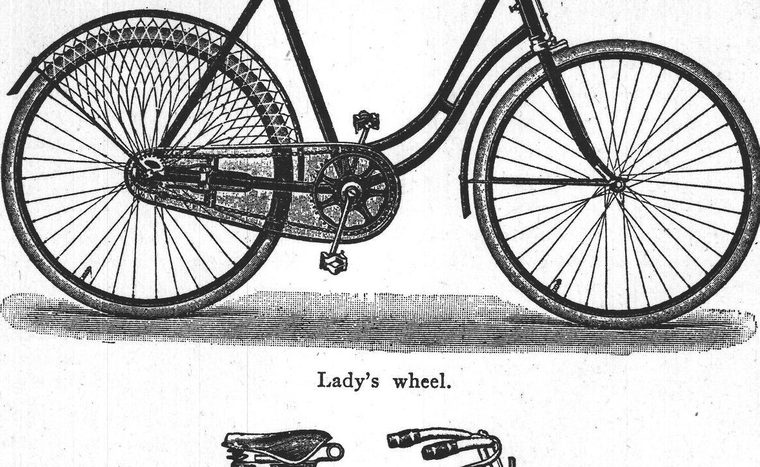
Frames have been made of various material, including papier-mache and hickory wood, but they are now made almost invariably of steel tubing. Ordinary tubing such as is used for water pipes is made of flat strips, with the edges rolled together and united by a seam. The tubing employed in making bicycles is much more expensive. It is drawn like glass tubing from a solid ingot of the finest steel, and has no seam. About twenty feet of tubing are required to make a frame. The various parts are joined together by the process called brazing. About 30,000,000 feet of this tubing are required in the United States annually. The tubing used has varied in weight considerably, oscillating between strength and lightness. The wheel of approved pattern may now be said to weigh about twenty-two pounds complete. The drop frame for the convenience of women was patented in 1886. The latest invention is the chainless gear. The first patent was granted in 1885, but practical patterns were not put on the market before 1897. The expense of their manufacture is nearly double that of ordinary single gearing. Other patents cover the coaster brake, pump, lamp, bicycle shoe, carrying basket, cyclometer, etc.
The bicycle is not only a great convenience, but has done much for the health, especially of those who are confined in cities. Parks and country roads are of little use to people who cannot afford to reach them. The mechanic with his wheel is able to reach his work with little expense of time and money. Wheels have done much to improve the condition of American roads. Thousands of miles of cycle paths have been built and a general revival of interest in roadmaking has been promoted by those who use bicycles.
There are indications that bicycles as a fad have had their day. They have been so cheapened that the possession of a wheel is no sign of social distinction, but the day of their usefulness has just begun.
See Automobile