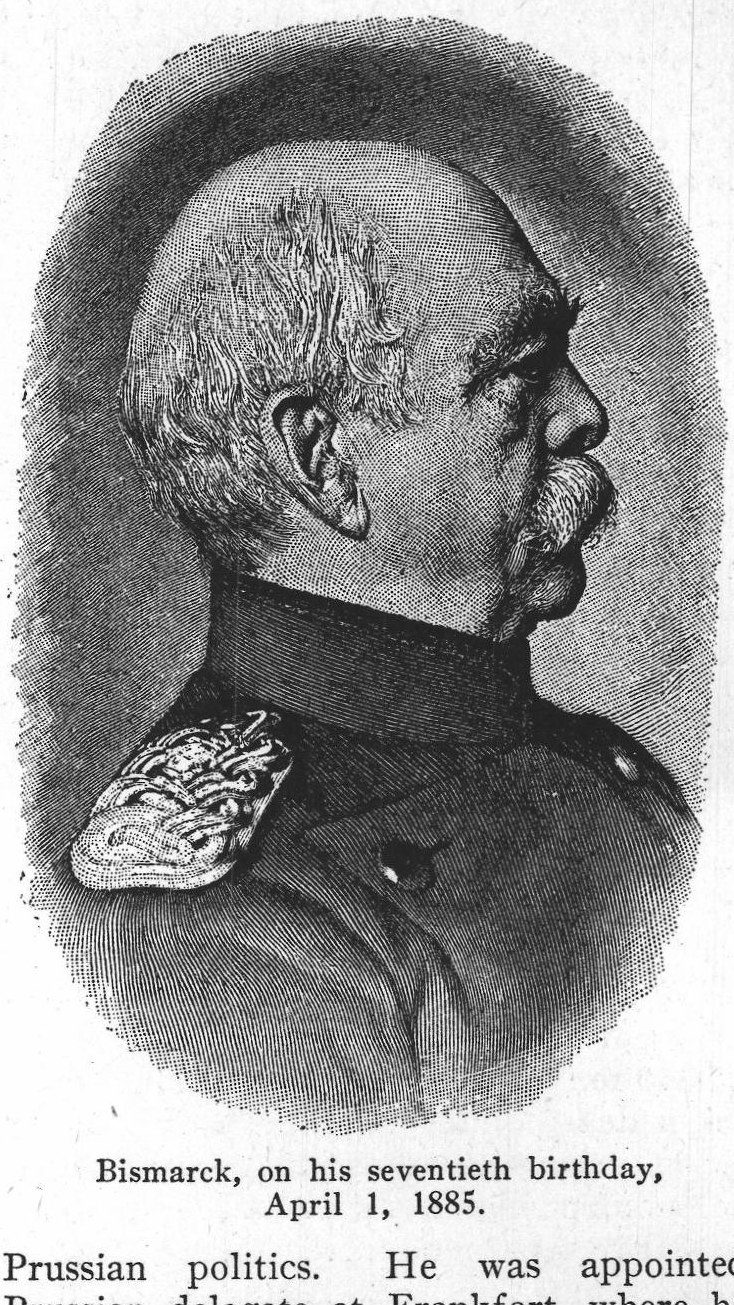
Bismarck
biz'mark (1815-1898), a German statesman. His full name is Otto Eduard Leopold Bismarck-Schoenhausen. He was born at Schoenhausen, in Brandenburg, April 1, 1815, and died at Friedrichsruh July 30, 1898. Bismarck was a university student of Gottingen, Berlin, and Greifswald, and served his regular term in the army. He devoted his early manhood to the management of the paternal estates. He came to notice in 1849 as a member of the Diet of Prussia. He was a man of massive, commanding appearance, who knew his own mind. He was recognized at once as a new force in Prussian politics. He was appointed Prussian delegate at Frankfort, where he met representatives from other German states, among whom he contracted friendships and enmities that lasted through life.
At this time Austria was the dominating influence in the German Confederation. Her representative carried himself, it was thought, in a supercilious manner. Bismarck was recognized at once as a man of powerful intellect and individuality. He became the leader of anti-Austrian forces. To go into Bismarck's career would be to write the history of Germany for a period of thirty years. To set aside Austria and make Prussia the leading German state became the ruling ambition of his life. We must be content with saying that under King William of Prussia, afterward Emperor William I of Germany, Bismarck, the prime minister, Von Roon, minister of war, and Moltke, commander of the army, built up the most efficient army on the face of the globe. They robbed Denmark of Schleswig Holstein in 1864, expelled Austria from the German Confederacy in the Six Weeks' War of 1866, and humiliated Napoleon III in the Franco-Prussian War of 1870-71. Bismarck was the leading spirit in it all. Though others wavered, he never did. At a meeting of the representatives of the northern German states, held in the magnificent hall of Versailles during the siege of Paris, Bismarck had the satisfaction of hearing his king proclaimed emperor of Germany.
Bismarck was a wonderful man for having his own way. He used to say that his greatest diplomatic successes came from saying exactly what he meant. While others accustomed to a more politic or deceptive way of speaking were looking for some hidden meaning, he carried his point. He was arbitrary. At one time he sent the Prussian legislature home because it would not vote money. He announced that the government would get on without a legislature. At times he was hampered by the jealousy of his fellow officials, and there was always a chance that some one might supplant him in the affections of the king. He says himself that more than once he waited in the king's anteroom trembling from head to foot lest the person then holding audience with the king, possibly a foreign ambassador, might induce William to adopt some unwise measures and overthrow all his plans. At the close of the war with France, he was loaded with titles and wealth, and was recognized as the foremost man in Europe. If ever a man built up an empire Bismarck did. It is not pleasant to know that in his later days the successors of his old king and emperor slighted him, and turned him off, 1890, like an old horse that had served its days of usefulness. It is safe to say that no other man of his century accomplished so much in the political field as did Bismarck.
Although Bismarck had reason to resent the treatment he received from his political enemies in Berlin, it must not be supposed that he ended his days in neglect. His private means were sufficient. His home and grounds at Friedrichsruh were comfortable, spacious, and beautiful. He was happy in all his family relations. He delighted in books, walks, drives, and hospitality. A secretary relieved him of the drudgery of correspondence.
The eightieth anniversary of his birthday was observed by half Europe. Sixty-eight thousand gas jets "lit Lombard Bridge--Hamburg's Rialto." Delegations from twenty-eight German universities came from the Baltic, the plains, and the Alps to Friedrichsruh to pay their respects and honor the Unifier of Germany. Four thousand students, led by six military bands, appeared on the lawn with eagle-emblazoned banners. They shouted themselves hoarse on the appearance of the man who was more to them than emperor and marched away singing Die Wacht am Rhine. Thirty-five special trains brought visitors. Seventy newspaper correspondents and five special telegraph wires told the world of gifts, speeches, and greetings. It was the greatest ovation ever accorded a person in private life--a greeting such as the American people might have extended to Abraham Lincoln had he lived to a similar age. Some notion of the stir may be had from the statement that the village postoffice handled 11,475 telegrams comprising 450,000 words. Bismarck received several thousand telegrams, 1,044 packages, 955 registered letters, and 450,000 ordinary letters and pieces of mail during the birthday week.
Professor Andrew D. White, United States ambassador at Berlin, who had every opportunity to know the great statesman, characterized Bismarck as, "big rumbling, heavy, fiery, minatory, objurgatory,--the greatest German since Luther."
See Metternich; Talleyrand; Germany; Franco-Prussian War