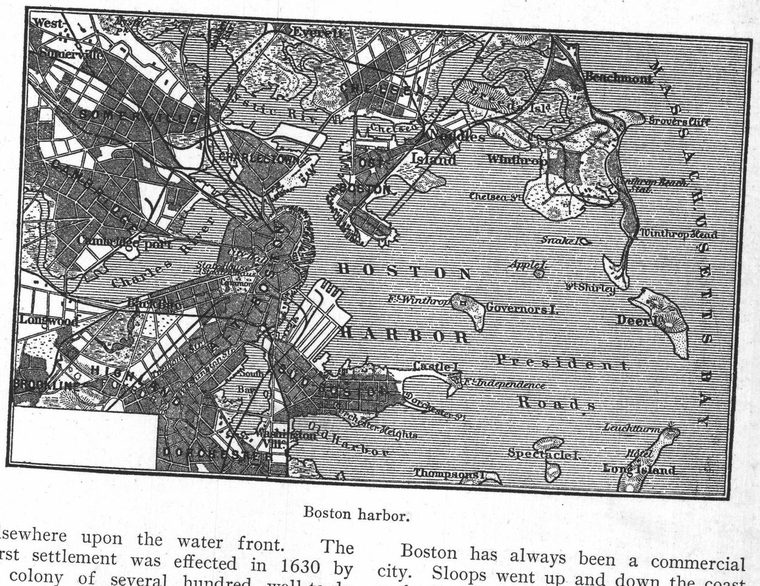
Boston
the capital of Massachusetts and metropolis of New England. It is situated on a peninsula formed by the Charles River and an arm of Massachusetts Bay. The area of the original peninsula has been more than doubled by filling in Back Bay and by encroaching elsewhere upon the water front. The first settlement was effected in 1630 by a colony of several hundred well-to-do Puritans under the personal direction of Governor John Winthrop. They named their new home after their old town of Boston on the coast of Lincolnshire, England. The name is a corruption of St. Botolph's town. The English Boston still has its parish church of St. Botolph's, with Gothic spire, chime of bells, and lighthouse tower.
The settlers of Boston were the strongest body of colonists to settle in the New World. They had education and means. They left England to establish a church to their own liking, and were, from the first, leaders in colonial affairs. The government of the town was managed like a country township, through the town meeting, up till 1822. In case of an emergency the leaders convoked, not a meeting, of the council, but a town meeting. This explains the activity and influence of Sam Adams and the number of orderly uprisings like the Boston Tea Party.
Boston has always been a commercial city. Sloops went up and down the coast gathering furs and other colonial products. Ships made regular voyages to the mother country. John Hancock, perhaps the most influential man in the colony, was a wealthy merchant. The English government could devise no severer punishment for the rebellious city than the Boston Port Bill of 1774, forbidding ships to enter Boston Harbor. Boston is still the second maritime city of the Union in point of commercial activity. It is the principal wool market, and handles more leather, hides, shoes, and fish than any other city in the Union. Enough shoes are made in the vicinity of Boston to supply every man, woman, and child in North America and the West Indies with a new pair yearly. The census of 1900 gave the city a population of 562,192, or fifth in the United States. If suburbs be counted, the rank of Boston is fourth, or if a radius of fifty miles be used, it is second only to New York. The state census of 1905 reported a population of 593,598.
The affairs of the city have been well managed on the whole. A fine park system, a public library, one of the best water supply systems in the world, sanitation, street railways, and lighting have been managed without the outrageous scandals that have fallen on other American cities.
The proximity of Harvard University, the presence of other institutions of learning, an excellent system of public schools, the activities of noted publishers, the residence of by far the lion's share of the names noted in American literature, notably Longfellow, Holmes, and Lowell, the publication of the Atlantic Monthly, and a leading place in the affairs of Congregationalism and Unitarianism have given Boston a decided reputation for intellectuality. Its being the intellectual, commercial, and political center of a large section led Oliver Wendell Holmes, in a spirit of facetiousness, to dub Boston "the hub of the universe."
Visitors take a particular interest in the Public Garden and Boston Common, in Bunker Hill Monument, in the Old South Church, now the depositary of colonial relics, and in Faneuil Hall where Sam Adams, Daniel Webster, and Wendell Phillips spoke.
Librarians from all over the United States go to see the building and arrangements of the Public Library. The State House with its gilded dome is open to everybody. Merchants, of course, take most interest in the wharves and business districts. Travelers find Boston an easy city to reach. All trains from New York way use the South Station, one of the largest in the world. All trains from Canada, the west and north, use the Union Station in the northern part of the city, so there is little opportunity for confusion.
See Adams; Faneuil Hall; Harvard; Massachusetts