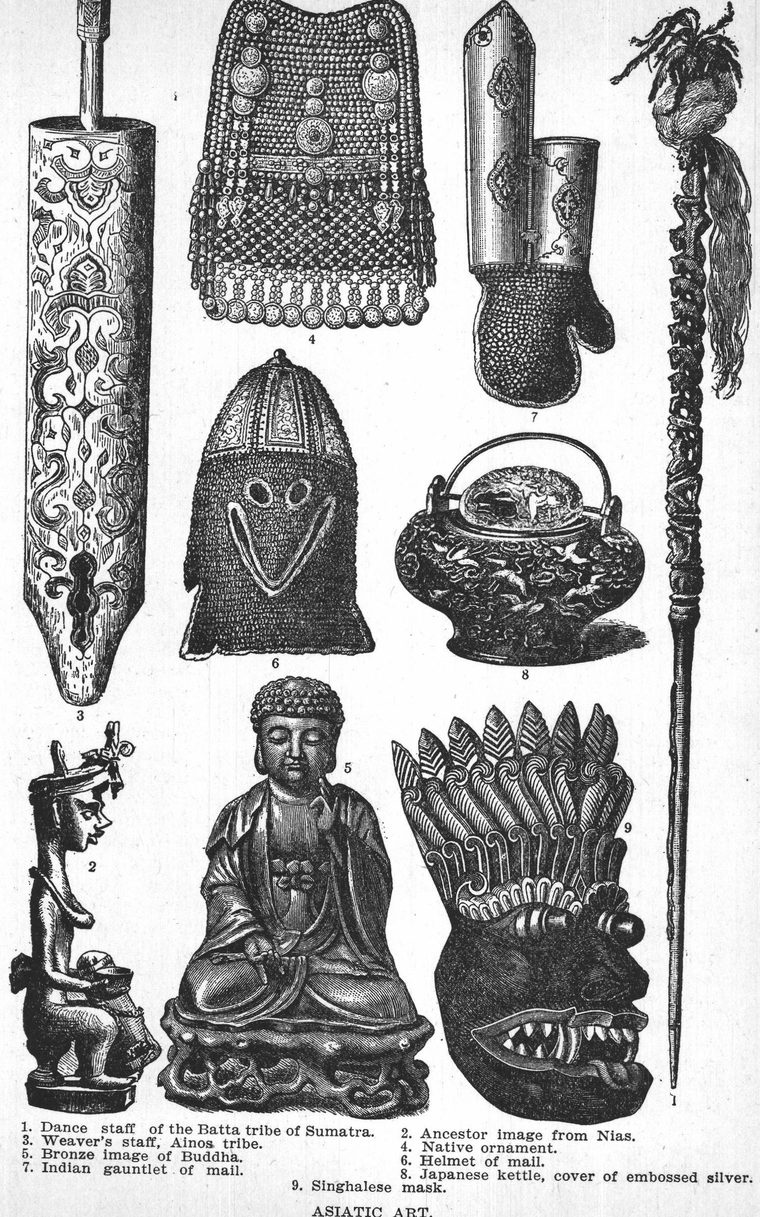
Buddha
boo'da, the founder of Buddhism. The name Buddha means "the enlightened," and is in reality a generic term denoting a deified teacher. Buddhists claim that many Buddhas have lived and taught. The one to whom the name came to be applied specifically, because of his great work as a reformer, was named in reality Siddhartha Gautama. He is supposed to have been born about five hundred fifty years before Christ. We have little knowledge of his life which can be called historical, but with the few facts are interwoven many traditions faithfully believed by Buddhists. He was the son of a Hindu prince who lived a short distance north of Benares, India. He was born in a pleasant garden by the river side, while his mother was on a journey to the home of her father. Many stories are told of the miracles attending his birth, of the prophecies pronounced when his father first looked upon the child, and of how, as the mother continued her journey, the baby was protected from the heat of the sun by cool shadows which moved above his head.
Siddhartha grew to be a handsome and intelligent youth, but too thoughtful to suit his parents' ideas of a happy prince. They therefore married him at an early age to his young cousin, the beautiful daughter of a neighboring king or raja. It appears that the young man now went to the other extreme; for we read of his relatives complaining to his father that he lived for pleasure only, and would be incapable of leading an army, should war arise. Gautama, hearing of this, appointed a day when his prowess should be tested. At this trial the young man proved himself superior, not only in manly exercises, but in knowledge, to all competitors. Complaints ceased, and Gautama pursued his own course. In the midst of his pleasures, however, he observed many things which made him ponder deeply. He saw a man bent with age. Asking Channa, his charioteer, why such things should be, he was told that age is the common fate of all. He saw a man afflicted with a loathsome disease, and Channa told him that all must suffer. He saw a corpse, and learned that all must die. Pondering these things, and striving to solve the mysteries of life and death, Gautama at last left his family and lived for years as a recluse. For some time he practiced the most severe penances and self-denial, but he learned the uselessness of such practices, and finally, while sitting under the "Bo-tree," known from that time as the tree of wisdom, he became "enlightened." When he had thus evolved a system of religious beliefs and a code of morality satisfying to his own mind, he began to teach his doctrines and soon made many converts.
There is an old Buddhist hymn which relates how an acquaintance met Buddha as he started out with the joy of his new religion shining in his face, and asked him where he was going. His answer was, "I am going to the city of Benares to establish the kingdom of righteousness, to give light to those enshrouded in darkness, and open the gate of immortality to men."
Buddha made it his custom to gather his disciples about him for instruction during the rainy season. When that was past, they separated for the purpose of spreading the new doctrines. According to tradition Buddha lived to be almost eighty years of age, continuing to teach until the end. His last words were spoken to his faithful disciples.