Coral
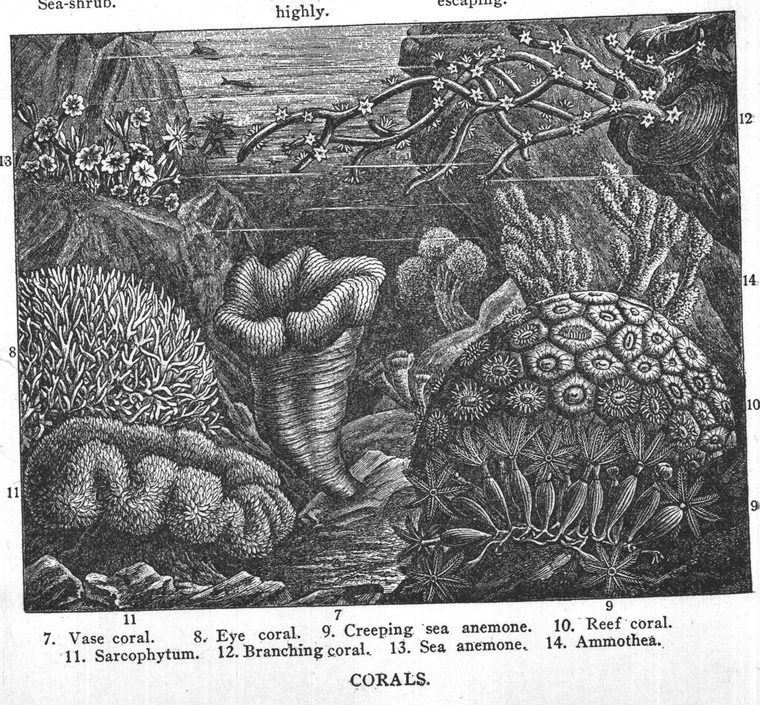
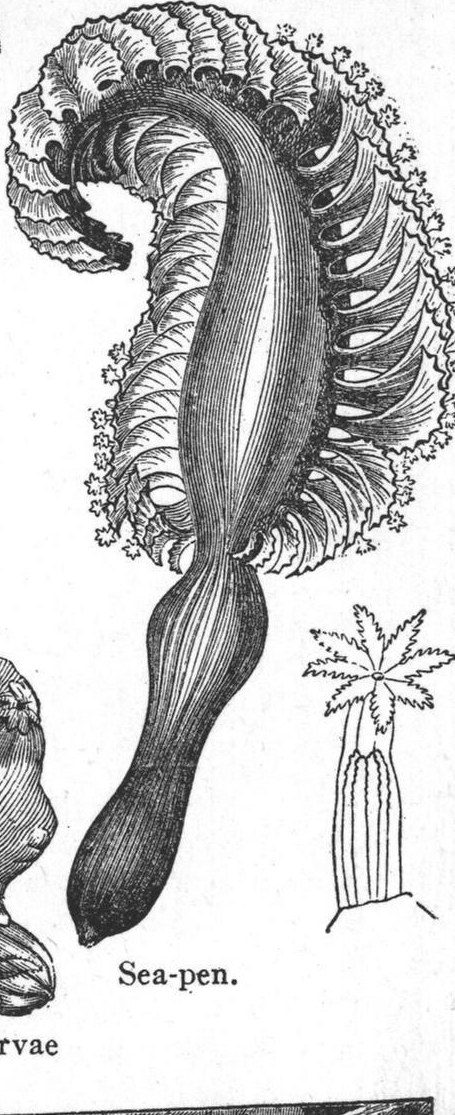
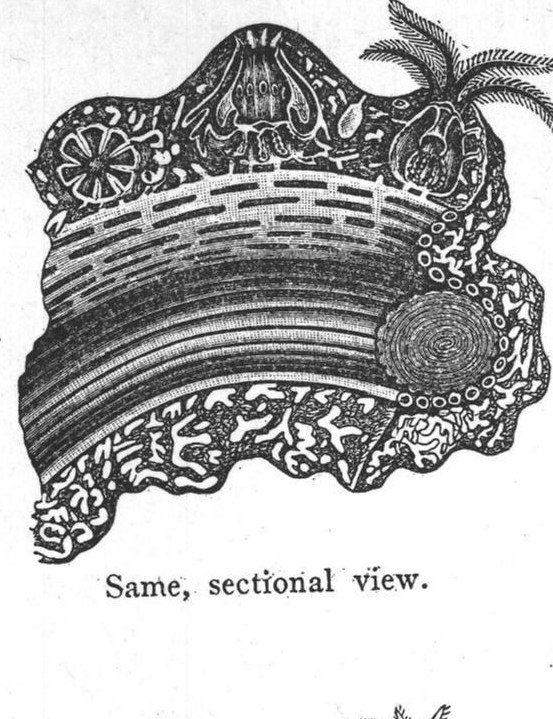
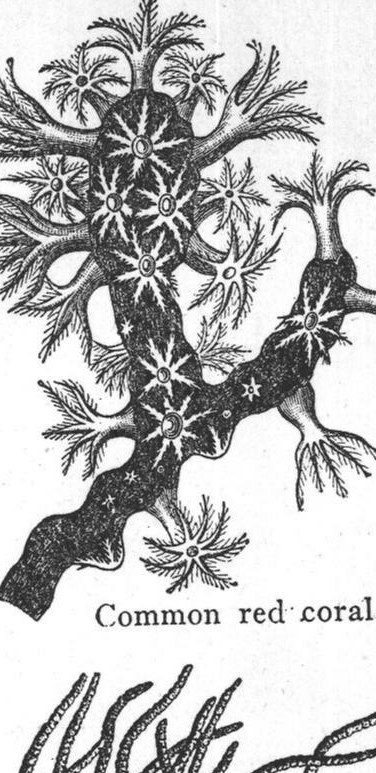
a limy secretion of marine animals called polyps. These polyps are related to the sea anemone, the jelly fish, and to the fresh water hydra. There are numerous coral-producing species. Though called a skeleton, coral is produced on the outside of the animal for a shelter, or home in which to live. A piece of coral is usually the product of a large colony of polyps that bud or branch like trees. The coral of some species takes the form of a fan; of others that of a branching shrub or flower; or a mushroom; or a brain-like mass; or a bunch of moss. One might conclude readily that coral is a sort of limy moss or other vegetable growth; but in reality it is an animal production corresponding very closely to the shell of a snail. A coral mass consists of tubes in which the polyps find shelter. As the polyp extends, the tube in which it lives grows longer. The coral-producing polyps-they are not insects--appear to live on sea water. They require a temperature that never falls below 68 deg., a hard bottom to which to attach themselves, and sea water entirely free from mud or grit.
No coral is found on the western coast of the two Americas. On their eastern coast it is confined to tropical waters extending from Florida to Brazil. Red corals, much prized for necklaces and other articles of ornament, are found in the waters of the Mediterranean. Beautiful coral comes from Japan. Coral is found sometimes in masses of extraordinary size. In the southern Pacific and Indian oceans it not infrequently forms reefs from a few yards to many miles in length. The great Barrier Reef, thirty miles off the northeastern coast of Australia, is of coral formation. It extends 1,300 miles along the coast, with a total area of nearly 100,000 square miles. The water between the reef and mainland is seldom less than 36 feet deep. The outer wall of the reef is usually vertical. It has not been surveyed with accuracy, but in places it has been found to extend nearly perpendicularly 1,700 feet below the surface of the water.
The circular islands of the Pacific known as atolls are also of this nature; the reef taking the form of the circumference of a circle, inclosing a round lagoon within. It was supposed formerly that the lagoon marks the apex of an island which has gradually subsided, leaving a fringe of coral which the polyps have built up and up as the bottom sank, but this theory of subsidence is now in question. The reef corals are built on the plan of six or some multiple of six; that is to say, the tubes are six or twelve sided. The other group of fan corals is built on the plan of eight.