Cuckoo
a family of birds allied in some respects to the woodpecker. There are well on toward two hundred species of cuckoos, and thirty-five are found in the New World. Two toes are directed forward and two backward after the manner of woodpeckers, but the cuckoos use their feet for grasping limbs rather than for climbing. The cuckoo of literature is a widely diffused bird, found in the northern part of the Old World in summer, and in India and northern Africa in winter. In England and temperate Europe its well known note is the harbinger of spring.
The cuckoo is a grayish bird about fourteen inches in length. It lays an egg no larger than that of the skylark, and has incurred a bad reputation by neglecting to build a nest of its own. Single eggs are deposited stealthily in the nests of small birds to be hatched by hedge sparrows, wagtails, skylarks, robins, thrushes, and buntings. The young cuckoo is all greed and appetite. It soon shoulders its foster brothers and sisters out of their own nest. The foster parents, the owners of the nest, work untiringly in their frantic attempts to keep its crying mouth full of worms. As soon as able to fly, it goes off and leaves them. The young cuckoo, therefore, though deserted by its own parents, is the type of ingratitude.
Although outranked by the skylark and the nightingale, the cuckoo was one of the earliest songsters to attract the attention of English poets. The following bit of lyric is of unknown date and authorship, but it precedes Chaucer by some centuries. With modernized spelling it runs as follows:
Loud sings cuckoo.
Groweth seed and bloweth mead
And springeth the wood new,
Sing cuckoo, cuckoo.
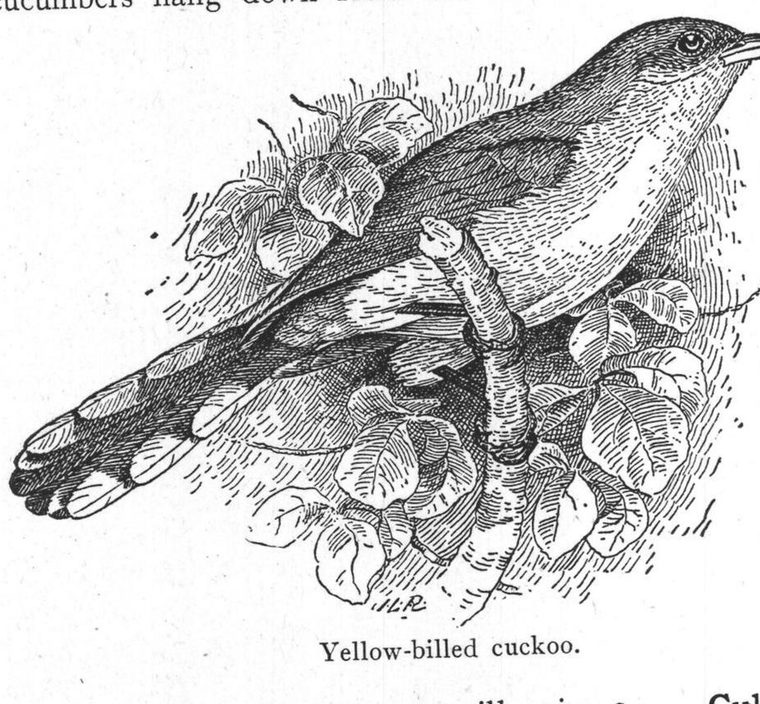
The red-billed and the yellow-billed American cuckoos have better manners than their British cousin. They breed throughout the eastern part of North America and winter in the tropics. Both lay from three to five greenish eggs in nests, usually resembling those of a dove, and feed their own young, chiefly with caterpillars.
Many German homes contain specimens of the famous cuckoo clock. In place of striking, a clever imitation of the cuckoo calls the hour.