Fire Escape
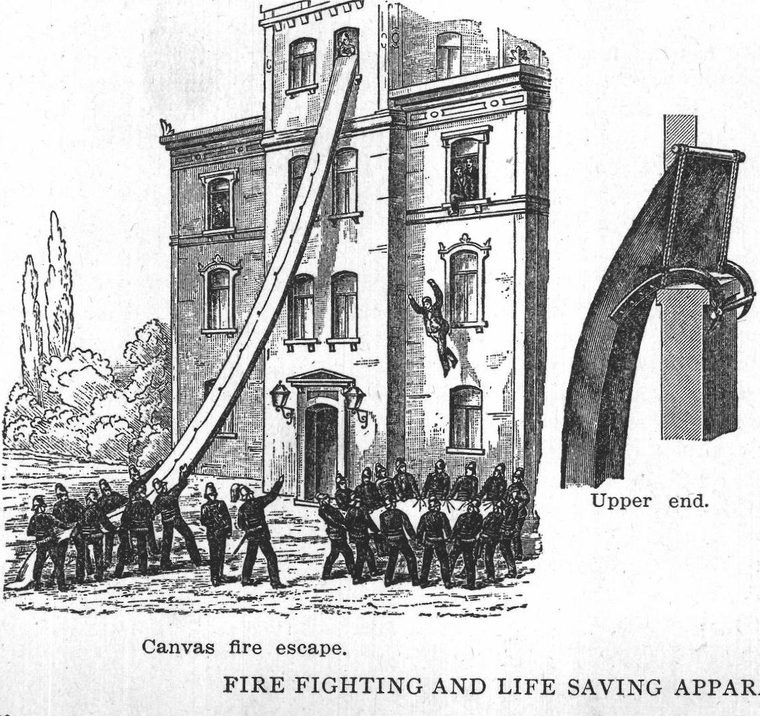
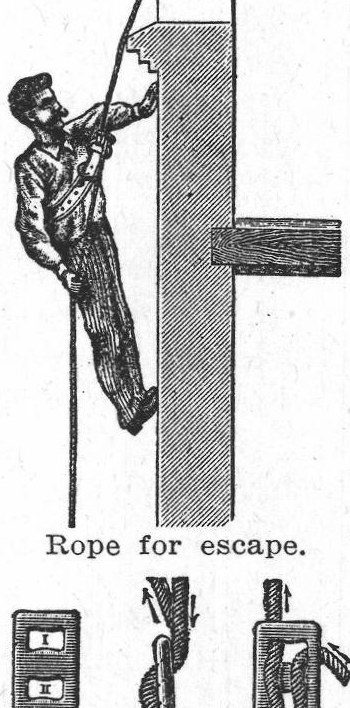
a contrivance for escaping from a burning building. The laws of most states require that theaters, hotels, schoolhouses, and all buildings of a public nature shall be provided with fire escapes. Many hotels provide a rope ladder for each room in the building. Iron stairways are built on the outside of many buildings to be used in case of emergency. Such stairways should be built always with numerous turns and landings. A straight iron ladder is of little service. In time of confusion, smoke, and danger, a person who loses his footing at the top of a straight ladder is likely in his fall to strip it of all who are on the rounds below him. This has happened more than once in a great fire, causing lamentable loss of life. One of the most ingenious devices is a metallic standpipe fitted with a spiral slideway within, like the screw of an auger. Persons slide down within this escape with the utmost security. The faster one slides, the greater his centrifugal motion and the more his progress is retarded. One may slide in this fashion from the top of a building several stories high without attaining a dangerous speed. The managers of buildings in which a large number of persons are employed sometimes take the precaution of having a fire drill. Large public schools in cities have fire drills. Teachers and pupils are under instruction to leave the building immediately whenever the fire gong is struck. Whenever the signal is heard everything else is dropped. Without waiting to know whether the signal is for a real or imaginary fire, all form into line and pass outside. From 1,000 to 2,000 pupils can pass out from a properly constructed building in from fifty to ninety seconds without the slightest confusion.