Frog
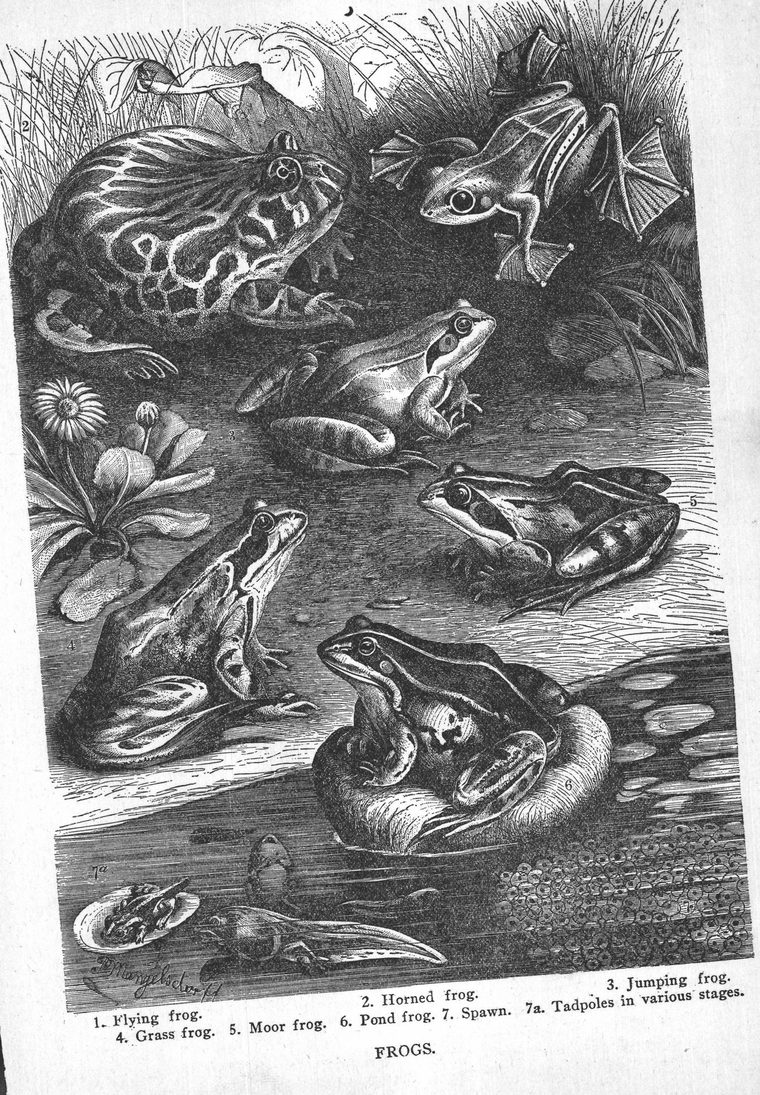
a genus of amphibious animals with an interesting life history. The eggs of the females are deposited in marshes and ponds in jelly-like masses or strings. These float about in warm shallows for a month, when they hatch out into tadpoles or pollywogs. The tadpole has a tail but no legs; gills, but no lungs; and a circulatory system like that of a fish. It has a horny beak and a digestive tract suited to vegetable food. A school of tadpoles may be seen nibbling the edges of aquatic leaves. As the tadpole grows the gills fall away and the hinder legs show themselves; then the front legs appear; the tail and beak waste away; a change of heart takes place; and the digestive system is modified to suit animal food. Bones, muscles blood vessels, and skin are changed for new and entirely different ones suited to a different life. In a few weeks' time the egg becomes a tadpole and the tadpole becomes a frog, able to breathe air, to swim in water, or hop on land, to catch insects with its long, sticky tongue, and to croak worse than a raven. Thousands of tiny frogs coming out of the tadpole stage at the same time, often overrun a locality, especially after a rain, giving an impression of a frog shower. A frog is four years getting his full growth, and is supposed to live ten or fifteen years. The frog has no ribs.
Frogs' legs are a staple article of diet, especially in France and in restaurants affecting French cookery. Certain ponds and extensive meadows near Paris are devoted to raising frogs for the city market. They are caught by means of nets. American cooks use half a million pounds of frogs' legs a year.
The hoarse croaking of the frog is made chiefly by the male and is reinforced by large air sacs, one in each side of the neck. Frogs live chiefly on an insect diet. On the approach of winter they dive into the mud in the bottom of the pond and remain in deep sleep till spring awakens their melodious music again. Ordinary frogs are aquatic. Tree frogs, of which we have several, have sticky toe pads, enabling them to cling to the bark of trees. Some of the common frogs are the leopard frog, the pickerel frog, the wood frog, the green frog, and, loudest of all, the bullfrog. There are in all several hundred species. Nothing has been said of the jumping power of the frog. It would be an interesting problem to take the weight of a frog and of a person, and the length of a frog's jump, and compute the relative distance to which a person should jump to keep up the comparison.
The frog has had frequent mention in literature. According to one fable, the frogs had a log to sit on, but were not content. They prayed Jupiter for a more active sovereign than King Log who did nothing. Jupiter sent them King Stork who ate his subjects by the score. Another fable runs to the effect that some foolish frogs, envying the stature of an ox, puffed out their cheeks and blew so mightily in an endeavor to swell up as large as the object of their envy that they burst their sides.
See Tree-Frog; Toad