Hegel, Georg Wilhelm Friedrich
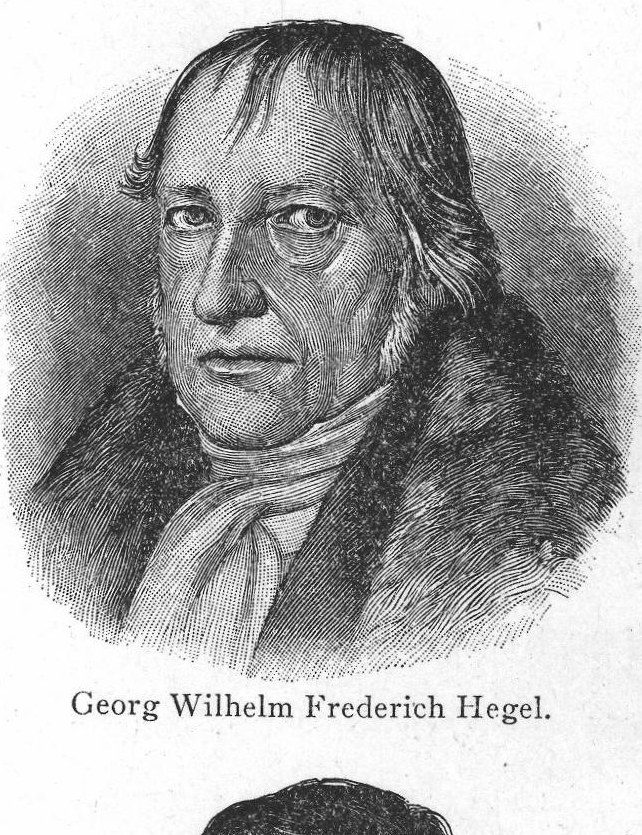
ha'gel, Georg Wilhelm Friedrich (1770-1831), a German philosopher. He was born at Stuttgart, and received an elementary education at the schools of that city. He received his degree at the University of Tubingen in 1793. For want of a more lucrative employment he acted as a tutor in a family living near Berne, Switzerland. His diary gives an account of various delightful trips afoot in that region. From Berne he made his way to Frankfurt, where he accepted a similar position in the family of a merchant. In 1799 he inherited $1,000 from his father, with which he took his way to the University of Jena, at that time perhaps the most celebrated institution of learning in Europe. Here he secured permission to lecture in return for fees, and rose speedily to the rank of professor. During the Napoleonic wars the university was impoverished and the students scattered. Hegel was forced to accept a position as the editor of an unimportant paper. In 1808 he was made rector of the gymnasium of Nuremberg--principal of the high school we should say. Here he married happily, and lived on an income of $650 a year. In 1816 he was offered a professorship of philosophy at the University of Heidelberg. Two years later he accepted a similar professorship at the University of Berlin, a position which he held with renown until the time of his death.
Hegel was considered a progressive, fearless thinker. His classrooms were thronged by students who spread his fame throughout Europe. He is described as having a plain, old-fashioned face, furrowed with thought. When lecturing he sat with his snuff box within convenient reach of one hand, while he turned his notes with the other. His utterance was slow. He seemed to struggle for words and at times would make little progress, yet the student needed to be constantly on his guard, lest the lecturer glide away with unexpected ease of movement and the connection be lost. He died from an attack of cholera.
Hegel was a voluminous writer. His complete works fill eighteen volumes. Among them are a Life of Christ, an Encyclopedia of the Philosophical Sciences, The Science of Logic, Lectures on Aesthetics, The Philosophy of Right, The Philosophy of Religion, The Philosophy of History, and The History of Philosophy. Hegel's writings present a complete system of philosophy, undertaking to explain the entire universe of thought and being, down to the minutest details. He occupies a large place in the history of German thought. His followers are known as Hegelians. See Herbart