Hospital
a place for the reception and care of the sick and the injured. In its origin the term is closely related to hotel. Hospitals appear to have been unknown among the ancients. Little provision, if any, was made for the care even of the wounded on the field of battle. The Greek and Roman armies had no medical staff. The monasteries set apart a room for the sick. The modern hospital is an outgrowth of this custom. At the time of the English Reformation the monks were in charge of the hospital service of the kingdom. This branch of the monastery was retained in several instances and grew into a large establishment. It became, we may say, fashionable for wealthy men to endow hospitals.
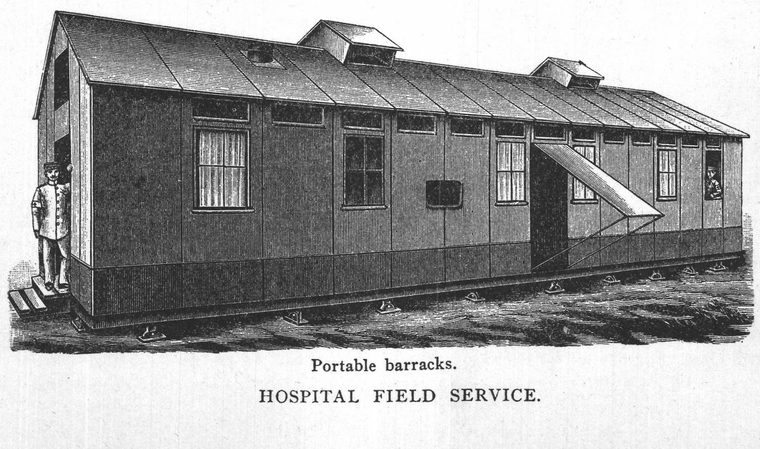
The cities of Europe are noted for large hospitals. One of the largest in this country is the Johns Hopkins Hospital of Baltimore. Modern nations vie with each other in providing hospitals for the use of the army and navy. During the late Japanese-Russian War, the Japanese field hospital, with its surgeons, remedies, and appliances, was fully abreast of the times. The hospital service which reaches the most people, however, is the small hospital of from ten to 100 beds. Not infrequently these are managed, and admirably so, by sisterhoods of nuns, or else they are owned and operated by physicians. While there is a general prejudice against leaving one's own home for a hospital, there are many reasons why the latter is to be preferred in case of serious or prolonged illness. The site is selected usually with a view to perfect drainage and light. The windows and other means of ventilation are arranged so as to secure an abundance of pure air. The floors are usually of hardwood, closely joined. The walls are periodically cleansed so as to avoid contagion. The bedsteads are of iron, the furniture is simple; in short, the rooms are sanitary. Medical attendance is close at hand, trained nurses manage each case according to the directions of the physician in charge. Rooms are at hand where surgical operations can be performed with the facilities demanded by modern science. While the home surroundings to which a patient is accustomed are wanting, the chances of recovery from severe illness or a critical operation are much greater in a hospital than in a home. The hospitals are a boon, especially, to patients whose home surroundings are not comfortable. It is possible, also, to give the best of attendance at far less expense, as in a hospital a nurse can attend to several cases quite as well as one.
See Surgery; Monastery; Medicine; Barber