Lace
an open, ornamental fabric. It is not woven nor is it embroidery. Lake knitting, it is a much more recent invention than weaving. Fine needlework was known to the Egyptian Pharaohs. Expensive embroidery, especially on the hems of garments, antedates history. Lacemaking as an art is thought to have grown out of needlework. Authorities admit that rude lace may have been produced during the twelfth century, but are of the opinion that nothing we should call lace was produced earlier than the discovery of America.
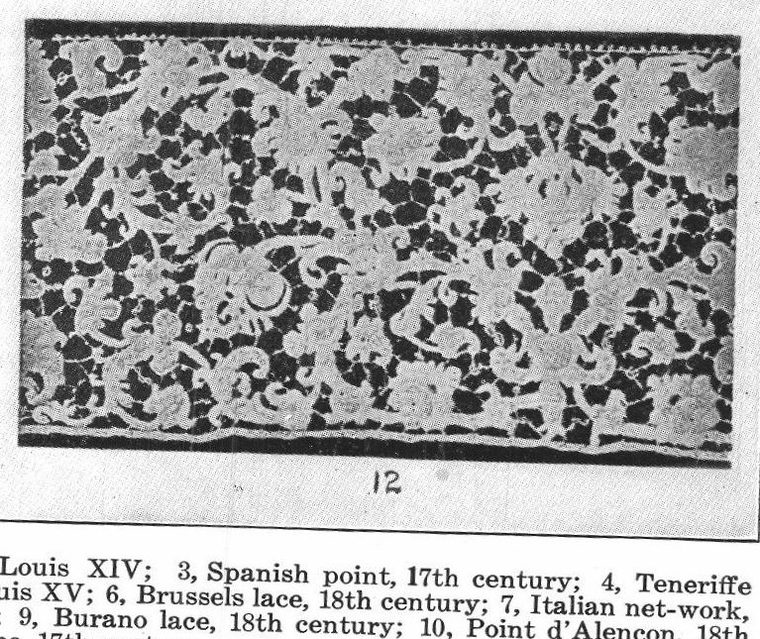
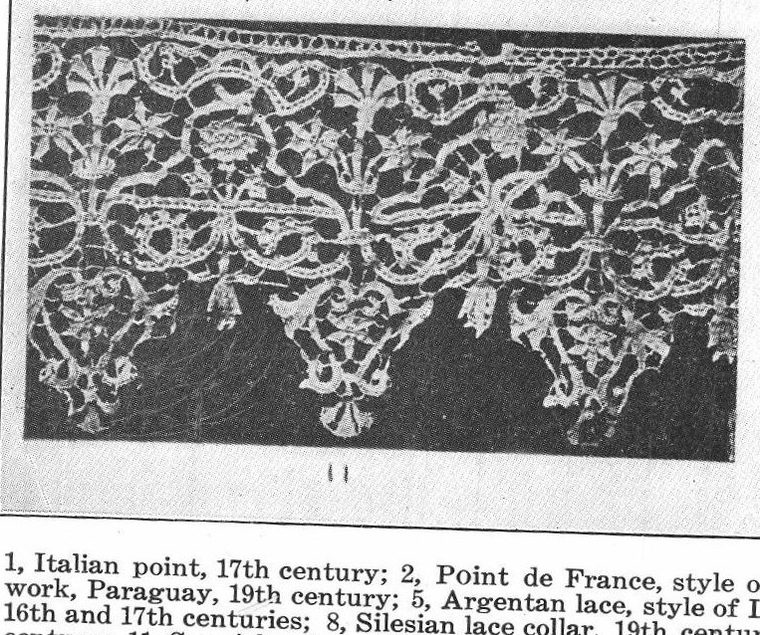
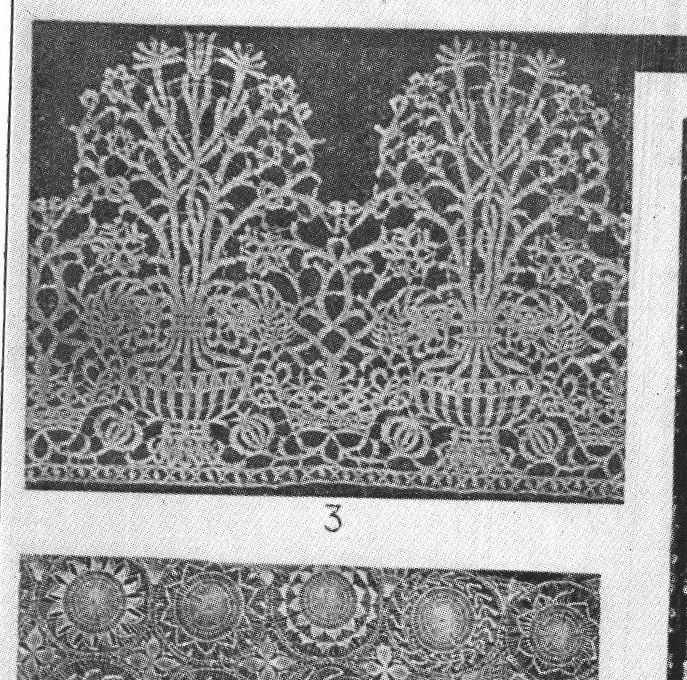
Hand-made lace is of two sorts,--point lace and pillow lace, or bobbin lace. Point lace is made with a needle, that is to say, with a point. The meshes are made with a single thread. Pillow lace is made with several threads, or even a hundred, each carried by a bobbin. Point lace early reached a high state of perfection in Venice. The artist first sketched his pattern on parchment. The parchment was then basted to a back of stout linen. Threads were laid on the lines of the patterns and tacked down by occasional stitches passing through both parchment and linen. The pattern was then filled in with thread and needle in a buttonhole stitch. After completion, the stitches holding the pattern threads were cut between the parchment and the linen, thus releasing the lace. Threads of flax, cotton, or silk, of a fineness almost beyond belief, can thus be worked into fairylike webs of exquisite patterns.
The Netherlands claim the invention of pillow lace. While the claim to more than development can hardly be allowed, it is certain that Flanders, which shares artistic honors also with north Italy, was noted early in the sixteenth century for delicate pillow lace of beautiful patterns. In making this sort of lace a pattern is drawn over parchment as before. The parchment is then fastened over a pillow, and the pattern is marked out by rows of pins inserted to half their length. As many threads as may be required are wound each on a bobbin. The lace maker then twists or braids the threads together, proceeding from pin to pin. The latter are used to keep the meshes in place. Groups of threads, whether twisted or plaited, may be combined and again separated at any pin according to the requirements of the pattern.
Henry III of France thought it not beneath his attention to employ a Venetian to serve as pattern designer for the lacemakers of his court. Colbert, the able minister of Louis XIV, by an edict, dated 1665, established colonies of Venetian lace workers at Alencon, Arras, Sedan, and elsewhere. At the same time, the further importation of Venetian and Flanders lace was forbidden. Schools of design were established. England bought laces and drew lacemakers from Flanders and France. The nuns of Ireland were famous for their lace. Through convent schools and otherwise art of lacemaking has been acquired by the peasantry of various European countries. Beautiful hand laces in silk, cotton, and linen may be bought at reasonable prices in many an out-of-the-way village.
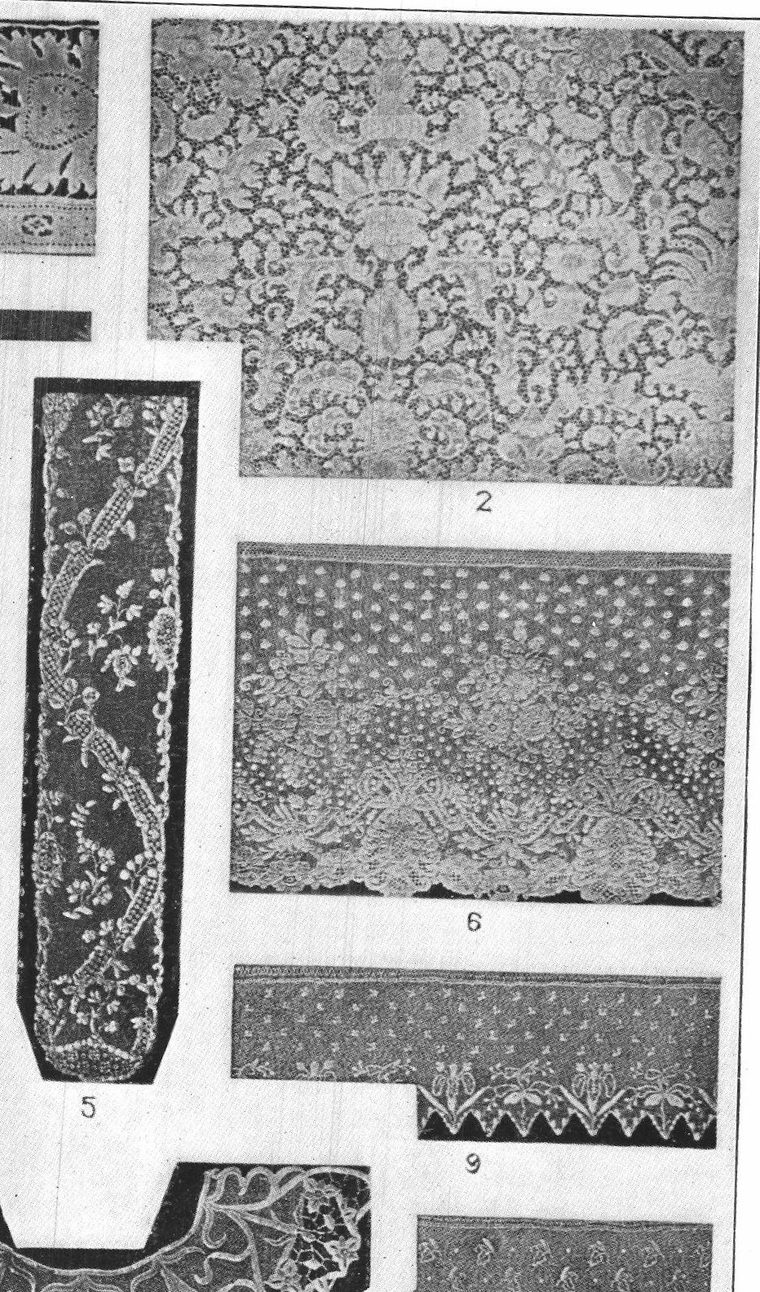
Laces are also named for the places in which they are made. Lille, Chantilly, Honiton, and Limerick or Irish lace are pillow laces. Brussels lace is of both kinds. Valenciennes lace is a pillow lace with a diamond shaped mesh. The threads are braided, that is to say, plaited. Mechlin, styled "the queen of laces," has meshes of a six-sided shape. Two sides are of four threads plaited four times. Four sides are of two twisted threads. Alencon, the most celebrated of French lace, is a point lace famous for exquisite floral designs. Honiton is an English pillow lace much favored by Queen Victoria and the ladies of her court. Since 1809 both point and pillow lace have been made successfully by machine. Nottingham, England, and Calais, France, are centers of this industry. The laces of Plauen, Germany, are worked by machinery on a loose sort of flannel, or on chemically prepared muslin. The fabric is then plunged into a bath of strong chemicals that eat away the wool or muslin of the foundation, leaving the cotton or silk of the lace uninjured. The ordinary laces on sale in stores are machine made.
A species of lace combining machine and hand work has become deservedly popular in recent times. In making this lace, machine made braids are used which imitate certain parts of point and bobbin laces, especially such portions as are formed of regular meshes or of comparatively heavy but simple figures repeated at short intervals. The pattern is drawn or stamped upon cambric and the braid basted in place. The points where the braid intersects are secured with the needle and the "filling in" is done with "real lace" stitches. If the braids are fine, the worker skillful, and taste is used in the selection of stitches appropriate to the various parts of the design, this method produces very beautiful lace. It may even excel the lace made entirely by hand, since the parts which form the background depend largely for their beauty upon the evenness and regularity of the mesh, in which characteristics the machine-made braids surpass hand work; while the intricate stitches and knots which form the real beauty of point and pillow lace are done by hand in this modern fancy work.
See Knitting; Embroidery