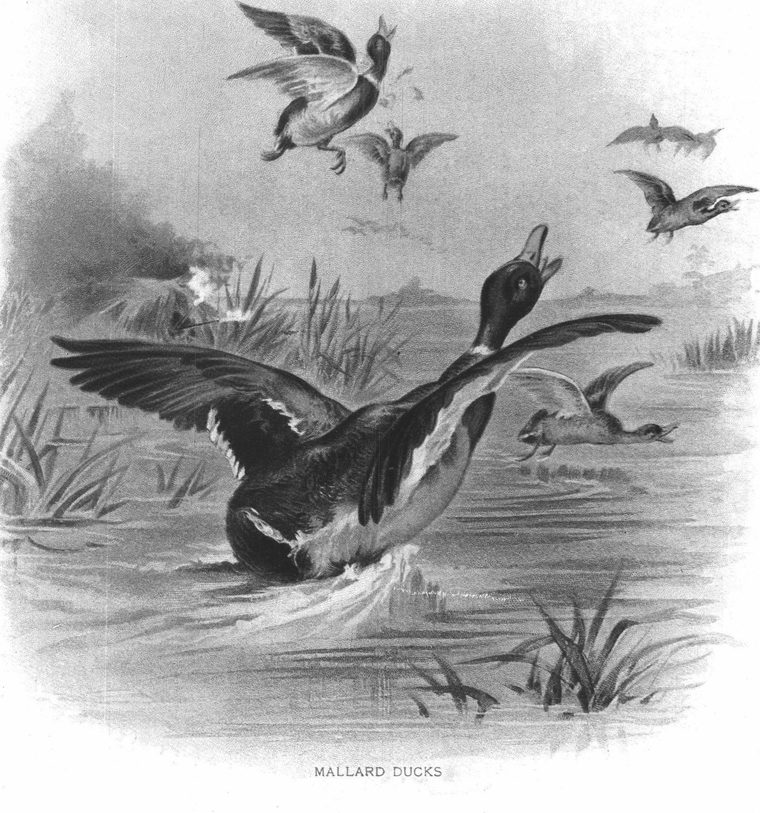
Mallard
an old French word, allied to male, and signifying a wild drake or male of the common wild duck (Anas boschas). By extension, the term is applied to both sexes of the common wild duck. The mallard is one of the most widely distributed ducks. It is intelligent and strong of wing. It ranges throughout the north temperate zone, nesting in China, Siberia, northern Europe, Canada, and the northern United States, and migrating as far southward as Panama and India for the winter. The nest is a basket of grass, lined with down from the breast of the duck. Eggs, about fourteen. The drake is a bird of fine carriage and is about twenty-two inches long. He has a brilliant, metallic-green head and neck. The breast is chestnut; the back is a pearly gray; the wing is trimmed with rich purple; the long black upper tail-coverts are recurved. The duck has a modest domestic appearance and is clad in brown picked out with black. In England the wild mallard is known as the stock-duck, because it is the ancestor of most of the domestic varieties. The mallard is distinctively a duck of the interior, breeding in grassy situations near great waters. Save in point of shyness, it is difficult to distinguish the wild duck from the tame. See Duck