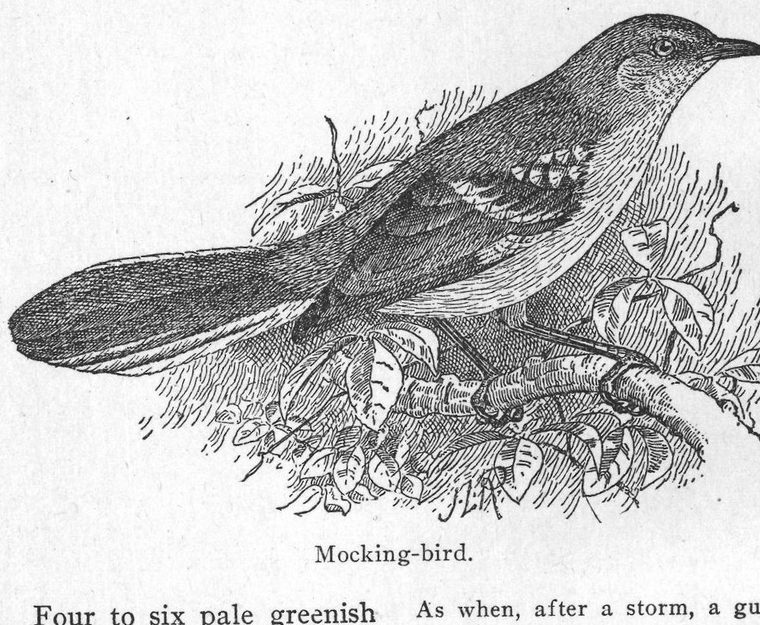
Mocking-Bird
a bird of the Southern States remarkable not only for its own powers of song but for an ability, possessed in varying degree by different individuals, of imitating the notes of other birds. In length about ten and a half inches, with ashy upper parts, and soiled white plumage beneath. It is a familiar resident of parks and gardens everywhere from the Ohio Valley southward. Four to six pale greenish blue eggs are deposited in a coarse cotton-lined nest in a thicket or orange tree. It is a self respecting, highly esteemed bird like the northern robin, and is held by its admirers to be a rival of the European nightingale as a musician. Its movements remind one of a catbird to which, indeed, it is closely related. Lanier writes:
Superb and sole, upon a plumed spray, That o'er the general leafage boldly grew, He summed the woods in song; or typic drew The watch of hungry hawks, the lone dismay Of languid doves when long their lovers stray, And all birds' passion plays that sprinkle dew At morn in brake or bosky avenue. Whate'er birds did or dreamed, this bird could say. Then down he shot, bounced airily along The sward, twitched in a grasshopper, made song Midflight, perched, prinked, and to his art again. Sweet Science, this large riddle read me plain: How may the death of that dull insect be The life of yon trim Shakespeare on the tree? Then from a neighboring thicket the mockingbird, wildest of singers, Swinging aloft on a willow spray that hung o'er the water, Shook from his little throat such floods of delirious music, That the whole air and the woods and the waves seemed silent to listen. Plaintive at first were the tones and sad; then soaring to madness Seemed they to follow or guide the revel of frenzied Bacchantes. Single notes were then heard, in sorrowful, low lamentation; Till, having gathered them all, he flung them abroad in derision, As when, after a storm, a gust of wind through the tree-tops Shakes down the rattling rain in a crystal shower on the branches. --Longfellow, Evangeline.