Monkey
in popular language, any animal having four hand-like feet. With the exception of the monkeys of Japan and China, all dwell safely within the frost line of the tropics. The monkey world reaches its highest development in tropical Africa, precisely where man is near his lowest limit. Passing by man, the zoologist finds it convenient to separate the order into seven groups.
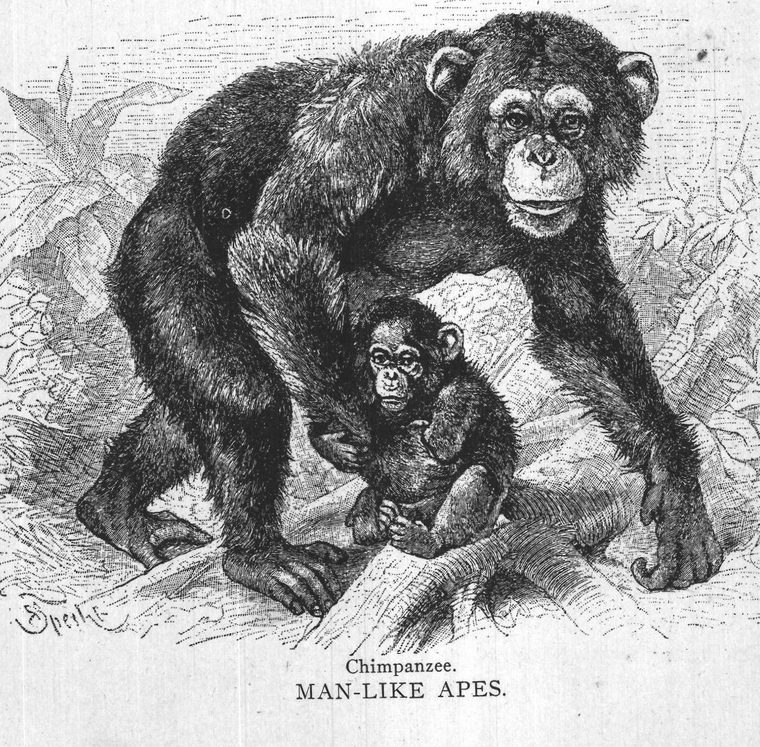
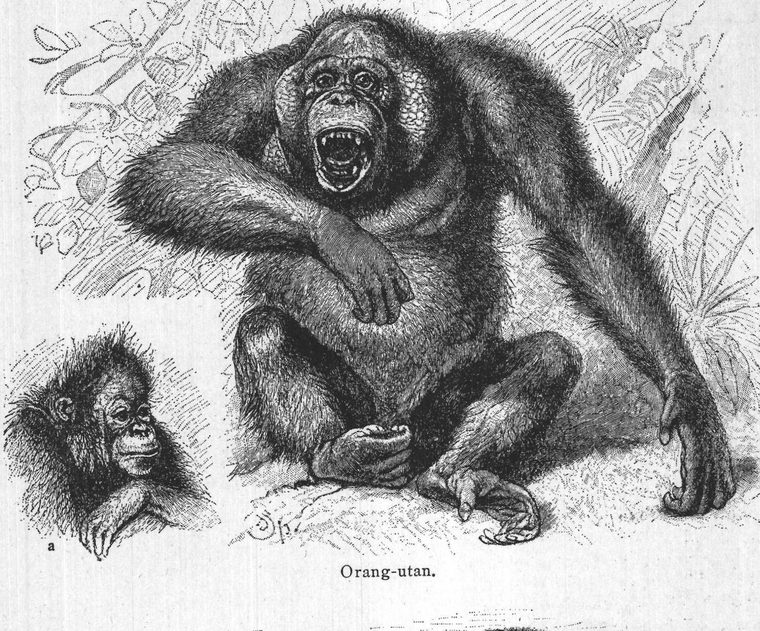
1. THE MAN-LIKE APES. The gorilla and chimpanzee of Africa and the orangutan of Malaysia are large, heavy, strong, coarse animals. The gibbons of Borneo, Siam, and Malaysia generally, belong to the same group, but they are a delicate, spidery folk almost without flesh. The forearms of a large specimen may be extended to a distance of five feet or over, and yet the owner weighs only ten pounds. There are several species--shy, affectionate fellows, swinging off through the tree-tops on the approach of man. Nothing will tempt them to stay within sight, but at the cry of a captured young one, the whole troop comes swinging back recklessly, almost in the very face of the hunter, in the greatest anxiety to recover the luckless infant. Like the other apes, the gibbon is without a tail, but it makes wonderful progress with its four slender, lithe arms. William T. Hornaday, who observed the gray gibbon of Borneo, writes: "The most wonderful habit of the gibbon is its flight down hill when pursued. Of course, it never dreams of descending to the earth, but in the half-open hill forests of Borneo I have seen these creatures go downward through the tree-tops, in a straight course, leaping incredible distances, catching with their hands, swinging under, catching with their feet, turning again, and so on by a series of revolutions, almost as fast as the flight of a bird."
2. THE OLD WORLD MONKEYS. The second group includes the monkeys and baboons of the Old World. None of them have grasping tails. The space between the nostrils is very narrow. Of these the best known is the Barbary ape of Gibraltar and North Africa. This is the original monkey of the European organ-grinder, the animal that has given meaning to the words monkey and ape and to which the literature of Europe is full of allusion. It is a restless, mischievous, apt, imitative waif, ready to dance, climb the rope, stow away crackers in cheek pouches, or to doff its cap and collect pennies. The Italian, his organ, and his monkey in a tawdry red suit, have made themselves fairly well known. The most northern of all monkeys is the sturdy, quick-tempered, red-faced monkey of Japan. It is clothed with an abundance of long, shaggy hair, and is no more afraid of snow than is the red squirrel. The most beautiful of all monkeys is the Diana monkey of West Africa. It wears a dainty suit of black, white, gray, and brown. Many of the Old World monkeys are strikingly colored. One African monkey is green in color. Many species have bare, sometimes brilliantly colored, buttocks. In size these monkeys vary quite as much as the dog. As a group they are more active and intelligent than the New World monkeys.
3. THE NEW WORLD MONKEYS. They are found between the limits of northern Mexico and southern Brazil. They live in tree-tops. Several species follow timber up the Andean Mountains into a region of considerable cold. American monkeys have long, lithe tails. The under surface is bare. The tail curls about a branch naturally, and carries the weight of the owner with perfect comfort. By curling its tail over a branch, the monkey can swing at ease with all four hands free for fun or for gathering fruit. In traveling, too, the American monkey swings by foot or tail indifferently. In crossing streams, for the monkey dreads the ground and wet feet, a troop of monkeys forms a living chain. Each grasps the tail of the one ahead of it. This chain swings to and fro from an overhanging tree on one side of the stream until the lowest member is able to catch a branch on the opposite side. The rest of the band, especially the young and laden mothers, cross on this bridge of relatives. The last monkey lets go, the chain swings over, and the monkeys are off in the forest--all in less time than is required to describe this living rope. A similar method is employed in reaching fruit at the tips of branches otherwise out of reach. The American monkey is without cheek pouches. The nostrils are set widely apart. The buttocks are hairy. The hind limbs are usually longer than the fore limbs. There are many species. The capuchin or ringtail "has a wrinkled and careworn face, as if burdened with sorrows." It frequents Central America. The body is gray, brown, or black, with white forehead, throat, and shoulder points. The spider monkeys are well named for their agility and slimness. They seem all legs and tail. The Mexican spider monkey is the most northerly American monkey. The owl monkeys have large, strong, owl-like eyes, and, like the owl, they feed at night. The agile squirrel monkeys are thus named from their size. They are fond of insects. They will clean a house or ship of cockroaches in short order. The shaggy saki of the Andes has a long, black, chin beard. The Yarkee of the upper Amazon resembles the red-faced monkey of Japan. The howlers have a sound-box of cartilage in the lower jaw. Sleep is impossible within a mile of a troop of these noisy animals.
4. THE MARMOSETS. These are small monkeys found from Mexico to Brazil. The species vary in size from a chipmunk to a cat. They are soft, silky, bright-eyed fellows, with long, fluffy tails. They are interesting household pets.
5. LEMURS. A Madagascar and oriental group. They have the body and nose of little foxes, the tail of a marmoset, and the hands of a monkey.
6. THE AYE-AYE. A lemur-like animal of Madagascar, so named from its cry. It has the face, ears, and teeth of a bat. The body is that of a cat. The tail is long and bushy. The fingers are long and slender and armed with nails. It lives in bamboo jungles on the larvae of certain insects found on the trunks of the bamboo.
7. THE TARSIERS. Small lemur-like animals of Africa and the Eastern Archipelago. One species spends its time in the tree-tops of the Philippine Islands. It is a grotesque, grayish brown, squirrel-like animal, with olive spots. The tail is bare save a tuft at the end. The tarsiers are so named for their long hind legs. They feed at night on fruits and insects.
See Ape; Gorilla; Chimpanzee; Orang-Utan; Baboon; Lemur