Nautilus
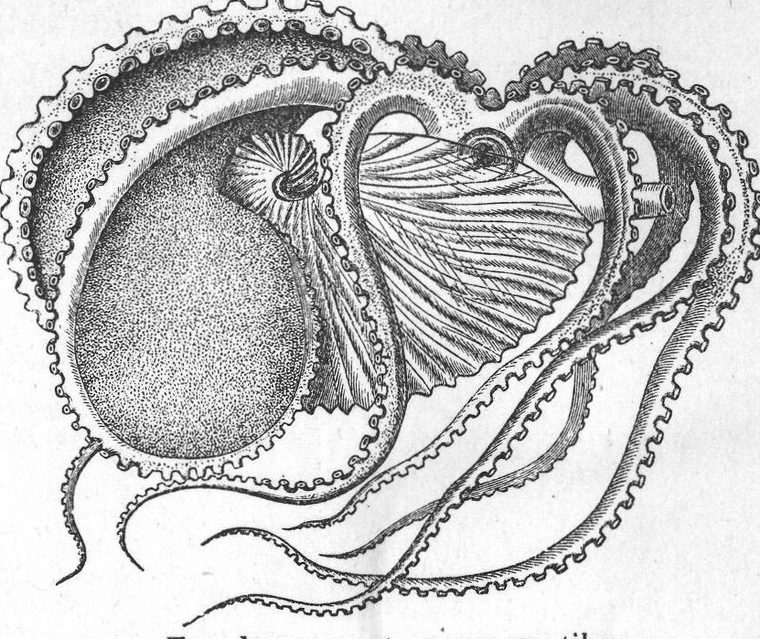
The Chambered, a pearly-shelled mollusks. It is related, not closely, to the octopus, and yet more distantly to the snail. The shell of this nautilus is a flat coil like that of a land snail. The foot or muscular body, occupying the mouth of the shell, is divided into about forty tentacles. There are two eyes. The mouth is provided with a hardened beak like that of a snail. There is no ink sac. The chambered nautilus lives on the floors of the seas about New Guinea and the Philippines at a depth of from 325 to 2,300 feet. It swims by ejecting a jet of water, but it does not sail at the surface of the sea by hoisting a sail to catch the breeze. It feeds on deep sea mollusks, which it holds in its tentacles while it extracts the contents of the shell with its rasping tongue.
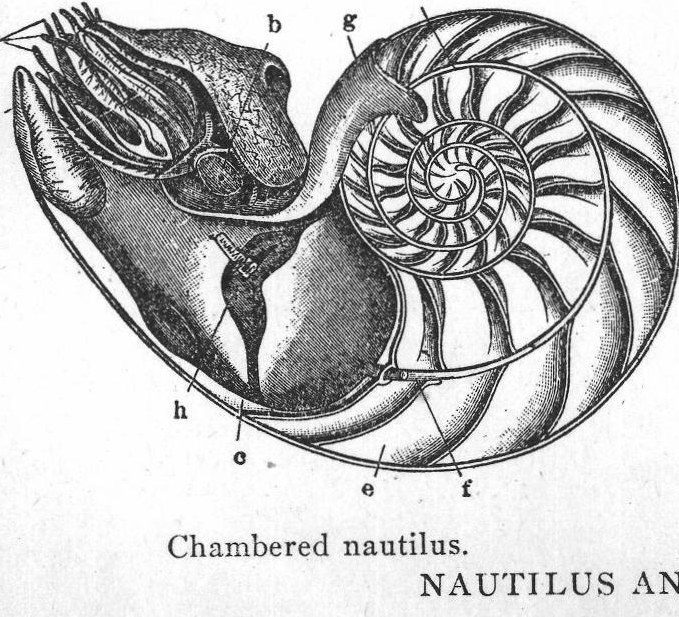
The chambered nautilus has a beautiful pearly shell of remarkable construction. The coiled shell is divided into chambers by cross partitions. A cut before the writer shows thirty chambers, each larger than its predecessor. The animal lives in the outer, the newest, largest chamber. The chambers are connected by a slender tube or siphuncle, coiling backward through the partitions to the original chamber. This siphuncle contains and is a part of the living animal, so that it is not exact, from a scientific point of view, to say that any part of the shell has been abandoned.
There are many fossil species, among which the ammonites may be named. A straight-shelled nautilus of bygone ages is called the Orthoceras from two Greek words meaning straight.
The poet Holmes has made beautiful use of the peculiar manner of growth in his poem The Chambered Nautilus:
That spread his lustrous coil;
Still, as the spiral grew,
He left the past year's dwelling for the new,
Stole with soft step its shining archway through,
Built up its idle door,
Stretched in his last-found home, and knew the old no more.
As the swift seasons roll!
Leave thy low-vaulted past!
Let each new temple, nobler than the last,
Shut thee from heaven with a dome more vast,
Till thou at length art free,
Leaving thine outgrown shell by life's unresting sea!
The shells of the pearly nautilus (Nautilus pompilius) are common on the shores of warm seas, but the animals are very rare. Naturalists do not seem to know how to get them, though the natives of Fiji and New Hebrides, who appreciate their flesh, trap them successfully in lobster pots baited with crustacean or sea urchin. The animal creeps or swims gently along the bottom at no great depth, and its appearance on the surface, "floating like a tortoiseshell cat," is probably the result of storms. It is called "pearly" on account of the appearance of the innermost layer of the shell. This is exposed after the soft organic stratum and the median layer which bears bands of colour have been worn away, or dissolved in a dolphin's stomach, or artificially treated with acid.
The beautiful shell is a spiral in one plane, divided into a set of chambers, in the last of which the animal lives, while the others contain gas. The young creature inhabits a tiny shell curved like a horn; it grows too big for this, and proceeds to enlarge its dwelling, meanwhile drawing itself forward in the older part, and forming a door of lime behind it. This process is repeated again and again; as an addition is made in front, the animal draws itself forward a little, and shuts off a part of the chamber in which it has been living. The compartments seen on a divided shell are not exactly successive chambers, they are fractions of successive chambers abandoned and partitioned off as more space was gained in front. Moreover, all the compartments are in communication by a median tube of skin--the siphuncle--which is in part calcareous.
It has been suggested, that "each septum shutting off an air-containing chamber is formed during a period of quiescence, probably after the reproductive act, when the visceral mass of the nautilus may be slightly shrunk, and gas is secreted from the dorsal integument so as to fill up the space previously occupied by the animal."