Norway
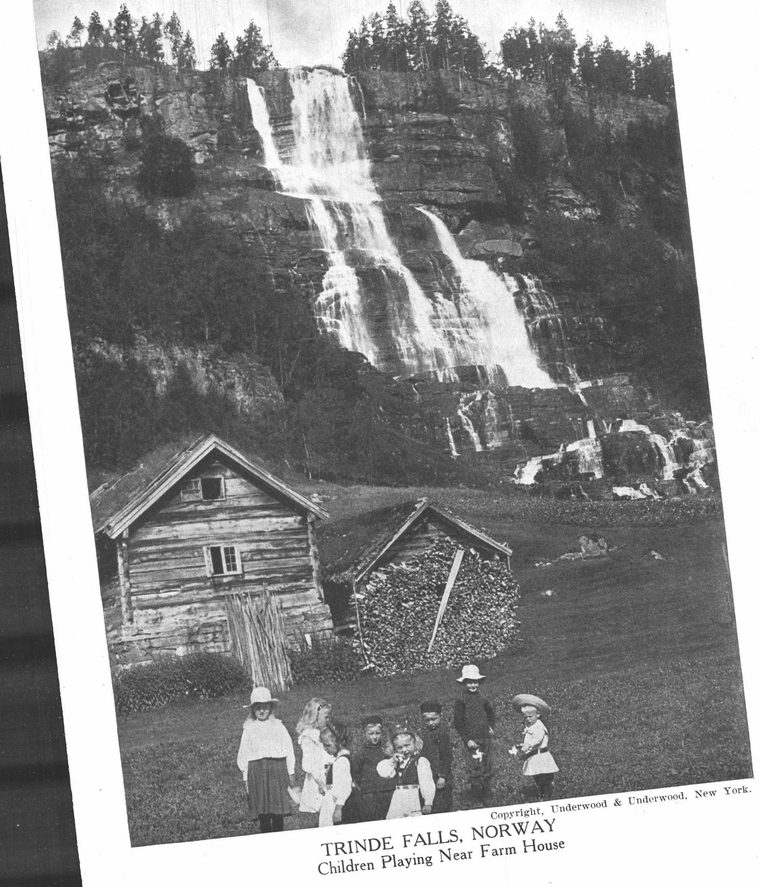
a kingdom of the Scandinavian peninsula. It is the most northwesterly country in Europe. It is 1,080 miles in extreme length and about 275 miles in extreme width. Norway is a more mountainous country than Switzerland. A vast billow rolling westward from the plains of Europe seems to have stopped suddenly and petrified at full height, presenting a precipitous crest along the Atlantic. There are numerous ridges and peaks 8,000 feet in height. The coast is indented deeply by channels or fjords extending far inward. They are the pathways of prehistoric glaciers that scoured their way to the sea. Sogne Fjord, the waters of which are 3,000 feet deep at its entrance, extends 100 miles inland. Hardanger Fjord, nearly 1,000 feet deep, is flanked by cliffs 6,000 feet high. Numerous mountain torrents tumble over the cliffs into the fjords. Some of these cascades fall from 2,000 to 6,000 feet. When the brinks are covered with mist, as they frequently are, these waterfalls, seen from ships in the fjords, have the appearance of falling from the sky.
CLIMATE, FORESTS, ETC. About one-fourth of the country lies in the Arctic zone. Owing to the influence of the Gulf Stream, the line of perpetual snow is beaten upward, however, to a height of from 3,000 feet in the north to 5,000 feet in the south. Were it not for oceanic influences Norway would be covered, no doubt, with a perpetual glacier like that which buries Greenland; but, under present influences, the isotherms run parallel to the coast. The coast line has warmer winters and cooler summers than the interior. Hammerfest, on the northern coast, several degrees above the Arctic Circle, has a warmer winter than Christiania, Stockholm, or St. Petersburg farther inland. The harbors of the western coast are always open. Seventy inches of rain and snowfall may be expected on the western coast and from ten to twelve inches on the eastern border. The mountain slopes are clothed well up with oak, beech, and magnificent pine forests. Willows and birches extend nearly to the snow line. Wild cranberries, raspberries, blueberries, and strawberries abound. There are a few wild quadrupeds. The bear, fox, wolf, lynx, hare, and lemming still find shelter in the forests. Numerous song birds nest in Norway. Owls and grouse are permanent residents. Waterfowl and snipe are abundant in season. Seafowl breed by the million in the cliffs.
POPULATION. Norway is the most sparsely populated country in Europe. The total area is 124,130 square miles. The population in 1906 was 2,321,688, about eighteen per square mile. Nine-tenths of the population live along the coast or near the fjords. An almost continuous chain of small islands, known as skerries, forms a natural breakwater, rendering navigation along the coast and in the fjords comparatively safe and delightful. Twelve hundred of them are occupied. They form about one-fourteenth of the entire area of Norway and are inhabited by about one-eighth of the population.
INDUSTRIES. The leading occupations are fishing, lumbering, and commerce. One person out of twelve of the entire population is engaged in fishing. One hundred and twenty thousand men and 30,000 boats are engaged in catching cod, herring, mackerel, salmon, and sea trout. As high as 67,000,000 pounds of cod are taken off the Lofoden Islands in a single year. The annual Norwegian fish catch is valued at about $12,000,000.
COMMERCE. In proportion to population Norway has the largest commercial fleet in the world. About $30,000,000 are earned annually carrying goods for French, Spanish, American, and even English merchants. Ships are gone from home for years. The principal Norwegian exports are lumber and fish; the principal imports are cloth, clothing, sugar, tobacco, and coffee. Instead of depositing their money in savings banks, many wage earners invest their savings in shares in industries. About one-fourth of the country is devoted to forestry. The chief manufactures of the country are lumber and timber products. Ships are built largely at Christiania. Much ship timber is exported to the Clyde. There is lack of coal, but water power is abundant. There are important manufactures of paper, as well as breweries, tanneries, and large factories. Norway is not without mineral wealth. There are mines of iron, copper, silver, cobalt, and nickel, but they are not worked extensively. The supply of building stone is unlimited, but it is too far from market to be a source of profit.
AGRICULTURE. About three per cent of the surface is under cultivation. Farming is carried on with care. The Norwegian farmers are an industrious, thrifty, comfortable, self-respecting people. At the Christmas season, they never fail to put up a sheaf of grain on a pole for the birds. Small farms managed by the owner are the rule. Barley, potatoes, and hay are the principal field crops. Under the influence of short, warm summers, and the long period of daylight, barley matures even beyond the Arctic Circle in the same length of time, it is said, required in Egypt. Hemp and flax are produced abundantly. Tobacco grows in the south. Dairying is carried on extensively. Most farms include a tract of land extending far up on the mountain ranges where stock may be sent to pasture for the summer. Cattle, horses, sheep, and goats are raised. There are a few swine. Reindeer are herded in the extreme northwest, where wild reindeer are still found.
HISTORICAL. In early times Norway was the home of numerous petty jarls or chieftains and was notorious for piracy. Each fjord had its jarl, its war galleys, its crews of determined sea rovers. The kingdom of Norway is one of the most ancient in western Europe. Harold Fair Hair, Hako I, and Magnus the Good were noted rulers. The crown of Norway has been at times united with that of Denmark and that of Sweden. In 1814 Napoleon forced Norway into a union with Sweden. The partnership was dissolved in 1905, when Prince Karl, the second son of the present king of Denmark, was invited to ascend the Norwegian throne. He assumed the name of Haakon VII. The government is, of course, a constitutional monarchy. There is no Norwegian nobility. The Parliament is known as the Storthing. The capital is Christiania. Bergen, a former capital, is one of the world's great fish markets. Trondhjem was a still earlier capital. It is yet the center of church affairs. Norwegian kings are crowned in its old cathedral.
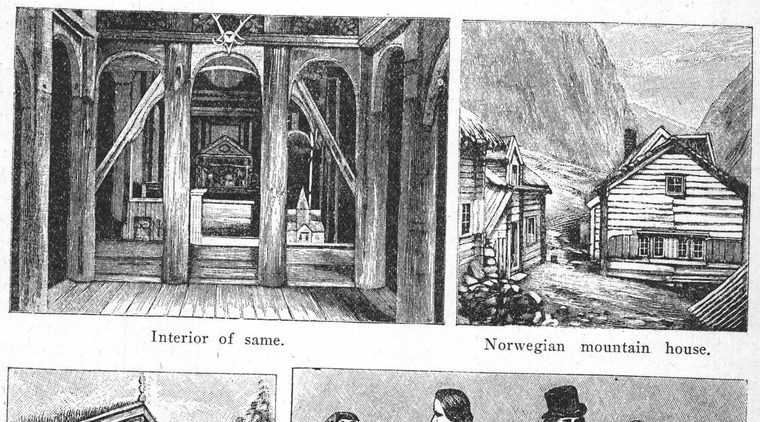
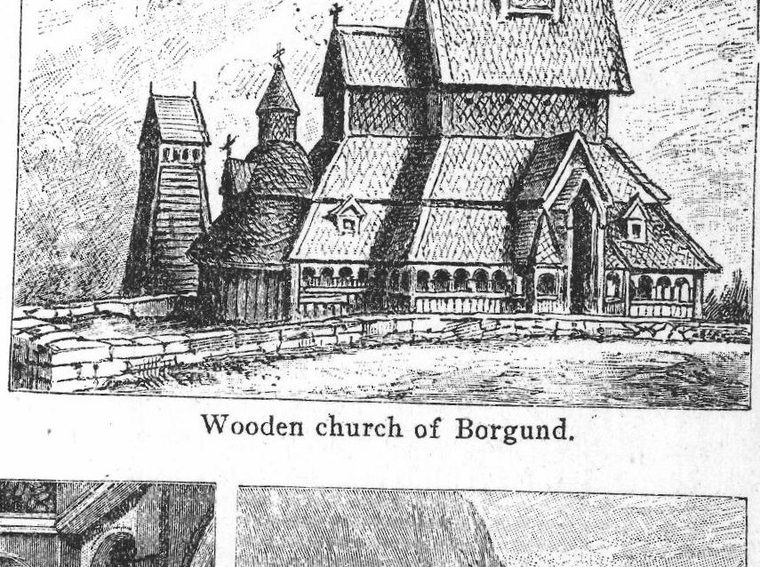
EDUCATION. Education is compulsory. In sparsely settled districts teachers are employed at public expense to go from hamlet to hamlet to instruct even the children of a single family for a few weeks. The larger towns have preparatory schools. The national university is located at Christiania. The people are largely Lutheran. Although stone abounds, the churches are almost without exception built of wood. Many contain artistic wood carvings.
SCENERY. Norway is a favorite region for the summer tourist. The scenery of the fjords is sublimely beautiful. The greatest waterfalls in Europe are there. The uplands attract hunters for grouse and anglers for trout. Tidy inns furnish comfortable accommodations. The great attraction of the traveler, however, is the phenomenon which has caused Norway to be called "Land of the Midnight Sun." In midsummer, from the Arctic Circle northward, the sun circles about without setting for days and even weeks. The farther north from the Arctic Circle, the longer this mid-summer day. At midnight the sun descends toward the northern horizon, hangs there like a great red ball, and begins to ascend toward the east without setting. To one accustomed to live in a more southern country the effect is almost supernatural. People and animals go to rest at regular hours; poultry goes to roost while the sun still hangs high in the northwestern heavens. In midwinter the nights are of corresponding length. At the Arctic Circle the sun fails to rise. Still farther north the only indication of day is a short twilight at the noon hour. The mildness of the climate and the safety of steamer navigation must always make the coast of northern Norway a favorite region in which to observe this phenomenon. A telegraph line extends as far northward as Hammerfest.
Statistics. The following statistics are the latest to be had from trustworthy sources:
| Land area, square miles | 124,130 |
| Population | 2,330,364 |
| Christiania | 227,628 |
| Bergen | 80,000 |
| Trondhjem | 40,000 |
| Stavanger | 31,000 |
| Births | 61,316 |
| Deaths | 31,214 |
| Emigrants | 21,967 |
| Number of districts | 20 |
| Members of senate | 30 |
| Members of lower house | 93 |
| Salary of King Haakon | $190,000 |
| Army active soldiers | 75,000 |
| Bonded indebtedness | $80,000,000 |
| National revenue | $32,000,000 |
| Unproductive area, per cent | 75 |
| Forest area, per cent | 22 |
| Improved area, per cent | 3 |
| Agricultural Productions-- | |
| Wheat, bushels | 30,000 |
| Oats, bushels | 9,000,000 |
| Rye, bushels | 800,000 |
| Potatoes, bushels | 20,000,000 |
| Mineral products, value | $2,500,000 |
| Fishermen | 110,000 |
| Catch value | $10,250,000 |
| Exports | $90,000,000 |
| Imports | $55,000,000 |
| Merchant ships | 7,862 |
| Miles of railway | 1,605 |
| Letters and postcards | 75,000,000 |
| Teachers | 8,715 |
| Pupils | 358,540 |
See Hammerfest; Trondhjem; Christiania; Cod; Ibsen; Bjornsen; Gulf Stream; Bergen
I do confess
Where winter sits, and sees the summer burn
In valleys deeper than yon cloud is high:
I love the ocean-arms that gleam and foam
So far within the bosom of the land:
It is not that. I do confess to thee
I love the frank, brave habit of the folk,
The hearts unspoiled, though fed from ruder times
And filled with angry blood: I love the tales
That taught, the ancient songs that cradled me,
The tongue my mother spake, unto the Lord
As sweet as thine upon the lips of prayer.
--Bayard Taylor.