Observatory
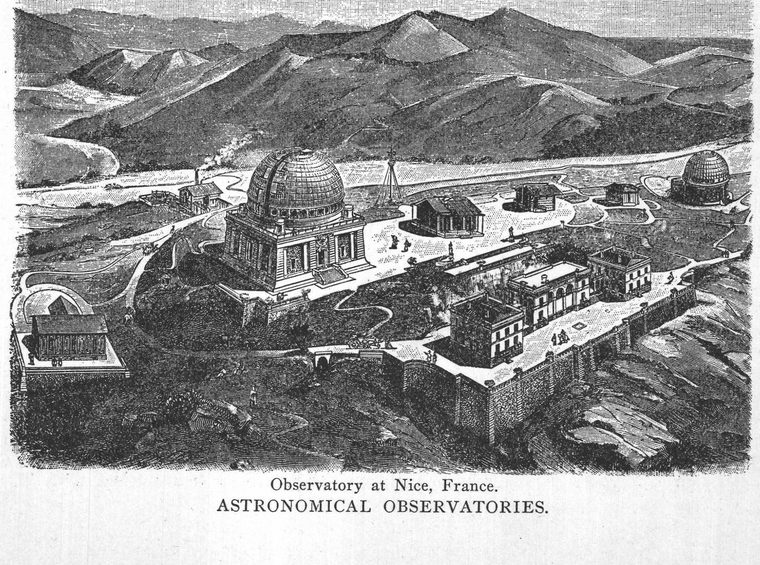
a place or building set apart for the observation of natural phenomena, as an astronomical observatory, or a meteorological observatory. An astronomical observatory requires to be situated where it may be as free from tremors of the earth as possible. A site should not be chosen near a busy railway line. An unobstructed view is required. For this reason a site is chosen away from the smoke of a large city. An elevated position, as the summit of a mountain affording a clear atmosphere and a free horizon is desirable.
The earliest observatory accorded the name was established by the Greeks at Alexandria about 300 B. C. Hipparchus, the father of astronomy, and Ptolemy, the geographer, did their work here. The Arabians founded observatories at Bagdad and at Cairo prior to 1000 B. C. A notable observatory was established by the Mongol khans in northwestern Persia about 1260. Another was founded at Samarkand. The noted telescope of Pekin was mounted on an elevated granite platform and was surrounded by an iron railing about 1300.
The earliest observatory in Europe was established by a wealthy merchant at Nuremberg in 1472. Nuremberg was not the first center of astronomical observations, but it was the first European city to have an observatory. Tycho Brahe established an observatory on the Danish island of Huen in 1576. The impulse given by this astronomer to long and patient research work led to the rapid establishment of other observatories.
The establishment of astronomy at Leyden and Dantzic led to the founding of the royal observatories at Paris and at Greenwich. About the middle of the eighteenth century the observatory was recognized generally as an important part of a university. The Britannica devotes several pages to the briefest mention of European observatories. Greenwich, founded in 1675, is by far the most noted, not so much for original work perhaps, as for the reason that the meridian of Greenwich has been adopted by most nations as the principal meridian from which longitude is reckoned.
The Pulkowa observatory, built by Czar Nicholas in 1835-9, enjoyed the distinction for thirty years of possessing the greatest refracting telescope in the world. This instrument had a fifteen inch aperture. It was replaced in 1885 by a thirty-inch refractor made by the Clarks of Cambridge-port, Massachusetts.
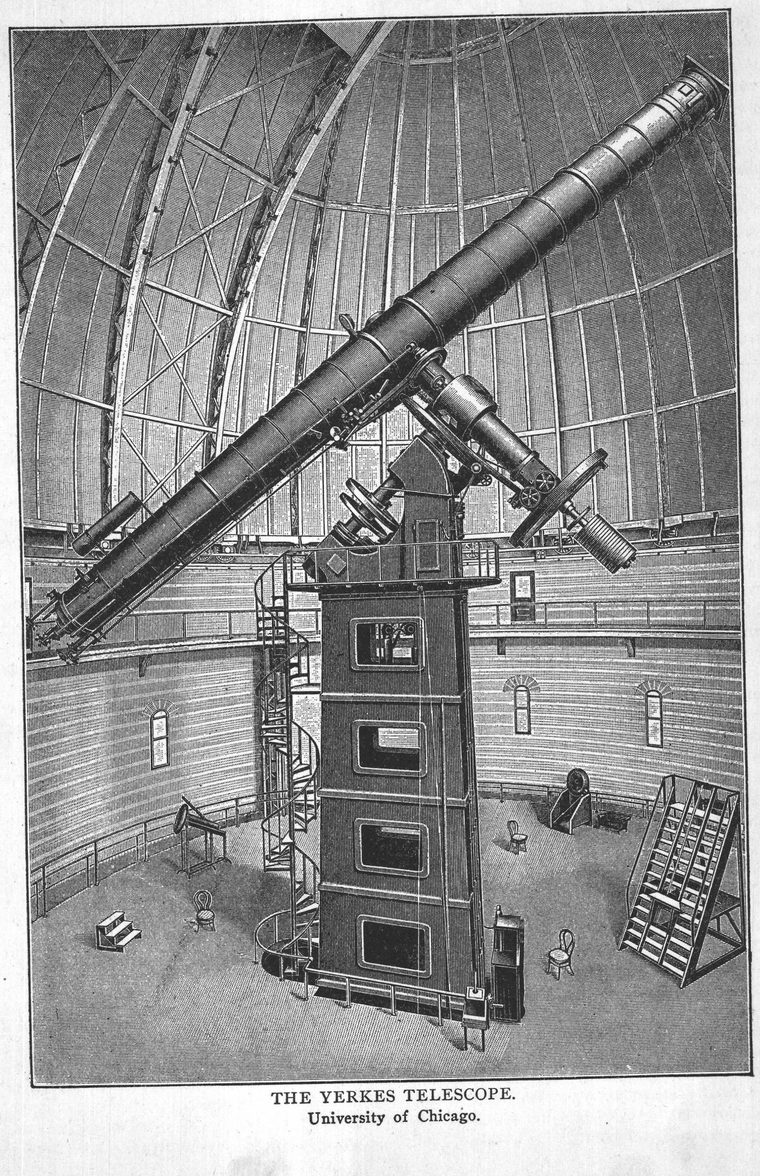
The first requirement of an astronomical observatory is a telescope. The building is designed to shelter this instrument and the attendants. In a modern observatory the telescope is mounted under a rotating dome, forming a storm-proof shelter. Observations are made through a slit or a whole side, as may be required. The telescope is provided with clockwork that shifts the direction of the telescope toward the west as rapidly as the earth turns toward the east. Once focused on a point in the heavens the clockwork keeps the instrument trained on the identical spot until it sinks beneath the horizon. Provision is made also for other instruments, including a meridian circle, minor telescopes, a sidereal clock, a chronometer, a spectroscope, apparatus for solar and stellar photography, etc. Convenient apartments are required for reference books, storage, and study.
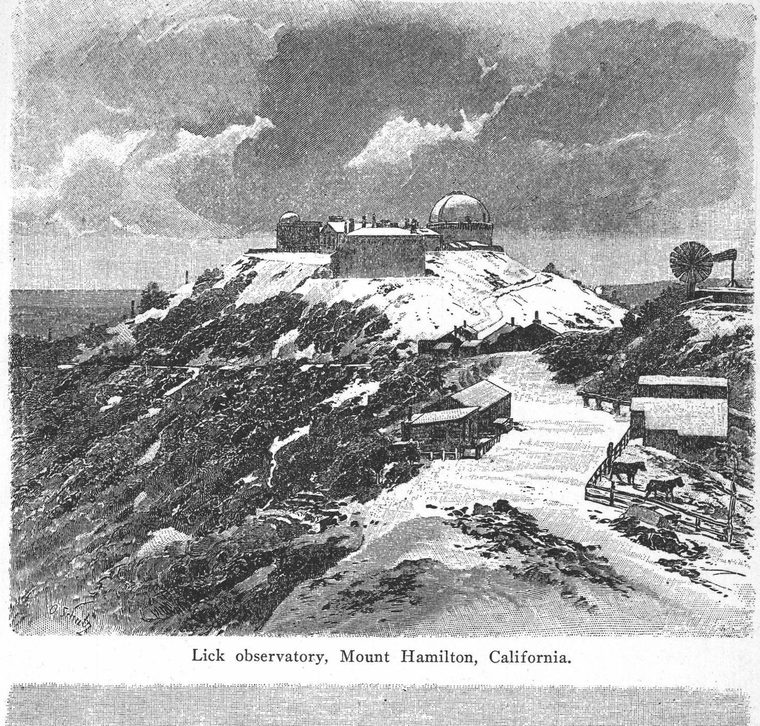
The observatory of Yale was opened in 1830; that of Harvard in 1839. The United States Naval Observatory in Washington was organized in 1842. Noted American observatories are the Lick of the University of California, situated on Mount Hamilton, 4,250 feet above sea level, and the Yerkes of the University of Chicago, situated at Williams Bay. Lick has a thirty-six-inch refractor and Yerkes has a refracting telescope of forty-inch aperture, the greatest known.
See Telescope