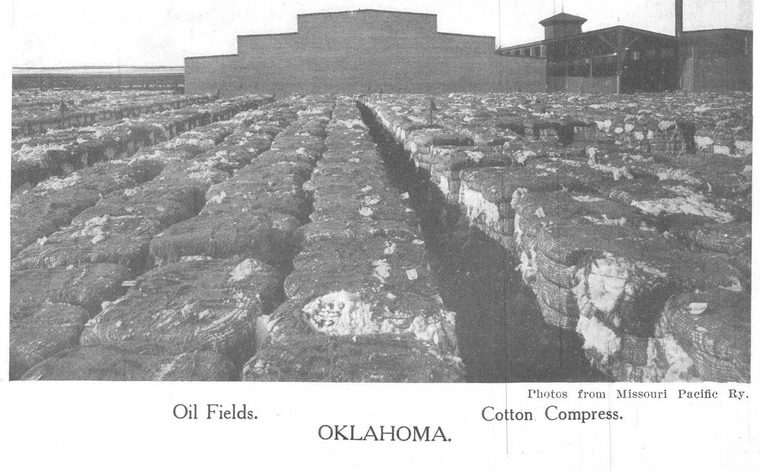
Oklahoma
the forty-sixth state of the American Union. It lies directly west of Arkansas, between Texas and Kansas. Area, 70,430 square miles--greater than the whole of New England. The territory now comprised within the limits of the state was set aside in 1832 as an Indian reservation. It was known as Indian Territory. In 1890 this territory, still unorganized, was divided, the western part taking the name of Oklahoma. In 1907 the two sections were reunited and admitted to the Union as the state of Oklahoma. November 10th is statehood day.
GOVERNMENT. The constitution is progressive. Laws of importance must be submitted to a vote of the people before they become effective. Women are granted partial right to vote. Candidates for office are nominated by popular ballot. State officials are not eligible for reelection. The sale of intoxicating liquor is prohibited, and popular education is enjoined.
NATURAL CHARACTERISTICS. The surface features of the state are not different from those of Kansas and Texas. The southern border follows the Red River. The central part of the state is drained by the tributaries of the Arkansas. None of the streams are navigable. Artesian wells have been located. The southeastern part of the state is rough or mountainous, and possesses undeveloped coal mines. Asphalt, oil, natural gas, granite, marble, gypsum, and lead are found. This section is well wooded. The central portion, with forty inches of rainfall, is a fertile prairie country. The west shades off into a region of insufficient rainfall.
AGRICULTURE. The more favored portion of the state has a rich soil and produces small fruits, orchard fruits, potatoes, small grains, cotton, tobacco, and corn in the greatest abundance. Oklahoma is perhaps the only state in the union in which cotton, corn, and wheat all grow to perfection. Fifteen million bushels of wheat, 800,000 bales of cotton, and 100,000,000 bushels of corn are raised, it is claimed, annually. In the west kaffir corn and other drouth-resisting crops are of importance. Cattle raising is an important industry. Alfalfa is a profitable forage crop. Bermuda grass is sown for permanent pasture.
MANUFACTURES. Manufactures are in their infancy. Flour milling, fruit canning, ginning, meat packing and dressing cotton-seed oil are the chief branches. There are also machine shops, tobacco factories, and creameries.
EDUCATION. A public school system has been set in operation. It is supported largely from the rentals of what are known as public lands. A university has been established at Stillwater, a normal school for whites at Alva, one for colored teachers at Edmond, a school for colored youth at Langston, and an industrial school for Indians at Chilocco.
POPULATION. The census report of 1900 gave a population of 790,391, of whom about 64,445 were Indians and 55,884 were negroes. In 1906 there were 1,109,435 inhabitants. Settlers are pouring into the state. The next census is expected to show over twice the population of 1906. There are six cities claiming a population of over 16,000. Guthrie, situated on the Cimarron, is the capital. Oklahoma is the largest city.
STATISTICS. The following statistics are the latest to be had from trustworthy sources:
| Land area, square miles | 69,870 |
| Water area | 600 |
| Population | 1,414,179 |
| Negroes | 55,000 |
| Indians | 100,000 |
| Oklahoma City (1909) | 45,380 |
| Muskogee | 14,419 |
| Guthrie | 11,652 |
| Shawnee | 10,955 |
| Salary of governor | $4,500 |
| Assessed valuation of property | $110,000,000 |
| Bonded indebtedness | none |
| State revenue | $1,250,000 |
| Agricultural Products- | |
| Corn, bushels | 122.000,000 |
| Wheat, bushels | 16,000,000 |
| Oats, bushels | 11,250,000 |
| Barley, bushels | 700,000 |
| Potatoes, bushels | 2,000,000 |
| Cotton, pounds | 412,000,000 |
| Wool, pounds | 510,000 |
| Hay, tons | 1,305,000 |
| Domestic Animals- | |
| Horses | 432,000 |
| Mules | 33,500 |
| Milk cows | 198,000 |
| Other cattle | 1,378,000 |
| Sheep | 58,000 |
| Swine | 655,000 |
| Flour and grist | $11,000,000 |
| Coal mined, tons | 3,642,000 |
| Petroleum, barrels | 44,000,000 |
| Clay products | $664,000 |
| Miles of navigable rivers | none |
| Miles of railway | 5,516 |
| Teachers in public schools | 7,500 |
| Pupils enrolled | 400,000 |
See Indian Territory; Oil; Cotton