Owl
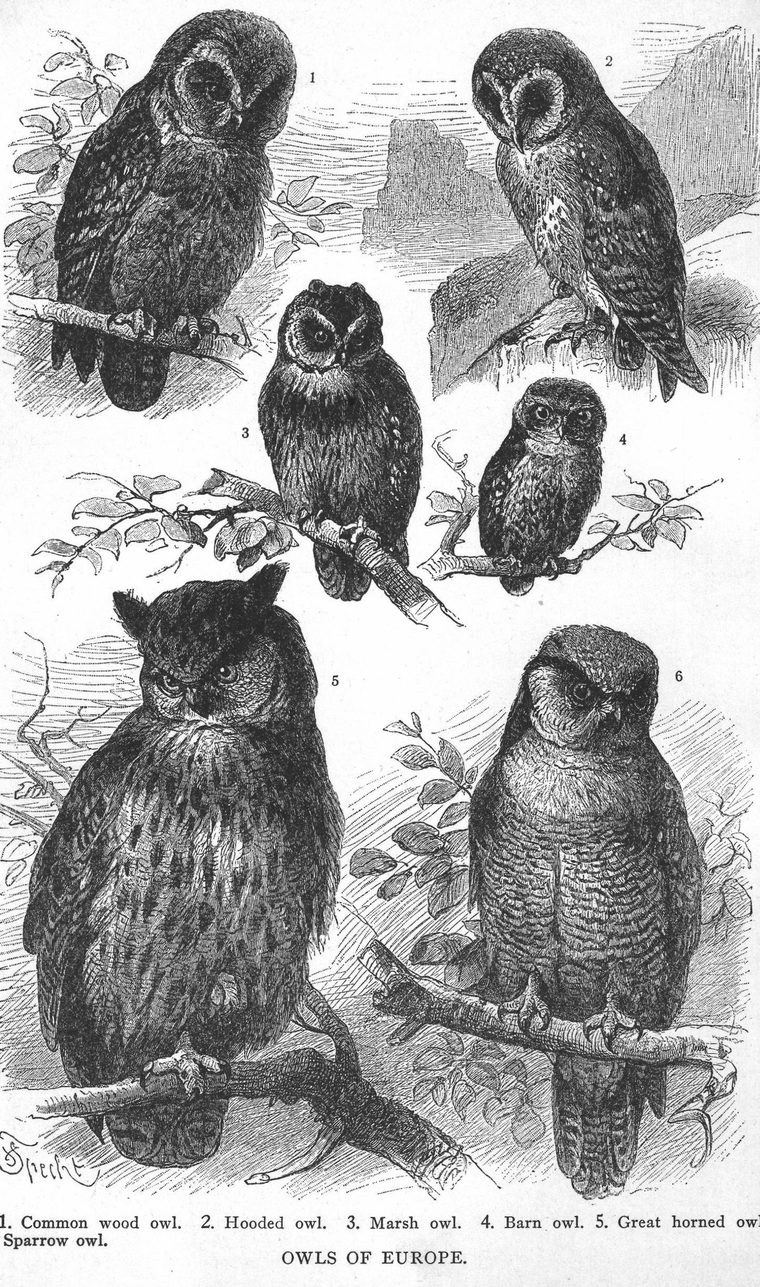
a family of birds of prey. The owl is known at once by its large feathery face and great wise eyes immersed in depressed circles of plumage. The owl is unable to roll its eye or to look sidewise without throwing its head around. The bill is half hid in feathers. It is curved from the base like that of hawk, and is well adapted to rend prey. The claws are sharp and curved for seizing, but are less powerful than those of a hawk. In order to surprise its prey, the flight of an owl is swift and noiseless. Most owls see better at dusk than in the daytime. For that reason they feed at night and seldom molest poultry, but live chiefly on rabbits, mice, insects, and other animals that move in the night time. A study of the stomachs of many hundred owls has demonstrated that, by the destruction of mice, they are to be regarded as more useful than otherwise. The owl eats its food, hair, feathers, and all. It is said that its health actually fails if fed on pure beefsteak. Hair, bones, and feathers are formed into pellets and cast up through the mouth. A study of these pellets gives a clue to the diet of the owl. In the Northern States owls nest in February. The eggs of an owl, usually two to four in number, are uniformly white and are almost hemispherical. In perching, the owl directs two toes forward and two backward.
There are eighteen kinds of owls in North America north of Mexico. The smallest is the elf owl of Arizona, six inches long; the largest is the gray owl of the Arctic region, thirty inches in length. Several species of barn owls are found throughout the northern hemisphere. The common American barn owl is a peculiar looking chap, eighteen inches in total length. The plumage clings tightly to the body. The face has a peculiar, monkey-like appearance, quite different from that of other owls. The barn owl takes shelter in church belfries, hay mows, hollow trees, and the like. It lives chiefly on rats and mice. The nest is placed usually in a tower or stable or a hole in a tree or bank. There are from five to nine eggs. A pair nested for years in one of the towers of the Smithsonian Building in Washington. A pair of barn owls is considered better than a cat to rid the premises of rats and mice.
The screech owl is a small, bunty little fellow about nine inches in length. It nests in barns and hollow trees. In New England its favorite retreat is an old apple orchard. When discovered in the daytime, the small birds annoy it with impunity; but, as night draws on, they are careful to absent themselves. Mr. Fisher, who examined the stomachs of 255 screech owls for scientific purposes, found that their food consists of small birds, mice, lizards, frogs, insects, spiders, crayfish, earthworms, etc. Out of 255 specimens, he found that one had been guilty of attacking poultry.
The saw-whet owl is smaller than the screech owl. It makes a noise resembling that made in filing a large-toothed saw.
The burrowing owl nests in the abandoned burrows of the prairie dog. Its principal food is grasshoppers, crickets, and other insects. Where a burrow of this sort does not offer, it is quite capable of digging a hole for itself. The burrowing owl of Florida, about nine inches in length, digs a hole in a bank, into which it places from five to seven eggs.
The barred or hoot owl places from two to four eggs in an old crow's or hawk's nest. It is without horns. The upper parts are grayish brown. The under parts are white, more or less tinged with buff. The breast is barred.
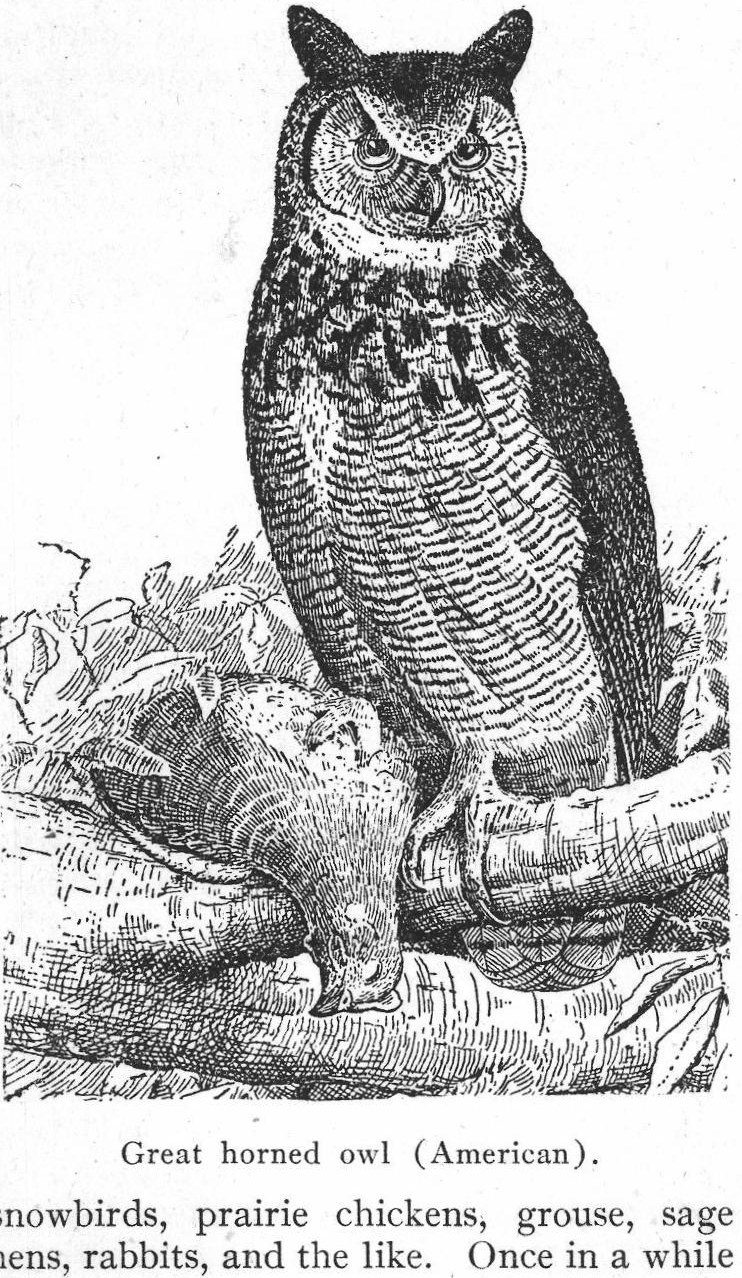
The call of the large forest owls is certainly startling. Some entertaining sketches are given by William J. Long. Chapman describes the usual call of the barred or hoot owl as "a striking medley of wha-whas mingled with rolling whoo-ahs, the whole reminding one of deep-voiced, mirthless laughter. Sometimes two birds give a concerted performance. One utters about ten rapid hoots, while the other, in a slightly higher tone, hoots half as fast, both performers ending together with a whoo-ah. At times, they utter a single prolonged whoo-ah, and, more rarely, a weird, gasping shriek emphasized at its conclusion like a cry of distress." The call of the great horned owl he gives as a "loud, deep-toned whoo, hoo-hoo-hoo, whooo, whooo. The syllables are all on the same note, and bear some resemblance to a bass-voiced dog barking in the distance. A much rarer call is a loud, piercing scream, one of the most blood-curdling sounds I have ever heard in the woods."
In time of abundance the owl is a liberal provider. A nest of great horned owls examined by a bird student was found to contain two young owls. The larder contained a mouse, a young muskrat, two eels, four bullheads, a wood duck, four ruffed grouse, one rabbit, and eleven rats, in all eleven pounds of food.
The snowy owl is twenty-five inches in length. It is of a pure white, more or less barred with brown or black. It breeds near the Arctic Circle. It nests on the ground. It hunts in the daytime. In winter it wanders southward looking for food. In winter this beautiful white bird may be seen coursing over the snowy plains of Minnesota, Dakota, and Montana. It lives on snowbirds, prairie chickens, grouse, sage hens, rabbits, and the like. Once in a while it gets as far south as Texas before turning homeward for an arctic summer. It is the handsomest of the American owls. Some individuals are almost spotless white.
The eggs of all owls are white. In the northern United States and Canada the owls nest so early in February that they are obliged to stay on the nest continuously to keep the eggs from freezing.
In literature, the owl holds a double place as a bird of ill omen and as the especial companion of Minerva, the goddess of wisdom. A stuffed owl is regarded as an appropriate ornament for the library. An owlish person is one who looks pompous and over wise. The word, owl, is also used provincially as a verb meaning to carry on a prowling business at night. Gray's solemn stillness of the churchyard is skillfully intensified by
The moping owl does to the moon complain
Of such as, wandering near her secret bower,
Molest her ancient, solitary reign.
It is also worthy of note that the owl appears to be a greater favorite with the poets than the proud soaring hawk. The owl is doubtless the more human and picturesque bird; then he belongs to the night and its weird effects. Bird of the silent wing and expansive eye, grimalkin in feathers, feline, mousing, haunting ruins and towers, and mocking the midnight stillness with thy uncanny cry! The owl is the great bugaboo of the feathered tribes. His appearance by day is hailed by shouts of alarm and derision from nearly every bird that flies, from crows down to sparrows. They swarm about him like flies and literally mob him back into his dusky retreat. Silence is as the breath of his nostrils to him, and the uproar that greets him when he emerges into the open day seems to alarm and confuse him as it does the pick-pocket when everybody cries Thief.--Burroughs.
And Dick the shepherd blows his nail,
And Tom bears logs into the hall,
And milk comes frozen home in pail;
When blood is nipped, and ways be foul,
Then nightly sings the staring owl,
Tu-who!
Tu-whit! tu-who! a merry note,
While greasy Joan doth keel the pot.
--Shakespeare.
He sleeps in his nest till morn;
But my blessing upon the jolly owl
That all night blows his horn.