Rat
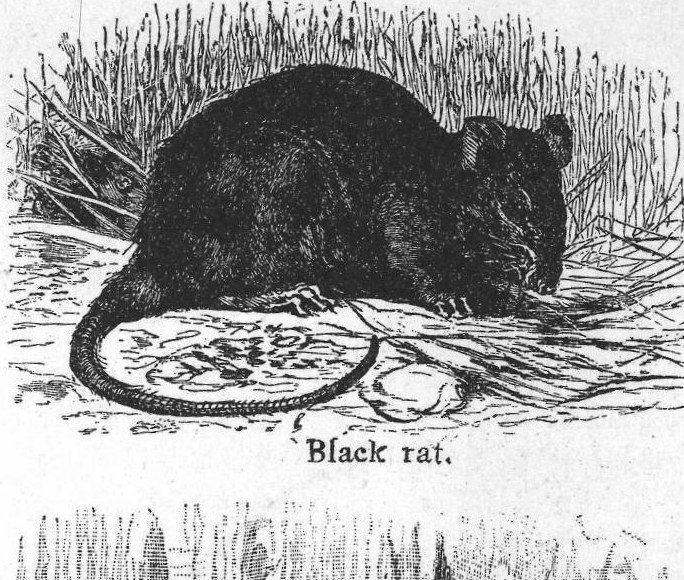
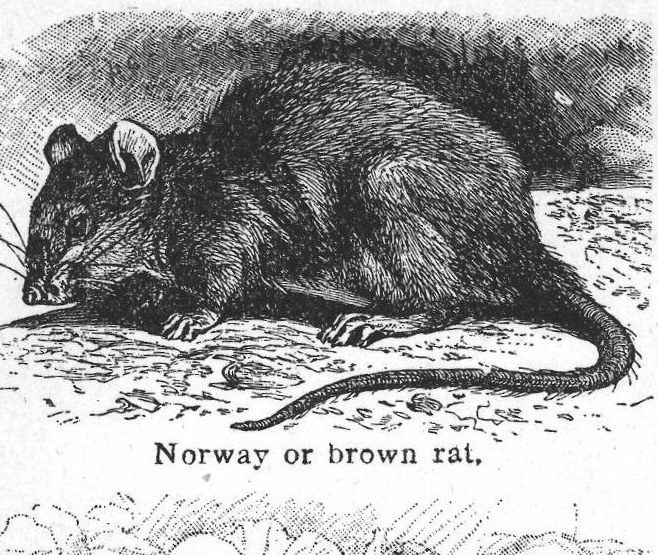
an animal of the mouse family. There are numerous species. The common or brown rat is a native of India. It has extended its range within comparatively recent times. It arrived in England about 1750, and was first reported in this country about the time of the American Revolution. It breeds several times a year and is an exceedingly destructive animal. The Florida or cave rat and the cotton rat of Southern States are well known in their respective sections. They remain in fence rows and outlying grounds, however, and do not infest buildings. A smaller black rat, with habits somewhat like the brown rat, and likewise a native of India, is so persecuted by its larger relative that it is comparatively rare. There are also several water rats; one in particular, called the wharf rat, which infests harbors. Rats are good swimmers, but they cross large bodies of water, in ships of course. A superstition, once prevalent among sailors, that rats desert an unlucky ship when it is in harbor, has found expression in the saying, "Rats leave a sinking ship."
Seattle, Washington, requires boats in port to place flaring tin shields on the mooring ropes to prevent rats from coming ashore. The harbor of Hamburg, Germany, is provided with a steam tug that goes to infested ships and pumps poisonous carbonic acid gas into the holds to destroy the rats. Rats are carriers of disease. The spread of the plague in India has been traced to rats. Under favoring circumstances rats have young every three or four months. If unchecked, a pair of rats are capable of establishing a colony of 20,000,000 rats in four years. In spite of cats, traps, poisons, terriers, and ferrets, rats have multiplied enormously in the ports and grain fields of Europe and Asia. A British officer investigating the cause of plague in Bombay declared that there were at least 2,000,000 rats in the wharves of that city alone. Almost in despair, the governments of Europe have set scientists at work to discover some possible means of exterminating rats. Two eminent scientists, Dr. Danysz of the Pasteur Institute of Paris and Dr. Neumann of Arlborg in northern Europe, have hit upon practically the same measure. They have discovered a bacillus, a bacterial germ which is harmless to human beings and to other animals, but which is fatal to rats and mice. A preparation containing this microbe was distributed throughout infested fields in France. The rats and mice disappeared immediately. Birds and other animals that ate the dead rats seemed to experience no evil effects. The Russian grain port of Odessa was infested with rats. The authorities applied to the Pasteur Institute for aid. Five thousand gallons of bouillon were prepared. Pieces of stale bread soaked in the bouillon were spread about the wharves and elevators. In a few days the authorities offered ten cents a head for every rat caught, but even professional ratcatchers were unable to find specimens. In eight weeks only fourteen rats were found where a million rats lived before. Equal success has been met in Germany and in Sweden. The Danish government established a laboratory at Copenhagen to supply the microbes to agricultural districts.
A very interesting account is given of a systematic attempt to rid the villages and fields of Suffolk, England, from rats and mice. At a given date, the infection was supplied in quantities. Bands of men and boys distributed rat food infected with the microbes everywhere. In a few days the entire locality was seemingly free from the gnawing, destructive pests.
A report issued by an English association, called "The British Incorporated Society for the Destruction of Rats," claims that a rat eats a half cent's worth of food per day, and that a colony of rats on an English farm causes a loss to the proprietor of $1.80 per year each. The total loss to the agricultural interests of Great Britain from ravages of rats is placed at $75,000,000 a year. Great Britain and its colonies spend a million dollars in buying rat poison. Rats are not only destructive, but they are a nuisance. They appear to have no compensating good qualities to justify their existence. If the so-called rat virus can be supplied through the drug stores in capsules, it would seem that persistent effort might rid the civilized world of both rats and mice.
The rat is not a sufficiently inspiring subject to find large place in literature. Robert Browning's poem of The Pied Piper of Hamelin gives a very excellent notion of the rat plague in the Hanse towns of medieval Europe. The following quotation gives some notion of the kinds of rats, as well as of the great numbers that infested European cities:
Great rats, small rats, lean rats, brawny rats,
Brown rats, black rats, grey rats, tawny rats,
Families by tens and dozens,
Brothers, sisters, husbands, wives--
Followed the piper for their lives.
The high, wet levels swarmed with mice and shrews, just as our arctic and alpine meadows swarm with them. The species were really widely different from ours, but many of them showed curious analogies in form and habits; there was a short-tailed shrew much like our mole shrew, and a long-haired, short-tailed rat like a very big meadow mouse. They were so plentiful that we frequently saw them, and the grass was cut up by their runways. They were abroad during the day, probably finding the nights too cold, and in an hour Heller trapped a dozen or two individuals, belonging to seven species and five different genera.--Theodore Roosevelt in Scribner's Magazine.