Rhinoceros
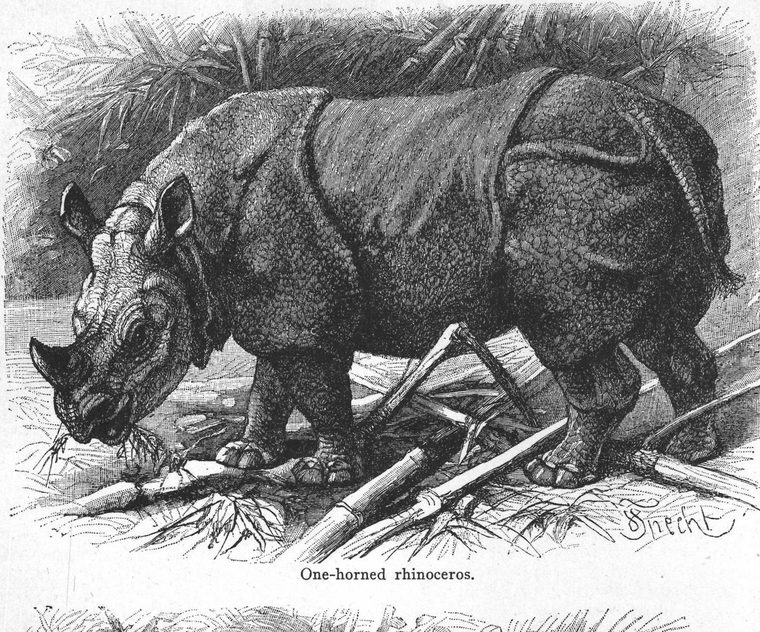
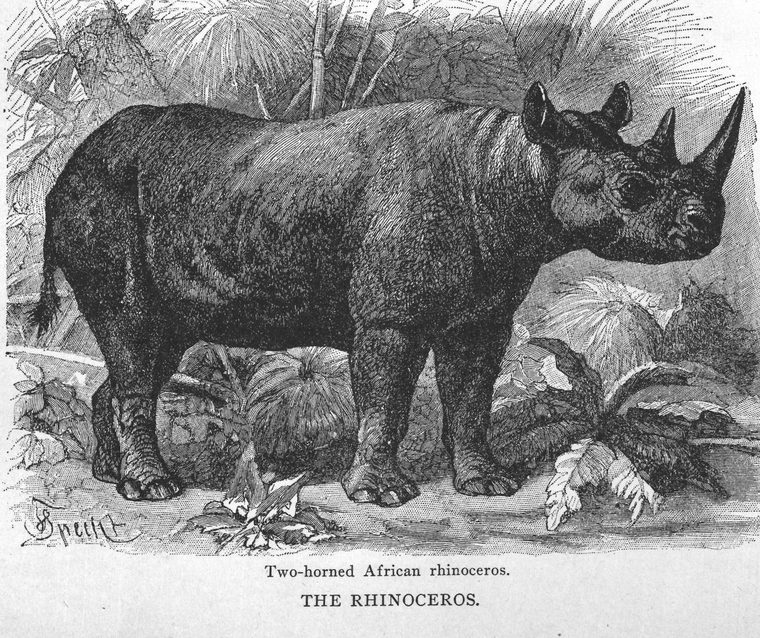
ri-nos'e-ros (Greek, nosehorned), a powerful, thick-skinned animal next to the elephant in size. It is exceedingly heavily set, bulky, and clumsy, with a pig-like body about five feet in height and from eight to ten feet in length. A large specimen often weighs 6,000 pounds. The hide is almost hairless, excepting the tip of the tail and surfaces of the ears, and is so thick and hard that it covers the body like plates of sole leather with a few wrinkles to permit movements of the limbs and head. The feet are broad and flat like those of an elephant, but each foot has three separate toes armed with hoof-like claws. The neck is thick and short, the ears are rather long, and are not unlike those of the pig. The eye of the rhinoceros is small and so deeply set that it is unable to see either straight ahead, or backward. It is obliged to turn its body sidewise like a pig, if it wishes to look straight ahead. The snout is long but the jaws are of equal length. The rhinoceros does not have a trunk, but its upper lip is long and pliable, enabling the animal to seize grass or other food. There are several species confined to Africa, southern Asia, and the Indian Archipelago. The upper lip of the Indian species is armed with a horn, sometimes three feet in length and not less than six inches in diameter at the base. It is an outgrowth of the skin, like a tuft of hair, and has no connection with the bone of the upper jaw. It is a terrible weapon of defense against the tiger or other animal unwise enough to attack it, and also useful in rooting, for a rhinoceros is fond of digging after the manner of a hog. The small rhinoceros of South Africa has two horns, one behind the other. Livingstone describes this species as a vicious, dangerous beast, likely to attack hunters if disturbed. Like the elephant, the rhinoceros has but one young at a time, and this at long intervals, and like the elephant again, the rhinoceros ranges in jungles in small families of five or six, living entirely on vegetable food, grasses, cane, and succulent roots. It is very fond of wallowing in mire like the hog. In captivity, it lives on any forage that cattle will eat. In geologic times woolly species were companions of the mammoth in Arctic regions. Fossil remains have been found in North America also. See Elephant; Hippopotamus; Boar; Tapir
The huge beast was standing in entirely open country, although there were a few scattered trees of no great size at some little distance from him. We left our horses in a dip of the ground and began the approach; I cannot say that we stalked him, for the approach was too easy. The wind blew from him to us, and a rhino's eyesight is dull. Thirty yards from where he stood was a bush four or five feet high, and though it was so thin that we could distinctly see him through the leaves, it shielded us from the vision of his small, piglike eyes as we advanced toward it, stooping and in single file, I leading. The big beast stood like an uncouth statue, his hide black in the sunlight; he seemed what he was, a monster surviving over from the world's past, from the days when the beasts of the prime ran riot in their strength, before man grew so cunning of brain and hand as to master them. So little did he dream of our presence that when we were a hundred yards off he actually lay down.
Walking lightly, and with every sense keyed up, we at last reached the bush and I pushed forward the safety of the double-barreled Holland rifle which I was now to use for the first time on big game. As I stepped to one side of the bush so as to get a clear aim, with Slatter following, the rhino saw me and jumped to his feet with the agility of a polo pony. As he rose I put in the right barrel, the bullet going through both lungs. At the same moment he wheeled, the blood spouting from his nostrils, and galloped full on us. Before he could get quite all the way round in his headlong rush to reach us, I struck him with my left-hand barrel, the bullet entering between the neck and shoulder and piercing his heart. At the same instant Captain Slatter fired, his bullet entering the neck vertebrae. Ploughing up the ground with horn and feet, the great bull rhino, still head toward us, dropped just thirteen paces from where we stood.--Theodore Roosevelt, in Scribner's.