Ring
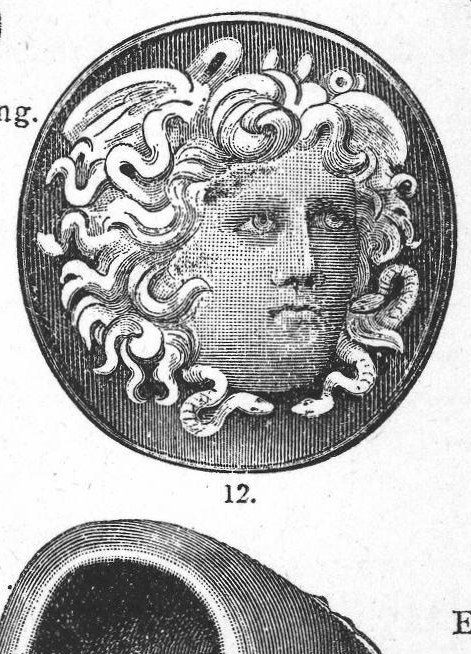
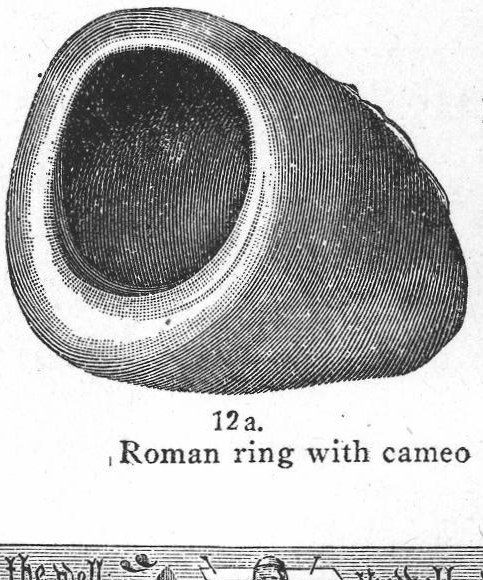
in jewelry, a band worn, usually on the finger, as an ornament. The broad portion at the back of the finger is known among jewelers as the bezel; the rest as the hoop. Rings were worn by all the nations of which we read in ancient history. The oldest rings now in museums were found in the tombs of ancient Egypt. Those of the wealthy were massive bands of solid gold. Poorer people wore silver, bronze, glass, and even blue porcelain rings. A few Egyptian rings of amber, ivory, and carnelian have been found. The scarab, or sacred beetle, frequently took the place of the bezel. The Hebrews, Greeks, and Romans wore rings. A ring was a sign of social standing or authority. A device cut in the bezel was used to impress the wax wafer with which missives and documents were sealed. To show that full authority was given, a king entrusted his messenger with his signet ring. In lieu of a written appointment, a king gave his prime minister a signet ring.
Spartan laws forbade the wearing of rings made of material more expensive than iron. The Athenians were given to the use of precious gems. The early Romans wore plain iron rings, but luxury crept in. After the battle of Cannae, Hannibal sent the Carthaginian senate a bushel of rings from the fingers of Roman knights. A ring belonging to one of the Scipios is kept in the Vatican at Rome. It is a plain, hammered-gold band set with a figure of victory. About the third century, Christians began to wear rings engraved with Christian symbols. The Episcopal ring became the symbol of the bishop's authority. There is a noted collection of bishops' rings in the South Kensington Museum, London. Many of them are set with rubies and sapphires of fine fire and striking appearance. They are of great size, due to the fact that they were designed to be worn over the finger of the glove.
The merchants of the Hanse towns adopted signet rings engraved with trademarks. The presentation of a merchant's ring was deemed proof that the messenger was duly authorized to make collections and give receipts. Rings were not always worn on the fingers. During the fifteenth and seventeenth centuries the pope was wont to send a newly appointed cardinal a ring to be worn on the thumb. They were impressive in appearance but of cheap material and inferior workmanship. In Henry IV Shakespeare speaks of "an alderman's thumb-ring."
The museums in the old capitals of Europe possess fine collections of rings. The best workmanship appears to have been executed in Italy. Shakespeare's ring, a massive gold band with the initials W. S., is kept in the British museum. Among curiosities are rings the bezel of which contained poison. Hannibal is said to have carried in this way the poison with which he ended his life. The Venetian jewelers were skilled in making rings the bezel of which contained a poison set free by pressure on a light spring. In shaking hands with an enemy it was possible to scratch his hand slightly, while deadly poison followed. The device was suggested, no doubt, by the fang of a snake.
The ring having no beginning and no end is a symbol of eternity. "With this ring, I thee wed," is a formula of the Church of England. According to good social usage, the engagement ring may be heavily jeweled, but the wedding ring should be a plain gold band. It should be placed on the fourth finger of the left hand, next the little finger, "Because, by the received Opinion of the Learned and Experienced in Ripping up and Anatomizing Men's Bodies, there is a Vein of Blood which passeth from that fourth Finger unto the Heart called Vena amoris, Love's Vein."