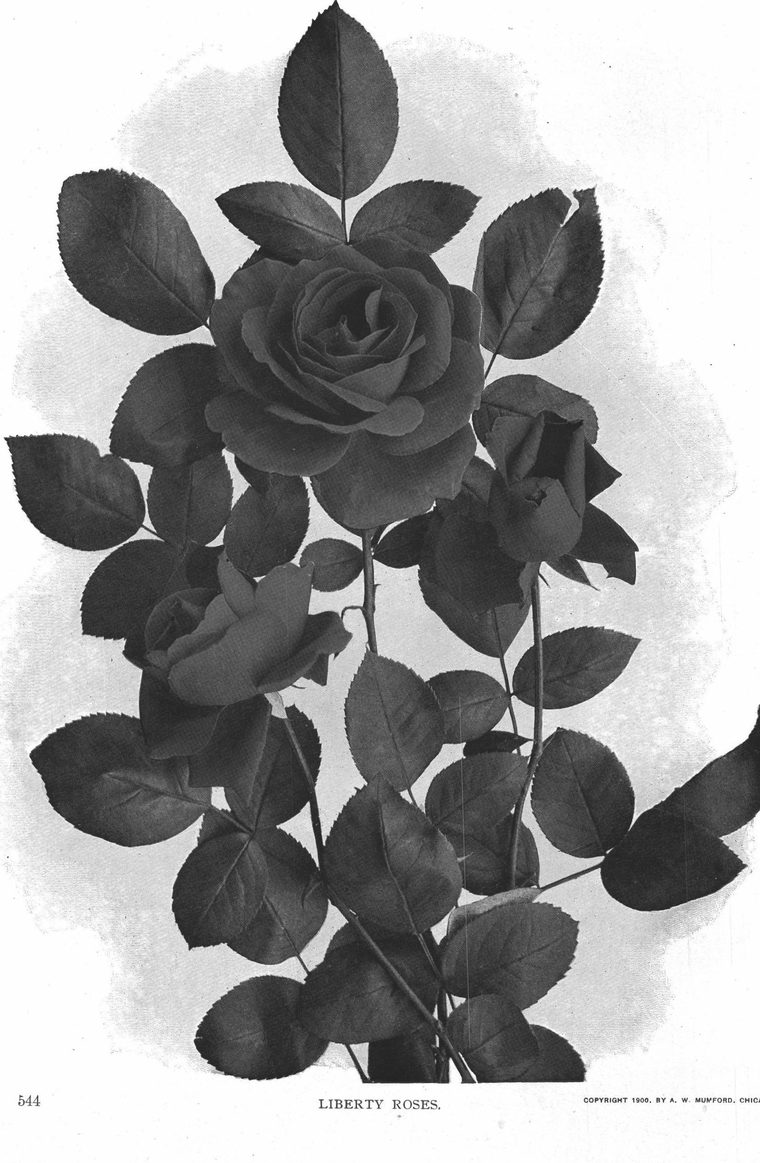
Rose
a thorny, flowering shrub, giving name to a large family, including many orchard and garden fruits. Wild roses have five petals, numerous stamens, and numerous pistils, one for each of the seeds, finally enclosed in the fleshy rose hip or calyx. A rose hip (it should never be called a rosebud, which is an unopened flower) is the very opposite of its cousin, the strawberry. If the end of the strawberry were pushed inward like the end of the finger of a glove until the naked seeds of the strawberry were on the inside instead of the outside, we should have the rose-hip style of fruiting. Or if the inside of the rose hip were to swell out and upward, as a boy pulls his pocket inside out, the rose hip would be constructed then on the plan of a strawberry. All wild roses are single. The double roses of cultivation have been made so by the gardener's skill in changing stamens back to leaves, that is to say, into petals. It is difficult to say how many species there are. One authority says thirty, another describes over 4,000. One story, too good not to be true, runs to the effect that an English authority made several species out of a number of American specimens sent him from the same bush. Great Britain recognizes about a score. Wild roses are found throughout the north temperate zone northward to Lapland and Hudson Bay. Some kinds are dwarf, shoe-high, others are prodigious climbers, making twenty to forty feet in a season.
Various classifications of the cultivated roses have been made. Gardeners recognize over fifty desirable species. Florists group roses into, first of all, summer flowering roses that bloom once each season, and perpetual roses that bloom the year around if conditions permit; and these again are divided in Bailey's monumental Cyclopedia into nineteen classes, which we can take space only to name: Provence, damask, and French, alba (white), Ayrshire, briers, multiflora (many-flowered), evergreen, and pompon are summer flowering groups. The perpetuals include hybrid perpetuals, hybrid tea, moss, Bourbon, Bourbon perpetual, China, musk, Ayrshire, polyantha, perpetual briers, and evergreen groups. Eglantine or sweet brier is a wild hedge rose.
The rose is by common consent the queen of flowers. Wild or tame, its beauty cannot be gainsaid. Whatever his favorite flower may be, everyone is fond of the rose. In English history the white rose was the badge of York, and the red rose that of Lancaster. Edward III impressed a rose on his coinage of gold. The rose and the rosette had their place in architecture. A rose window surrounded by delicate tracery was worked out in stained glass. "No rose without thorns," expresses the philosophy of the common people. "The rose is red, the violet blue," may be found scribbled on many an old school book. A "bed of roses" is the utmost expression of elegant luxury. The "Last Rose of Summer" voices regret for pleasures nearly over. An allusion to the rose, if delicately made, is particularly appropriate to feminine beauty, as when Byron says:
Stirred with her dream, as rose-leaves with the air.
A rosebud set with little wilful thorns,
As sweet as English air could make her.
and his Maud,
Queen rose of the rosebud garden of girls.
I am not a rose, but I have lived near the rose.
"Let us crown ourselves with rosebuds before they be withered," a grave bit of advice from the wisdom of Solomon, points out the propriety of appreciating our opportunities before it is too late. Shakespeare may be right in saying, "That which we call a rose, by any other name would smell as sweet," but certainly to substitute a new word would be a serious loss to our literature. See Attar; Perfume; Oil