Shakespeare, William
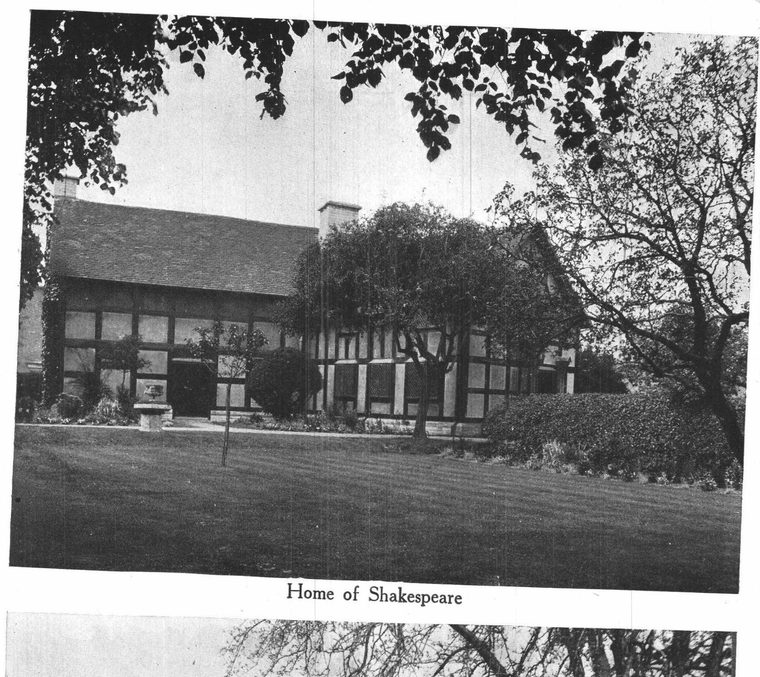
shaks'peer, William (1564-1616), the greatest name in literature. Little is known of his life. He was born at Stratford-on-Avon. The Shakespeare home, a wooden frame filled in with masonry,--still stands. The father was a landholder and a dealer in gloves. Little is known of Shakespeare's education. Accurate and pleasing allusions to flowers, insects, birds, and trees, as the "nodding violet," "the ineffectual fire of the glowworm," "the mocking cuckoo," "the temple-haunting martlet," and "the sere, the yellow leaf," show that his mind was well stored with images and that his youth was not mispent. Some account is at hand of time spent in a lawyer's office, and of the trial of himself and companions for deer-stealing. Sir Thomas Lucy, the owner of the deer, is caricatured in Justice Shallow of the Merry Wives of Windsor.
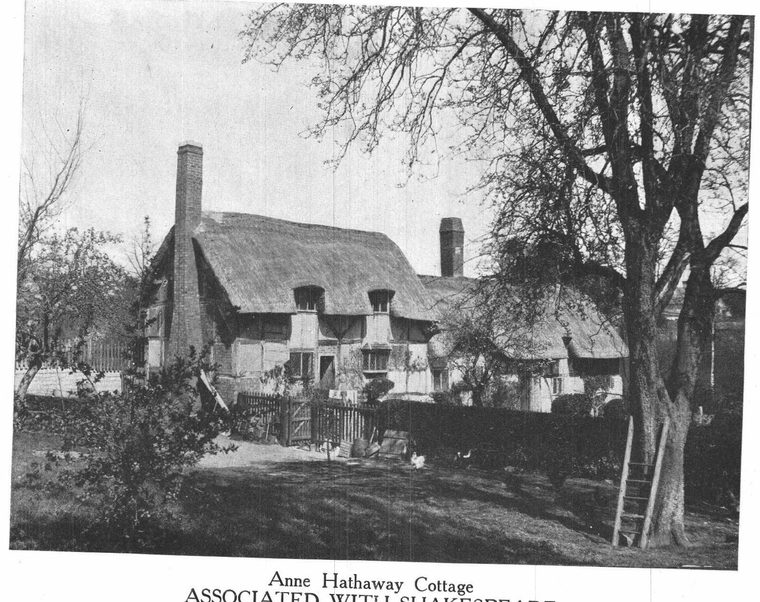
One of "Will" Shakespeare's favorite rambles across meadows and over hedge styles led evidently to a cottage where Anne Hathaway lived. The garden, thatched roof, low doorway, heavily beamed sitting room, wide fireplace, oaken settle, and furniture are kept as they used to be when Will, eighteen, and sweet Anne, twenty-six, afterward his wife, kept company. The cottage is now a literary Mecca. A book of visitors is kept. It bears the signatures of most Americans known in literature, as well as that of U. S. Grant and other public men.
About 1586 Shakespeare went to London, evidently to seek fame and fortune. Here he became an actor, a mender of old plays, and a writer of new ones. The Globe and Blackfriars theaters, situated on the Strand, then fronting the Thames, were the scenes of his triumphs. After twenty-five years of London he returned to Stratford, where his savings had been invested thriftily in property that brought him in a good rental. He established his family here in the best house in town and took more comfort, no doubt, in his worldly prosperity than in his plays, which he is said to have considered faulty enough.
He died on the anniversary of his own birthday, April 23, 1616, and was buried in the chancel of the parish church. An inscription on the memorial stone, composed, it is thought, by himself for the purpose, runs:
To bigg the dust enclosed heare;
Bleste be the man that spares thes stones
And curst be he that mobes my bones.
Shakespeare's writings may be separated into poems and thirty-seven plays. His poems are Venus and Adonis, Lucrece, The Passionate Pilgrim, and his Sonnets.
The generally accepted classification of plays is as follows:
Henry VI, Part I.
Henry VI, Part II.
Henry VI, Part III.
Richard II.
Richard III.
King John.
Henry IV, Part I.
Henry IV, Part II.
Henry V.
Henry VIII.
Titus Andronicus.
Hamlet.
King Lear.
Macbeth.
Julius Caesar.
Antony and Cleopatra.
Coriolanus.
Cymbeline.
Much Ado About Nothing.
Twelfth Night.
As You Like It.
Taming of the Shrew.
Pericles.
Merry Wives of Windsor.
Measure for Measure.
All's Well That Ends Well.
Love's Labor Lost.
Comedy of Errors.
Two Gentlemen of Verona.
Midsummer Night's Dream.
Merchant of Venice.
Troilus and Cressida.
Winter's Tale.
Tempest.
A reasonable acquaintance with Shakespeare is essential to an understanding of literature. An intelligent person desires to understand such allusions as the ingratitude of King Lear's daughters, the jealousy of Othello, the madness of Hamlet, the advice of Polonius, the judgment of Portia, the choice of the caskets, and the grossness of Falstaff.
Next to the Bible, Shakespeare's writings are the greatest mint of words and quotations. The extent to which quotations from Shakespeare have passed into proverbs is well put by a critic who humorously states that Shakespeare lacks originality. One cannot read a page of his writings without coming upon familiar thoughts and expressions. Lowell is of the opinion that the apt expressions for which Shakespeare is noted were not coined by him, but were caught from the people and used because they expressed his meaning and could be under-stood by everybody. "A woman's reason," "passing fair," "what the dickens," "a little brief authority," "a mere anatomy," "good men and true," "true as steel," "beginning of the end," "feed fat the ancient grudge," "staff of my age," "in the twinkling of an eye," "the quality of mercy," "a Daniel come to judgment," "the uses of adversity," "tongues in trees," "sermons in stones," "lack-luster eye," "better days," "sans teeth, sans eyes," "bag and baggage," "gallop of verses," "warrant heart whole," "budge an inch," "poor but honest," "at fingers' ends," "a horse of that color," "the jaws of death," "as like as eggs," "a twicetold tale," "to paint the lily," "elbow room," "give the devil his due," "a trick worth two of that," "mine ease in mine inn," "the winter of our discontent," "grim visaged war," "my kingdom for a horse," "the most unkindest cut of all," "what a fall," "the milk of human kindness," "vaulting ambition," "the wine of life," "moon in russet mantle clad," "every inch a king,"--these are a handful of the coins original or otherwise to which Shakespeare has given currency.
The following lines are a few of the many that have been quoted so often, and with so many variations, that they have passed into the common fund of speech from which writers draw freely without further need of giving credit:
Beware the ides of March.
Thereby hangs a tale.
My cake is dough.
Fling cake is dough.
Fling away ambition.
Lend me your ears.
When shall we three meet again?
Stand not upon the order of your going.
Throw physic to the dogs.
That this too too solid flesh would melt.
Give thy thoughts no tongue.
Beware of entrance to a quarrel.
Something is rotten in the state of Denmark.
The time is out of joint.
One may smile and smile and be a villain.
Let the galled jade wince.
The game is up.
The sand heaped by one flood is scattered by another, but the rock always continues in its place. The stream of time, which is continually washing the dissolute fabrics of other poets, passes without injury by the adamant of Shakespeare.--Samuel Johnson.
See Drama; Globe Theater; Stratford; Irving