Siege
the sitting down of a military force before a fortified place and continued offensive operations for the purpose of taking it. To invest a fort is to surround it by a hostile force. The investing force is known as the besieging force. The defenders are the garrison. To raise a siege is to abandon the attempt. Preparations for an expected siege include strengthening the fortifications and laying in a supply of munitions of war and of provisions. In modern warfare hostilities are not begun until the garrison has been summoned to surrender and has declined or neglected to do so. It is considered humane to allow women, children, and non-combatants to depart before hostilities begin.
The cutting off of supplies has ever been considered an important and first step in conducting a siege. In modern sieges the use of explosives bears a prominent part. Heavy artillery is employed to make breaches in the walls, and bursting shells are thrown within the fortifications to dismay and destroy the defenders. Tunnels or mines are led beneath the walls, and heavy charges of dynamite or other powerful explosives are set off. Storming columns yet enter the breaches in the walls, but shells-heavy shells-grape, and shrapnel now take the place largely of surprise and of assaulting forces.
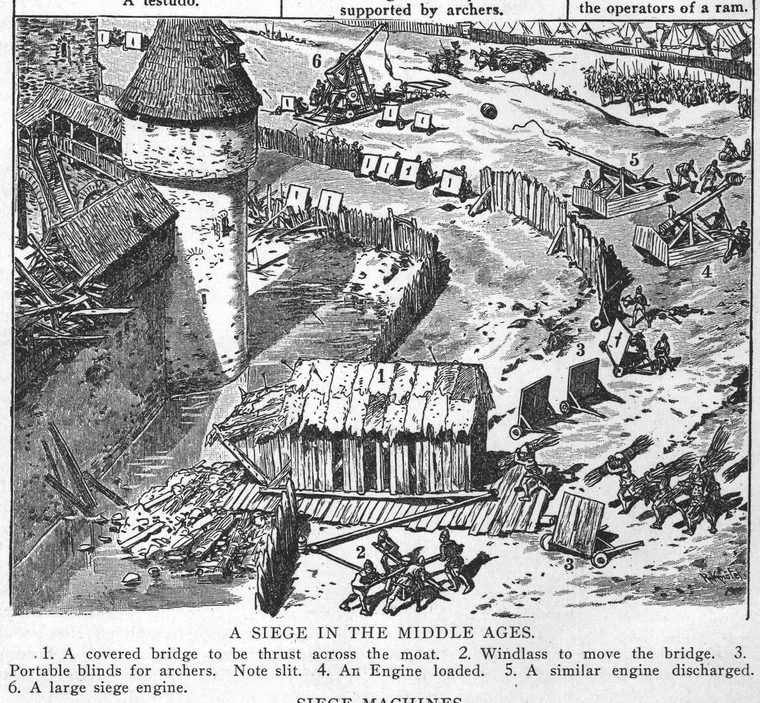
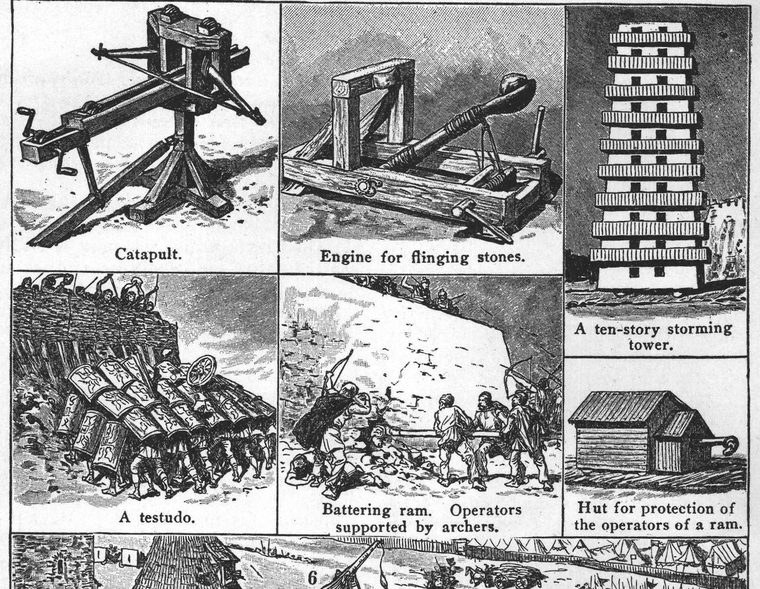
Before the day of powder, nitroglycerin, and lyddite, a siege was an affair of catapults, battering rams, scaling ladders, storming towers, assaults, and hand to hand conflicts. Among the sieges noted in ancient history are those of Troy by the Greeks at an uncertain date; Tyre by Alexander, 332 B. C.; Syracuse by the Athenians, 413 B. C.; Saguntum by Hannibal, 219 B. C.; and Carthage by the Romans, 149-146 B. C.
Rome was besieged several times. The Romans are said to have taken sooner or later every walled town they ever laid siege to. The siege of Acre, 1191, belongs to the period of the Crusades. The siege of Rochelle, 1628, is one of the most noted in French history. Others are Metz, 1870; and Paris, 1870-1. British history is full of sieges. Among those of note are Calais, 1347; Orleans, 1428; Taunton, 1644-5; Londonderry, 1689; Gibraltar, 1782-3; Sebastopol, 1854-5; Lucknow, 1857; and Ladysmith, 1900. Constantinople was taken by the Turks in 1453; the Spaniards laid siege to Leyden in 1573-74. "High Belgrade," the frontier of the Danube, witnessed a dozen sieges. Prince Eugene took the city in 1717, and it was again hombarded by the Turks in 1862. Scarce a hill or pass in Europe but had its fortress, and scarce a fortress, however ruined, but has its story of siege and defense. In Scott's Ivanhoe the story of taking a castle is told vividly.
The defense of Port Arthur by the Russians in 1904 established a new era in the history of warfare by siege. American soil is not noted for sieges. Those of Quebec in 1759-60. New Orleans in 1814, Vicksburg in 1863, and Richmond in 1864-5, may be mentioned. Detroit was besieged by Pontiac in 1763-4.