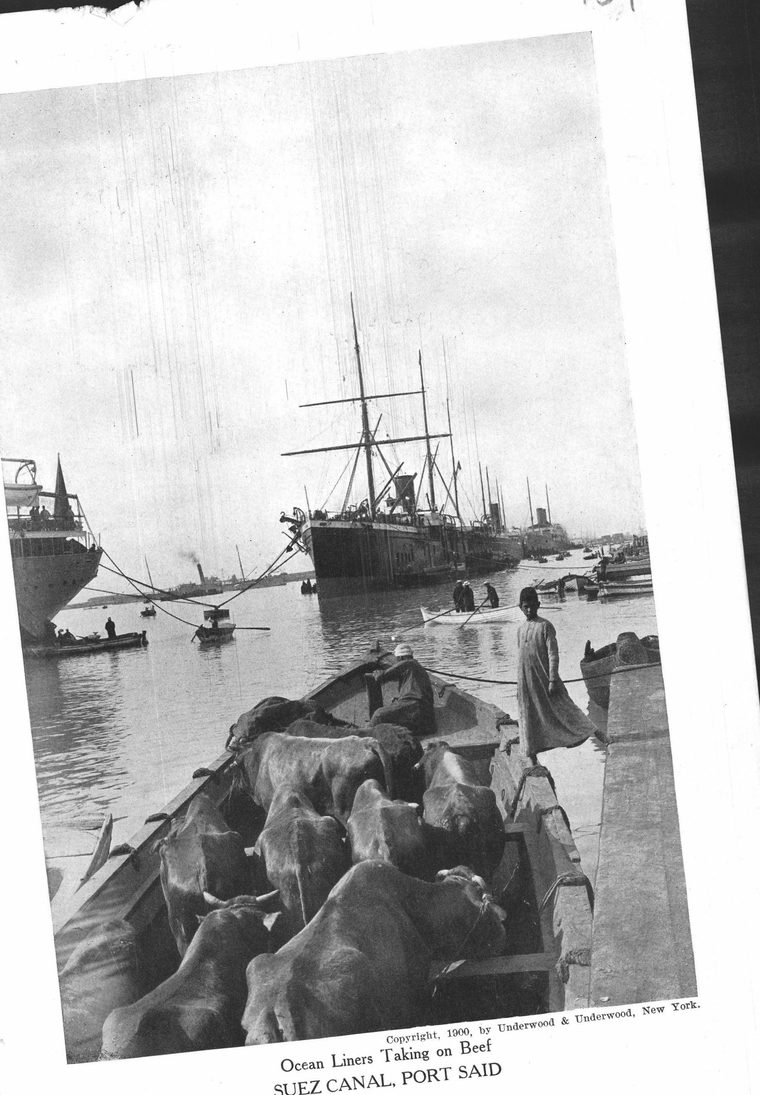
Suez Canal
soo-ez' ka-nal', a ship canal extending across the Isthmus of Suez from Port Said on the Mediterranean to Suez on the Red Sea, ninety-seven miles distant. There is no current. The canal has been deepened since its first construction. It permits the passage of ships drawing twenty-eight feet of water and is seventy-two feet wide at the bottom. The top is from 196 to 327 feet wide, according to the nature of the soil. In places the great ditch is faced with walls of masonry. At one point the contractors were obliged to blast a passage ninety feet deep through a ridge of sandstone. Advantage was taken of the deep beds of dried up lakes. Lake Timsah in particular, near the middle of the Isthmus, has been refilled with sea water and forms a welcome body of water in which the largest ships may pass or anchor. The town of Ismailia has grown up on the western bank of the lake. A fresh water canal forty feet wide and nine feet deep, dug from the Nile to provide the original workmen with water, joins the Suez Canal at this point by locks. It has been extended to Suez on the Red Sea, and a large watermain with frequent plugs was laid in the opposite direction to Port Said. This Nile canal is still utilized. It affords passage for canal boats and, through systems of pipes, it supplies water for irrigation and household purposes in the Suez region.
The Suez Canal Company was organized by Ferdinand de Lesseps, a French engineer, in 1856. Said Pasha of Egypt gave him an exclusive permit and took one-fourth of the stock. Half of the shares were taken in France and a few in England. Work began April 25, 1859. The canal was opened November 17, 1869. The original cost was $100,000,000. Forty million dollars have been spent in improvements. Steam dredges and other labor-saving machinery were employed, but the work was done largely by 80,000 Egyptian fellahs, commanded to labor by the khedive, and by a motley crowd of wretched laborers--Nubians, negroes, Arabs, and Greeks. A large part of the loose sand was carried out in baskets by these laborers.
Port Said has been improved by the construction of extensive breakwaters, basins, quays, a lighthouse, and by the installation of waterworks and electric lights. It is a busy commercial town of 50,000 inhabitants. Suez has similar improvements, including several large dry docks for the repair of steamers.
In 1875 the British government paid the Egyptian ruler $20,000,000 for his interest. Lord Beaconsfield was criticized severely, but these shares would sell for five times that sum today and are yielding an annual dividend of over $5,000,000. The canal is now to all intents and purposes a British waterway. It affords the shortest water route by 5,000 miles between London and Bombay. Over one-half of the Suez patronage is British. Next in order come the ships of Germany, France, Holland, Austria, Russia, and Japan. The United States is represented hardly at all.
While passing through the canal, ships are under control of competent pilots. A Suez pilot is required to speak at least two languages--French and English.
There are about 120 pilots on the canal and they receive an average of $3,000 per year for their services. A pilot receives ten dollars for a night's work. His time of work is regulated by the government. Each pilot takes four or five ships through a part of the canal a week and is required to take several hours' rest after guiding a ship through his district. On the canal proper there are about eighty pilots; twenty of these live at Port Said, forty at Ismailia, and the other twenty at Suez, thus dividing the canal into three districts. Those at Suez and Port Said are engaged in taking the ships out of the port and bringing them in. Those at Ismailia engage in the navigation of the canal proper.
To avoid washing the banks, steamers are required to slow down to six miles an hour. From seventeen to twenty hours are required for a transit. There are frequent widenings to permit large ships to meet and pass. Owing partly to the difficulty of navigation, the Red Sea sailing vessels are no longer allowed in the canal. Laden ships and war vessels pay a toll of 7.75 francs, about $1.47 per ton. Empty ships pay 6.50 francs per ton. Passengers pay ten francs, nearly $2 each. In 1907, 4,273 ships paid $23,200,000. It cost Russia a fortune to send a part of its fleet through the canal on the way to Japanese waters in 1904. In 1905 there were 4,115 transits. The cost of maintaining the canal is about $1,400,000 a year.
Under the terms of a new franchise, obtained in 1910, the charter has been extended to the year 2008. The Egyptian government is to receive $20,000,000 in four payments and in 1921 it will share in the profits on a rising scale, beginning at four per cent and attaining to twelve per cent by 1968. After that, and until the end of the concession, the government is to get half the profits, with the sole restriction that the company's share shall not be less than $10,000,000. Thus, if the funds available for distribution should in any year be less than $20,000,000, the company will appropriate $10,000,000 and the government will get the rest.
See Tonnage; Canal; Sault Ste. Marie; Erie Canal