Tortoises
tor'tises, Terrapins, and Turtles, a large order of land and water reptilians. In size and appearance the members of the order differ almost as much as the fishes; but they possess certain general characteristics. All have genuine backbones. The ribs have widened and grown together, uniting with the breastbone in such a way as to form a case or box of bone, open in front and rear. This case is called a shell. The upper part of the shell is called the carapace; the lower part is called the plastron. Most species are able to withdraw the head, tail, and the feet within the shelter of the shell. The various species are entirely without teeth, but they have strong, horny jaws with edges sharp enough to chisel off and cut up both vegetable and animal food. The tortoises, terrapins, and turtles all dig holes in the earth and deposit leathery eggs, leaving them to be hatched by the heat of the sun. There is great confusion in the common names applied to the different species. The mud-turtle is really a terrapin; the tortoiseshell of commerce is the carapace of a sea turtle, and so on. Authorities propose that the name tortoise be applied to dry land members of the order; terrapin to the pond, river, and swamp species; and turtle to those that frequent the seashore. This use of terms would clear up the situation.
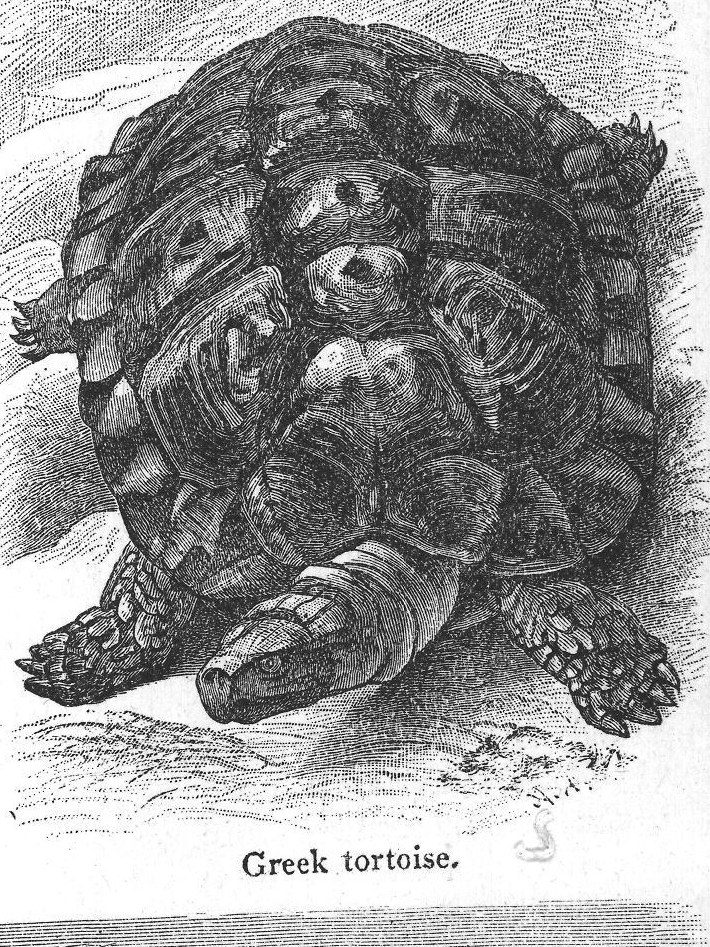
The tortoises, then, are dry land animals. The toes are without web. The species wander about, morning and evening, lifting the shell well from the ground. They search for snails, earthworms, crayfish, grubs, and various fungi. They feed, also, on green plants. The tortoise is supposed to be the longest lived animal, exceeding even the elephant in age. It is believed that some have lived several hundred years. A giant tortoise, thought to be over 400 years old, died recently in the London Zoo-logical Garden. He was brought from the Galapagos Islands in the eighteenth century, and was then regarded as over 200 years old. Drake, as he was called, lived on lettuce. He had the capacity of an ox. Individual tortoises attain a weight of 300 or 400 pounds. The largest of all is the giant tortoise of the Galapagos Islands. It lives chiefly on cacti and coarse grass. A similar tortoise inhabits the Seychelles Islands. A large specimen, known to be 250 years of age, was exhibited at the Louisiana Purchase Exposition held at St. Louis. It came from the Seychelles Islands east of Madagascar. The inhabitants held this venerable tortoise in high respect and were very unwilling to loan it. It was a high favorite at the fair. Children were permitted a ride on its back.
The largest American species is the gopher tortoise of the Gulf States. It weighs from two to fifteen pounds. It has a very heavy, strong shell. It takes its name from a habit of burrowing in the sandy soil of the pine forests which it inhabits. Still another species is the box tortoise. The front and rear ends of the plastron of the box tortoise are hinged to the center. When alarmed the box tortoise draws in its head and feet. It is able to pull up the front end and the rear end of the under shell like the drawbridge of a castle, completely closing each end of the box and excluding the claw of an enemy. Neither the raccoon nor any other natural enemy of the box tortoise is able to pull open the shell. At first sight this tortoise is hardly distinguishable from a terrapin, but it is never known to go near the water.
The tortoise is not unnoticed in literature. The reader will recall the dissatisfied tortoise who begged the eagle to teach him to fly. The eagle good naturedly carried the tortoise aloft and set him adrift, but the tortoise came to his end on the rocks below. The fable of The Hare and the Tortoise, and how the slow tortoise won the race from his sleeping competitor, is also familiar.
The terrapins or "mud-turtles" are numerous. There are many species. Apparently they spend most of their time sitting on logs ready to sllde off into the water. Most of them prefer ponds to running water. In midsummer they seek dry spots, sometimes a mile or two from water, in which to excavate pockets and deposit their eggs. In the autumn they burrow in the mud at the bottom of ponds and lie there like frogs all winter. One terrapin, about six inches in length, is known as the "muskturtle" or "stink-pot," from the musky odor which it emits. It is able to draw the ends of the lower shell inward slightly, somewhat after the manner, only less so, of the box tortoise. Another well known species is the red-bellied terrapin or "slider." It has a reddish plastron, and is always ready to slide into the water. The shell is about a foot long and eight inches wide.
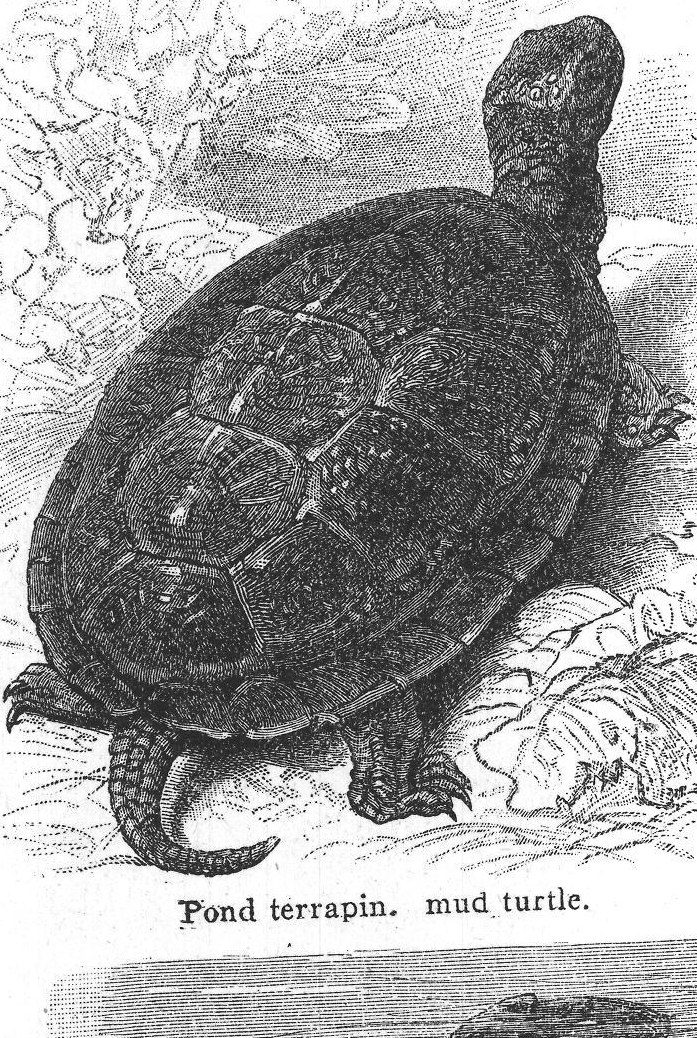
The most widely known of all the terrapins is the common pond terrapin or "mudturtle." It is from six to eight inches in length. As compared with other species it is rather flat. The sections of the carapace are of a greenish black edged with yellow. The outer margin of the carapace is marked with bright red. The under shell is yellow and brown. The legs and tail are marked with red lines. The upper jaw is notched in front.
The diamond-backed terrapin, so called from the shape of the plates of the carapace, is an inhabitant of the salt sea marshes. It was found at one time anywhere along the coast from Massachusetts to Texas, but especially about Chesapeake Bay. It has a high reputation for soup, a fact which has almost caused its extermination. Specimens are now worth from five to ten dollars each in the restaurants of the large cities. Maryland has established a terrapin hatchery. It requires about eighteen years for a diamond-back to grow large enough for the table.
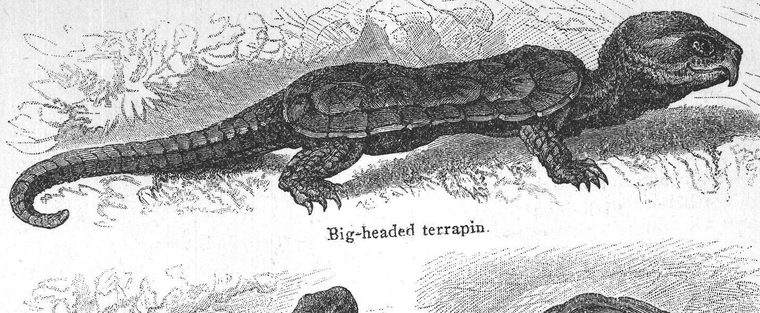
Another species is the alligator terrapin of Louisiana. The upper shell is covered with clumsy projections; the head is large and strong. It attains a weight of from forty to one hundred pounds. It is the largest of the terrapins. The so-called snapping turtle should be known as a snapping terrapin. It has its name from a way of snapping at its food. Both it and the alligator terrapin are accused of stealing young ducks from the surface of ponds. They are wicked, savage creatures, living largely on fish. The moss-back is a sluggish terrapin of inland ponds. It stirs about so little that its back actually becomes covered with a growth of moss. Unprogressive people are known sometimes as "moss-backs."
The soft-shelled terrapin is an inhabitant of the Mississippi and its branches. Both the upper and the lower shell are soft and leathery. The feet are palmated. The animal is an excellent swimmer. It is flat. The shell attains a length of sixteen inches. Large specimens of "soft-shell" weigh forty pounds. It deposits its eggs on sand bars at night; otherwise it is believed never to leave the water.
The turtle is a marine animal of a reptilian nature, closely allied to the tortoise. The turtle's legs are converted into flippers, a long pair in front and a shorter pair in the rear, with toes entirely covered by a skin sack. The bony case of a turtle is too small to allow head and flippers to be drawn entirely within. The turtle is a fine swimmer and lives in the ocean, going ashore only to lay eggs on hot sandy beaches. The turtle comes ashore at night with great caution, selects a spot some distance, it may be, from the water, digs a hole a foot or two deep, deposits fifty to two hundred eggs, one by one, in regular layers, scrapes the sand back into the hole, and smooths the surface so that the eggs cannot be located readily by enemies. She then goes off to sea, leaving her eggs to hatch in the hot sand. The little turtles find their own way out, which they do cheerfully and betake themselves to the ocean. The turtle lays from two to three times each season. The eggs have leathery, somewhat tough shells, and are from two to three inches in diameter. Some turtles feed on shellfish and other animal food. The flesh of such turtles is strong and useless for food. They are hunted for oil only. Most kinds live on seaweed and have tender, well flavored flesh, fit for table use. Turtles' eggs are sought by the islanders for food.
The green turtle of the West Indies is sought for food. Turtle West Indies is sought for food. Turtle steaks and turtle eggs are esteemed great delicacies. The traditional London aldermanic dinner is introduced by green turtle soup. These turtles swim as far north as Great Britain and Long Island Sound, but Ascension Island is the locality most noted for green turtles. They attain a length of five to six feet and weigh from 200 to 600 pounds. They are taken sometimes with a slipnoose or harpoon when apparently asleep on the surface of the ocean, but chiefly by men who lie in wait for them when they come ashore to lay their eggs. The hunters then rush upon them and turn them over on their backs, where they lie helpless till their mates have been secured in similar fashion. The green turtle takes its name from the color of its fat.
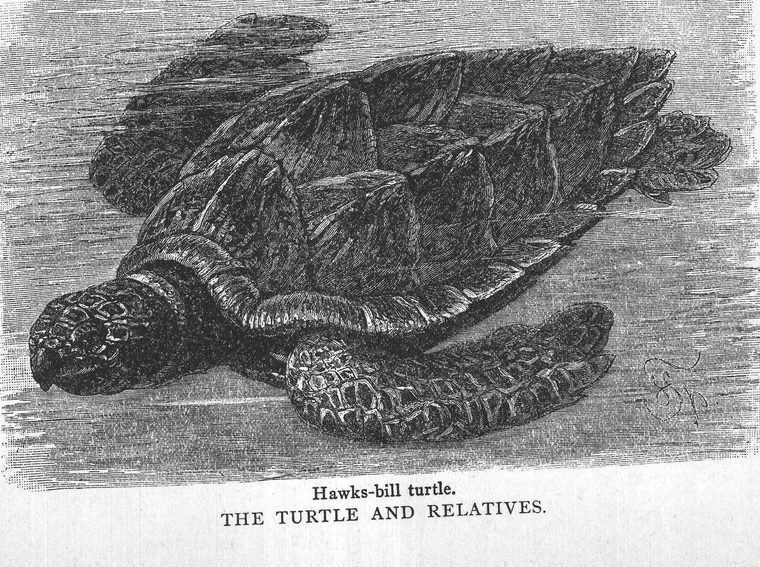
The hawk's-bill turtle of the Red Sea and of tropical waters generally is so called from the shape of its mouth. This turtle is from two to five feet in length. It furnishes the tortoiseshell of commerce. The upper shell is composed of thirteen heavy overlapping plates, with the beautiful cloudy markings so valued in combs and other ornamental articles. Tortoiseshell becomes plastic under heat, and can be pressed flat or into curved molds. Pieces may be soldered together by a hot iron, or by means of heat, heavy pressure, and a glue made from filings of the shell. The largest plates are perhaps six by eighteen inches, and are an eighth of an inch thick. Tortoiseshell is worth several dollars a pound. It is imitated by celluloid.
The loggerhead turtle, found in American waters from Brazil to Cape Cod, attains a weight of 1,100 pounds. Some people claim to enjoy loggerhead steaks. Ordinarily it is useless for food, but it yields oil, and its shell serves a rude civilization for a number of purposes,-tubs, drinking troughs, and the like. It has immense, voracious jaws with which to crush oysters and other shellfish on which it feeds.
The leathery turtle is notable for a leathery covering in place of horny plates. It attains a weight of 800 pounds and has the habits and range of the loggerhead.
See Reptiles