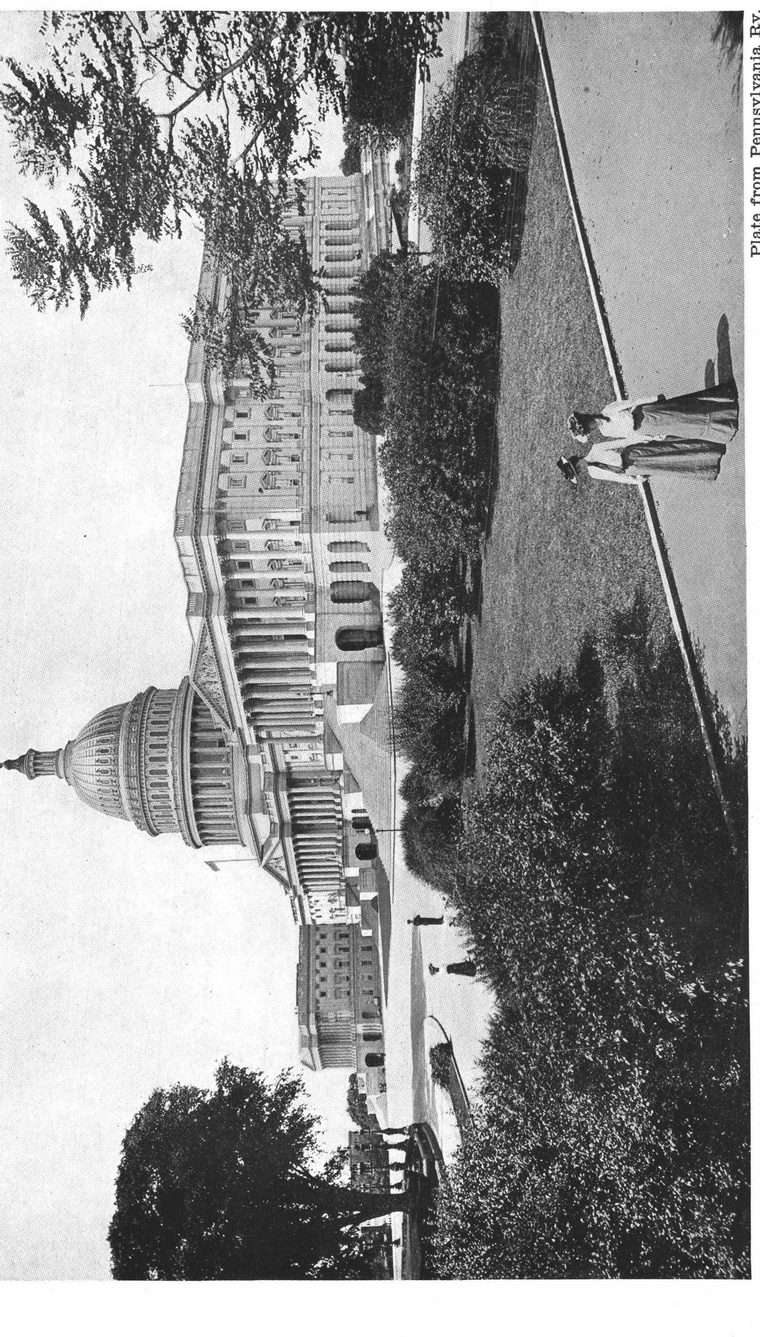
Washington
the capital city of the United States. It is situated on the left bank of the Potomac. The wharves of the city are washed by tide water and are about 100 miles from Chesapeake Bay. For the origin and government of the city, the reader is referred to the article on the DISTRICT OF COLUMBIA. The city was named, of course, for George Washington. He spoke of it modestly as the "Federal City."
The plan of the city is peculiar. First of all, thoroughfares, known as streets, were laid out on north and south and east and west lines, dividing the city into blocks, checkerboard fashion. To render it easy to reach any part of the city, without the loss of time required to travel at right angles, twenty-three diagonal thoroughfares, known as avenues, were laid out. Their intersections form points from which streets and avenues radiate like the spokes of a wheel. Thus large focal squares, like those occupied by the Capitol and the White House, may be approached by a score of streets and avenues. Many blocks are parallelograms; others are split by diagonals into triangles; others have lost a corner, or have but a corner left. The streets running east and west are lettered; those running north and south are numbered. The avenues are named, usually, for the states. The narrowest street is sixty feet wide. Pennsylvania Avenue, leading from the Capitol to the White House, is 160 feet wide. It is one of the great streets of the world. In early days the Portuguese minister dubbed Washington "The City of Magnificent Distances."
The city is well paved, chiefly with noiseless asphalt, and is kept scrupulously clean. Innumerable little corners and parks are beautified by shrubbery and flowers and embellished by bronze statues of distinguished Americans. The grounds of the Soldiers' Home, the National Zoological Garden, the United States Naval Observatory, and especially the White House grounds and the Mall, the latter a tract half a mile wide and extending from the Capitol to the Potomac, are simply delightful in their effect. The roar of wholesale traffic is absent. Public buildings give an air of stateliness. The streets have a gay, holiday appearance. The atmosphere of the city is distinctly American, but the general impression is not unlike that produced by a European capital.
Next to the Capitol in interest is the White House; the residence of the president. The architect was an Irishman. It is understood that the building is modeled after the palace of the Duke of Leinster, near Dublin. It is a stone building 170 feet long and 86 feet deep. It is two stories high. The White House is painted white. It has an Ionic portico on the north front. The original building, begun in 1792 and occupied by John Adams in 1800, was burned by the British in 1814. Four years later the present building was erected. The lower floor is devoted largely to reception rooms. The Blue Room is used for the reception of diplomats; the East Room for the public; the Red Room, with hangings of Pompeian red, is used by the ladies of the family for the reception of callers and for social gatherings. The state dining room, with 1,500 pieces of exquisitely decorated china and table services of silver and cut glass, and the conservatory are on this floor. The president and his family live upstairs. In 1903 a wing was built for office quarters in which the president and his secretaries do their work and may be seen like other business men. The reception rooms are adorned with portraits of the presidents and members of their families. They are open usually to the public. Some presidents used the name Executive Mansion, but President Roosevelt prefered the old name of White House.
The Agricultural Department is a branch of the government service. It has a notable herbarium. The museums have an interesting display of agricultural products illustrating the growth and industrial use of silk, cotton, wool, flax, etc. Silk, for instance, may be seen in all stages of development from the worm to a piece of silk dress goods. The experimental grounds contain many interesting plants. The Botanical Garden contains rare plants from all parts of the world.
The Library of Congress, completed in 1897 at a cost of $6,000,000, is an imposing building with gorgeous inside finish. There are paintings and statuary of merit, half overwhelmed by barbaric decorations in gilt and oppressive design. The Library has fifty miles of shelving and about 1,000,000 volumes. The ultimate capacity is 4,500,000 volumes. Telephones and pneumatic tubes enable the attendant to call for a book in the remotest part of the building and have it on his desk in a few minutes. Books are returned to the stack rooms in the same way. An underground tunnel and an automatic tray carrier enable members of Congress to obtain books for use in the Capitol in a very short time. Books may be consulted freely by the public but may not be borrowed.
The tour of the Treasury Building may be made on any business day. It is a stately pile of sandstone and granite just across the street from the White House. It ranks next to the Capitol in architectural importance. A lofty colonnade of thirty-eight Doric columns marks the front entrance. American and Italian marble have been used lavishly for interior finish. The cash room, or cashier's office, is the first department to attract attention. It resembles a large bank which, in fact, it is, the national banking room. A gallery enables visitors to look down on piles of gold, silver, and currency which assistants are busily paying out on orders presented at the wickets. A visitor desiring the honor of doing business with the government may step up to the proper window, present a greenback or other government note for redemption, and receive the gold or silver it calls for. Currency, postage stamps, and revenue stamps are printed in a separate building. A million dollars' worth of new bills is brought to the treasury daily in a steel wagon attended by armed guards. The notes are counted by expert women and done up in packages for issuance. In a special department, known as the redemption division, old notes are received and exchanged for new. A force of experts is engaged in piecing together bills nibbled by mice, worn and torn currency, bills damaged by fires, chewed by insects, and the like. Old currency is destroyed in a huge steel receptacle called a macerater. It contains water and closely set knives that grind the contents into a fine pulp. Each day at one o'clock four officials, each one with a key, all four keys being required to open the macerater, throw in, it may be and usually is, a million dollars of old paper money, relock and start the mill. It can hold a ton of pulp. June 27, 1894, 151,000,000 dollars' worth of old currency and bonds was destroyed. The exhibit of old coins and of counterfeit notes is interesting. Visitors are shown the entrances to the vaults where 100,000,000 silver dollars and as much gold are guarded night and day. In fact, $800,000,000 is not an unusual sum to have on hand. There are sixty-eight regular watchmen. Arms are at hand to equip 1,000 men. The police department and the army are in close communication. An electric alarm would bring a relief force in a few minutes.
The State, War, and Navy Department is a four storied granite building, possibly the largest office building in the world. There are two miles of marble hallways. The stairways are of granite and bronze, calculated to render the building fireproof. The loss of the records and archives deposited here would be a calamity to civilization. There are priceless historical relics. The original laws of the United States, the crabtree staff of Franklin, the sword of Washington, the desk of Jefferson, the Great Seal of the United States, the Declaration of Independence, national treaties, the proclamations of the presidents, and many an old flag are kept here.
The Patent Office contains half a million models of inventions. Many of historic interest have been transferred to the National Museum. The Pension Bureau, the Dead Letter Office, the Postoffice, the Navy Yard where cannon are built, the Corcoran Gallery of Art, and the Washington Monument, all are of interest.
There were in 1900, 278,718 inhabitants. Of this number 75,572 were colored,--the largest negro community in the world. The population of Washington, according to the census of 1910, was 331,069.
See Capitol; Smithsonian Institution; Pension; Postoffice; Patent; Potomac; Arlington; Mount Vernon