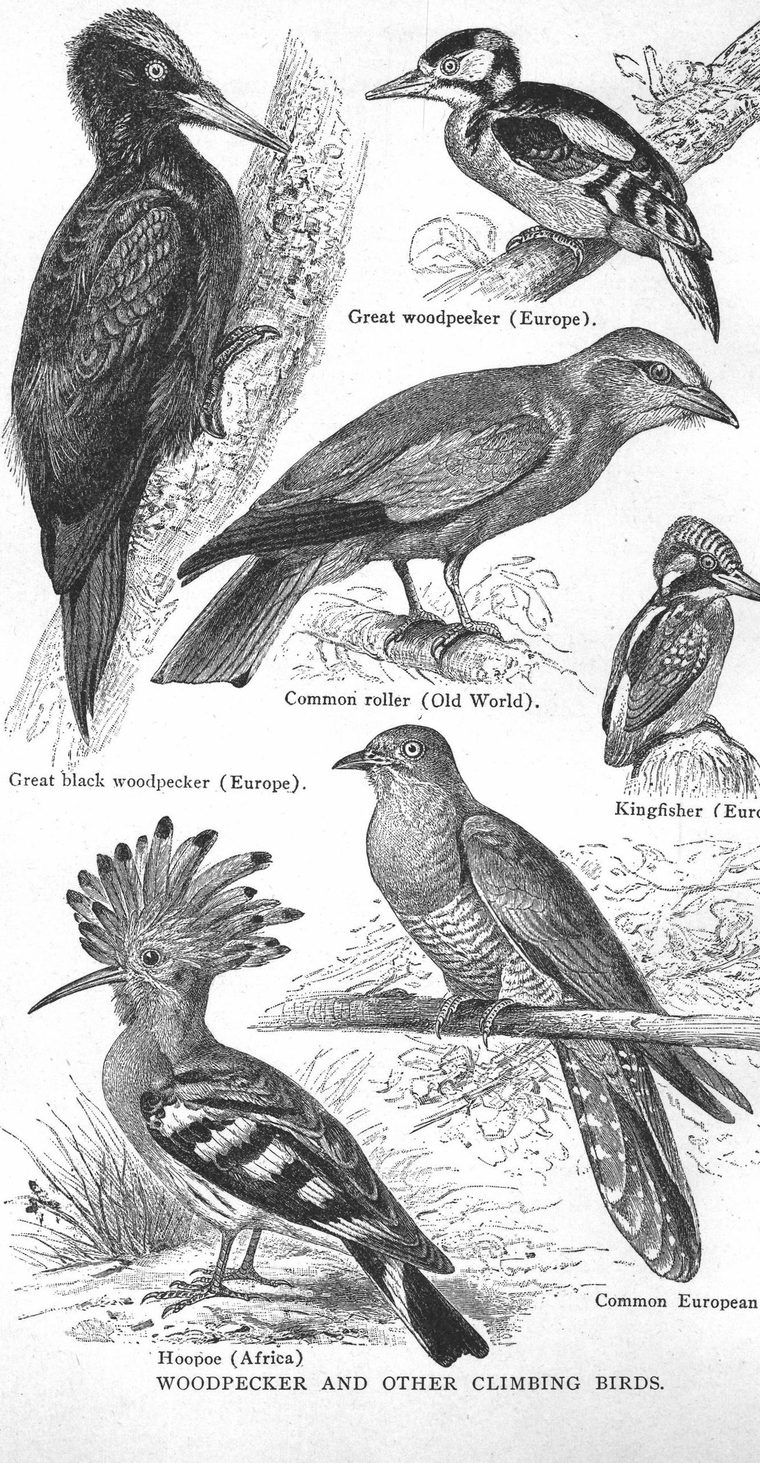
Woodpecker
a family of climbing birds. There are about three hundred species. Woodpeckers are found in all forests save those of Australia and Madagascar. North America has twenty-five species. The woodpecker has a foot designed for climbing. Two toes with sharp claws point forward and two toes, save in a single genus, point backward. With the aid of stiff tail feathers as a brace, it can climb the tallest tree or cling to the under side of a branch, large or small, with perfect safety. The bill is straight and sharp, and is shaped like a chisel or wedge. The muscles of the neck are strong and active. By hammering with the bill the stronger species can drill a hole in any dry tree in the forest. The typical woodpecker locates a grub in an old tree, either by listening or inspecting, then drills a hole until the grub is uncovered, when a long, sticky tongue is darted in and the captive insect is transferred to the crop of the mechanic in the twinkling of an eye.
The high-hole, yellowhammer, or flicker, as it is locally called, is satisfied with berries, insects, and grain obtained more after the manner of sparrows. Ants are its favorite food. The red-headed woodpecker, frequently at least, passes the breeding season in catching caterpillars from vines for the support of self and family. Ants, wasps, beetles, grasshoppers, crickets, moths, caterpillars, spiders, strawberries, cherries, and seeds serve for variety. The yellow-bellied sapsucker drills holes in the bark of trees and sips the sap. The ivory-billed woodpecker, now restricted to the Gulf States, is a magnificent black fellow, twenty inches long, with a scarlet crest and white stripes running from the eyes to the middle of the back. The hairy and the downy' woodpeckers look enough alike to be twins. They follow up the ants and the grubs pretty assiduously. They are familiar in orchards and dooryards. The arctic woodpecker of the northern pines has only one hind toe. The pileated woodpecker, with a scarlet crested head, a white breast, and a dark back, is a fine bird seventeen inches long. It was once common in the forests of North. America but is retiring with the receding forests.
Woodpeckers nest usually in holes of their own drilling in old stumps or partially decayed trees. The American species lay from four to nine uniformly white eggs. The rolling tattoo of the woodpecker is produced by drumming with the bill on a dead limb. It is the call of the male to its mate. The sapsucker, the flicker, and red-headed woodpecker go south in winter. Other species range for food, but cannot be said to migrate.
The red-headed woodpecker of California drills holes in the bark of the pine tree and drives in acorns so tightly that the jay cannot get them out. The Spaniards called it the carpenter. It is supposed that these acorns are drilled in to serve as breeding places for the larvae of insects on which the woodpecker feasts later in the year. Some say the woodpecker, like the jay, stores the acorn for the sake of the kernel itself.
See Flicker