Wren
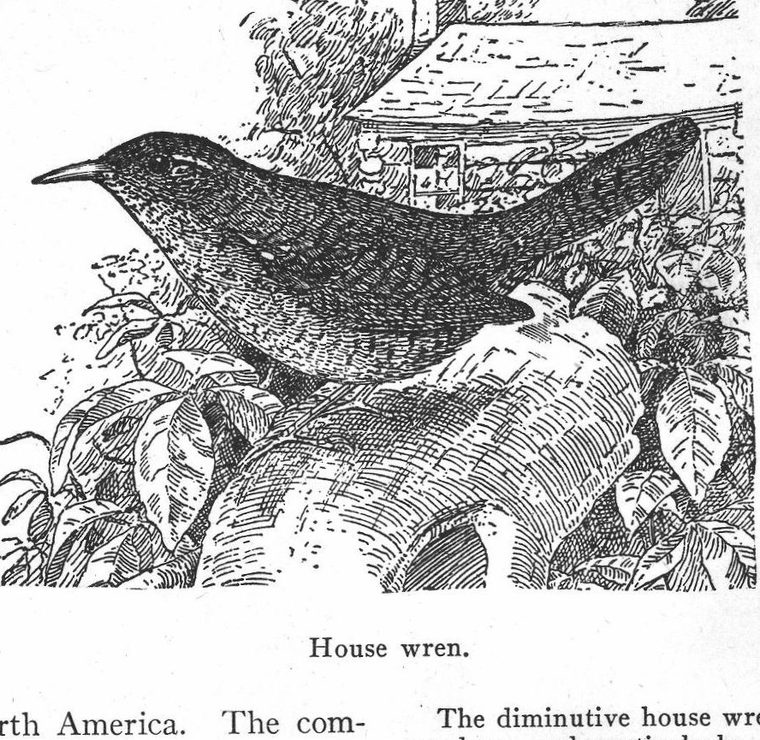
ren, a group of short, excitable birds related to the catbird, the brown thrasher, and the mockingbird. There are five species in North America. The common house wren is the most intimate of all wild birds. It prefers to nest in a bird house and will occupy any old shoe, gourd, jug, box, or other receptacle put on a pole or lodged in the fork of a tree. Failing to find a home prepared, it will seek a crevice in a cornice, a hole in a wall, or a knothole in a rail, post, or log. A hole the size of a silver quarter is just right for a doorway. The common house wren is brown above with a crimson or olive tinge, and with grayish white under parts. This wren carries its short tail straight up in the air and jerks it incessantly. In singing it raises its head, drops its tail, and quivers with energy. In making a nest the amount of apparently needless material gathered is limited only by the size of the cavity. Six to eight wine-colored eggs. Total length of bird, about five inches. It is found throughout eastern North America. The European house wren is well known as Jenny Wren in juvenile literature. The golden-crested wren of England is so small that seventy-two of them weigh only a pound. In France the motherly little house wren is undisturbed. It is called "little king" and "God's little hen." An old Scottish verse runs:
That harry the Ladye of Heaven's hen.
The diminutive house wren frequents barns and gardens, and particularly old orchards in which the trees are partially decayed. He makes his nest in a hollow branch where perhaps a woodpecker had a domicile the year before, but he is a pugnacious character, and if he happens to fancy one of the boxes that are put up for bluebirds, he does not hesitate to take it. He is usually not slow to avail himself of boxes, gourds, tin cans, or empty jars placed for his accommodation.
As regards food habits, the house wren is entirely beneficial. Practically, he may be said to live upon animal food alone, for an examination of fifty-two stomachs showed that ninety-eight per cent of the contents was made up of insects or their allies, and only two per cent was vegetable food, including bits of grass and similar matter, evidently taken by accident with the insects. Half of this food consisted of grasshoppers and beetles; the remainder of caterpillars, bugs, and spiders. As the house wren is a prolific breeder, frequently rearing in a season from twelve to sixteen young, a family of these birds must cause considerable reduction in the number of insects in a garden. Wrens are industrious foragers, searching every tree, shrub, or vine for caterpillars, examining every post and rail of the fence, and every cranny in the wall for insects or spiders.--F. E. L. Beals.