Yellowstone National Park
a government reservation comprising 5,575 square miles. The park lies chiefly in Wyoming, but extends into Idaho and Montana. The first man to see and know any portion of what is now the Yellowstone Park was John Colter. Colter had been with Lewis and Clark at the mouth of the Columbia River, and on the return to Mandan, in 1806, severed his connection with these explorers and retraced his course to the head waters of the Yellowstone. During the summer of 1807 he traversed at least the eastern part of the Yellowstone Park country. The map in the Lewis and Clark report, published in 1814, shows "Colter's Route in 1807." The original park, enlarged in 1891, was set aside by Congress in 1872 as "a public pleasure ground and a game preserve." The park is surrounded by show-clad ranges, know as the Shoshoni, the Big Game, and the Teton. The general elevation of the plateau is 7,800 feet. The surrounding peaks, as Index, Saddle Mount, and Sunlight, are from 10,000 to 12,000 feet in height. The highest peak within the park is the Sheridan, 10,385 feet high. The floor of the plateau is composed of a vast flow of lava. There are a number of extinct volcanic peaks but none are now active. The head waters of the Yellowstone, the Snake, the Lewis, the Madison, and the Shoshoni lie within the park. The largest body of water is Yellowstone Lake. It is drained northward by the Yellowstone River. It flows for ten miles through Grand Canon, the walls of which are in places 2,000 feet high. Yellowstone Falls are about 370 feet high.
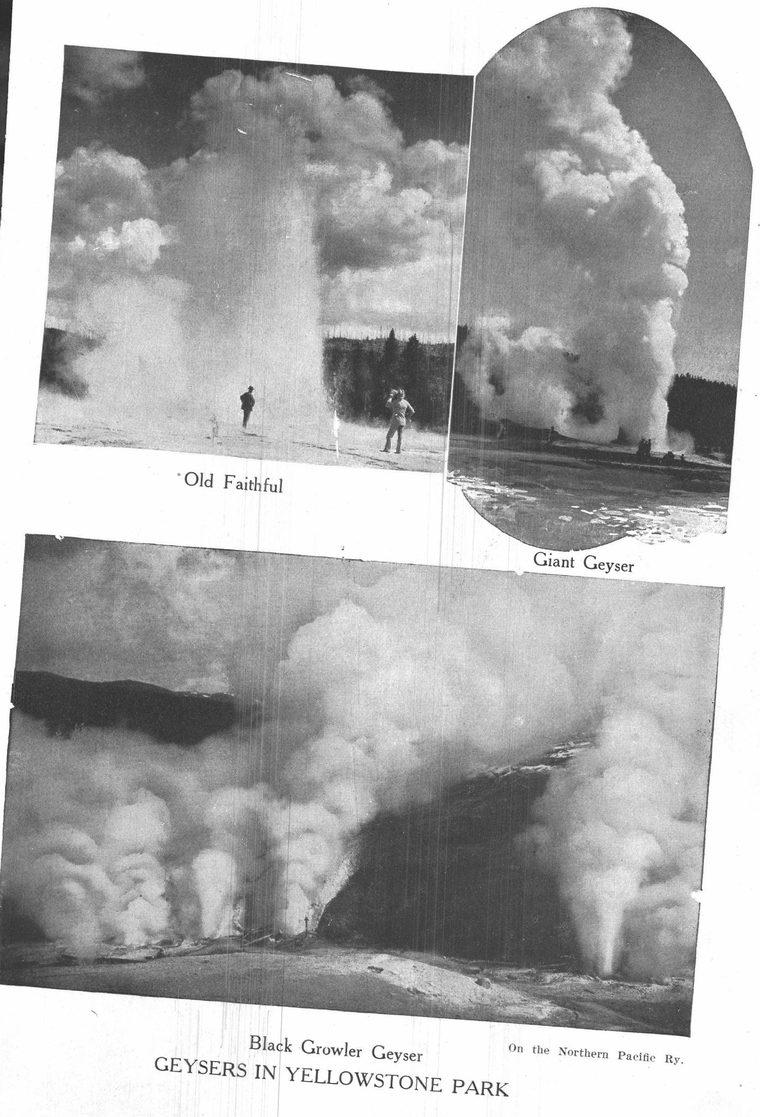
The most singular scenic features of the park are geysers and hot springs. There are three separate geyser basins in the valley of what is known as Fireho River. The larger geysers have received individual names. The Giant and the Giantess have immense craters; the Bee Hive and Castle are so called on account of the shape of their cones. The Sawmill and the Lion have a roaring noise when in action. Old Faithful spouts steam and water at regular intervals of sixty-four minutes. He has not been known to vary. Hell's Half Acre is a crater of hissing steam. The Devil's Paint Pot is so called from the way in which the many colored clays of its basin change their hues. In places the hot waters of the springs leap from one huge cup to another arranged in the form of terraces.
The summits of the mountains are above the timber line; otherwise the park is covered with a growth of evergreen trees, chiefly black pine, spruce, and fir. There are many beautiful mountain flowers. The wild animals of the park are protected by law. None but guards are allowed to carry firearms. One of the few existing herds of buffalo is one of the attractions of the park. Other wild animals are antelopes, elk, various deer, mountain lions, the beaver, moose, mountain sheep, and both the black and the brown bear. The bears, being secure from molestation, become very familiar. Whenever one shows signs of becoming surly or dangerous he is killed by the guards. Fish are abundant in the lakes and streams. Camping parties are allowed to take them with hook and line, but not otherwise. The park may be reached most conveniently by way of Cinnabar over the Northern Pacific. Hotels have been built at national expense near this entrance. They are leased to responsible parties. The entire park has never been explored thoroughly, but a good road has been built through it from north to south. Official stages now make regular trips through the park. Camping parties are permitted to enter with their own supplies and conveyances and to spend as much time as they please within the park. Tourists are required to leave their firearms with the sergeant of the guard.
The rules of Congress forbid the removal of mineral specimens and the defacement of geysers by writing or by breaking off specimens. Parties are permitted to pick up fallen timber for camp fires, but are required to put out their fires before they move on. The hunting or killing of any bird or animal is forbidden. No one is allowed to reside permanently in the park or to engage in any business without express permission from the secretary of the interior. Herding and grazing are forbidden. No saloons, barns, or advertisements are permitted within the boundaries of the park. Persons guilty of disorderly conduct are expelled promptly and may not return without written permission from the authorities at Washington. In 1905 the park was visited by 30,000 persons.