Home › Tables of Weights, Measures, Etc › American Cord-Wood Measure
American Cord-Wood Measure
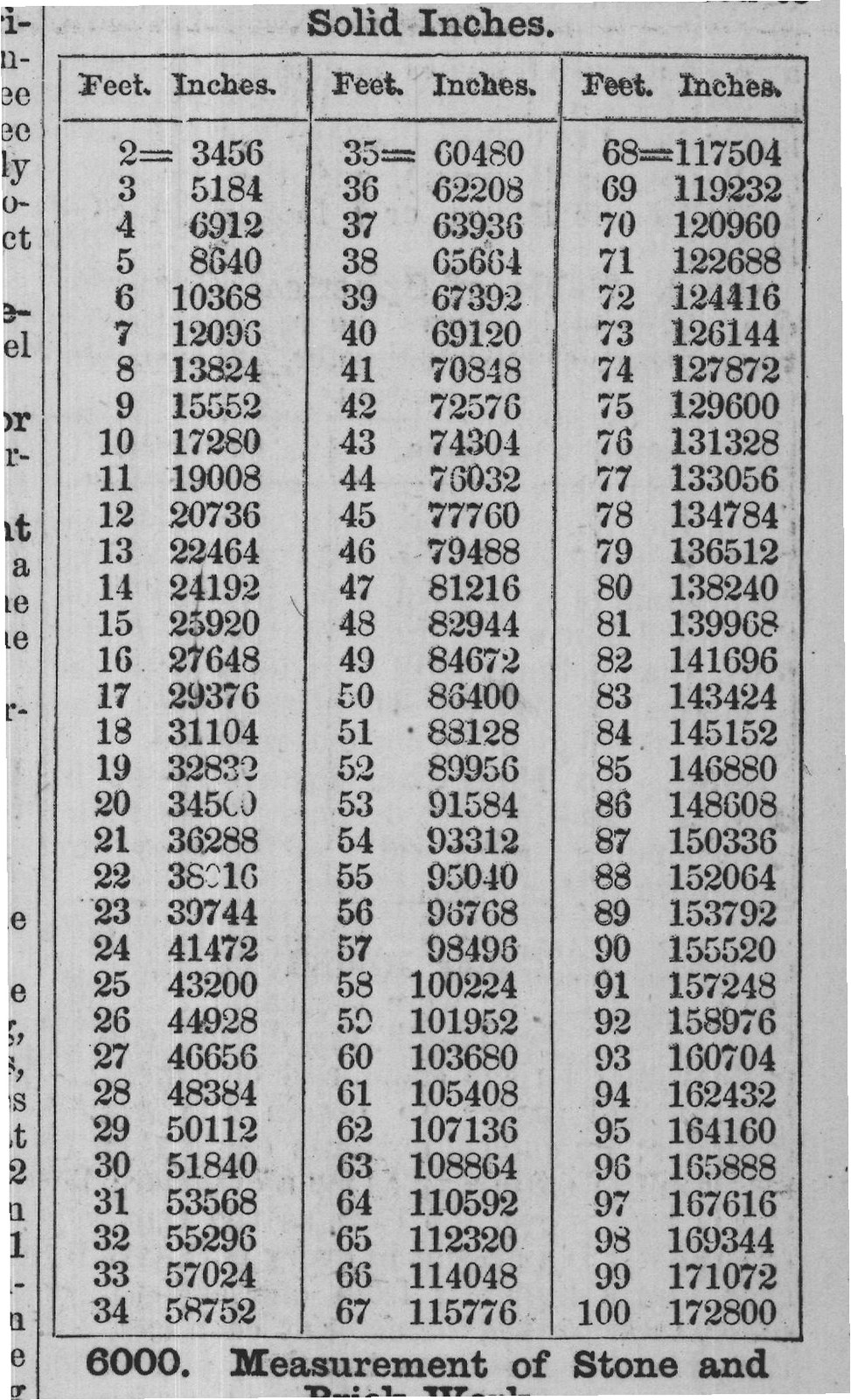
Timber is measured by the ton of 50 cubic feet of round, or 40 cubic feet of hewn timber. Cord-wood is measured by the cord, which consists of a pile 8 lineal feet long and 4 feet high; and, as the wood is reckoned to be 4 feet in length, contains 128 cubic feet. 34 58752 67 115776 100 172800 6000. Measurement of Stone and Brick-Work. “ 16 inches wide, 12 high, 1 feet long, 18 inches wide, 12 high, “ = = or Quarrymen's Measure. {measured in wall. (22 cubic feet. To be { (24.75 cubic feet. To {be be measured in pile. cubic feet. The cubic yard has become the 1 cubic yard = 3 feet×3 feet = 27 standard for all contract work of late years.
Stone walls less than 16 inches thick count thick, each inch additional is measured. as if 16 inches thick to mason; over 16 inches Number of Bricks required in Walls for each 8 Square Foot of Face of Wall.
A stick of cord-wood should measure 4 feet 4 inches from end to compensate for the Thickness of Wall. slope or bevil of the cut, and provide for an 4 inches.. cquivalent of 4 feet of solid wood. The contents of each lineal foot of the length of the 12 pile is called a cord foot, and contains one- 16 eighth part of a cord, or 16 cubic feet. A 20 New York load of wood is one-third of a cord.
A shipping ton contains 42 cubic feet.
Also, the cubic foot being considered unity, Thickness of Wall. “ .. " 7+ 24 inches. 15 28 22+ 32 46 “ 521 “ CO “ “ “ “ ...
Cubic yard = 600 bricks in wall.
Perch (22 cubic feet) = 500 bricks in wall.
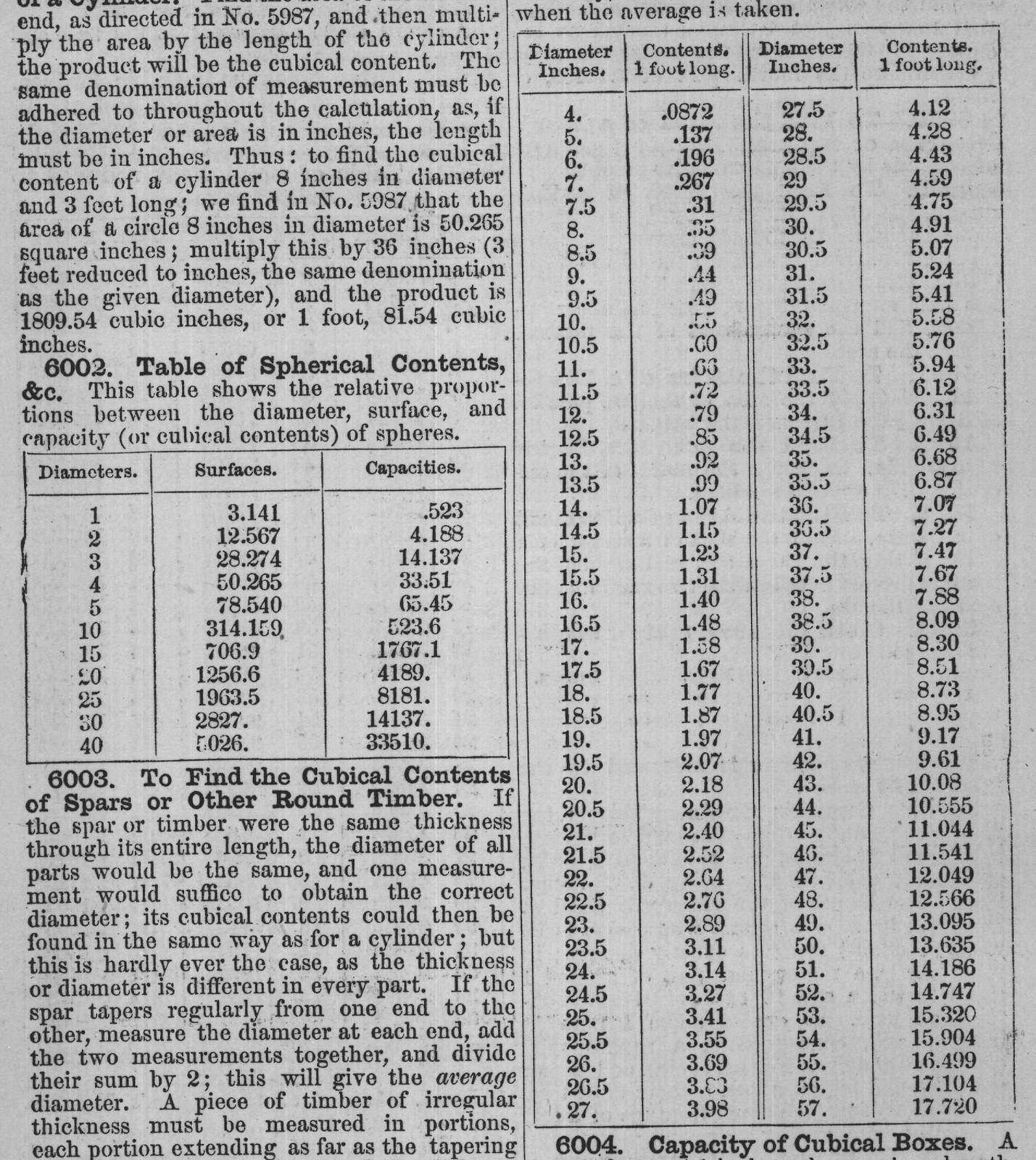
To pave 1 sq. yard on flat requires 41 bricks. " edge “ “ 23 39744 56 96768 89 153792 24 41472 57 98496 90 155520 25 43200 26 44928 27 46656 28 48384 29 50112 30 51840 31 53568 58 100224 50 101952- 60 103680 61 105408 62 107136 63-108864 91 157248 92 158976 93 160704 94 162432 95 164160 32 55296 33 57024 64 110592 65 112320. 96 165888 97 167616 98 169344 66 114048 99 171072 6001. To Find the Cubical Contents the reason that many sticks of timber taper of a Cylinder. Find the area of the circular suddenly, and others are unequal in diameter end, as directed in No. 5987, and then multi- when the average is taken. ply the area by the length of the cylinder; the product will be the cubical content. The same denomination of measurement must be adhered to throughout the calculation, as, if the diameter or area is in inches, the length must be in inches. Thus: to find the cubical content of a cylinder 8 inches in diameter and 3 feet long; we find in No. 5987 that the area of a circle 8 inches in diameter is 50.265 square inches; multiply this by 36 inches (3 feet reduced to inches, the same denomination as the given diameter), and the product is 1809.54 cubic inches, or 1 foot, 81.54 cubic inches.
Diameter Contents.
Inches. 1 foot long.
Diameter Inches.
Contents. 1 foot long. 4. .0872 27.5 4.12 5. .137 28. 4.28 6. .196 28.5 4.43 7. .267 29 4.59 7.5 .31 29.5 4.75 8. 30. 4.91 8.5 .39 30.5 5.07 9. .44 31. 5.24 9.5 .49 31.5 5.41 10. 55 32. 5.58 10.5 .CO 32.5 5.76 6002. Table of Spherical Contents, &c. This table shows the relative proportions between the diameter, surface, and capacity (or cubical contents) of spheres. 11. .66 33. 5.94 11.5 .72 33.5 6.12 12. .79 34. 6.31 12.5 .85 34.5 6.49 Diameters.
Surfaces.
Capacities. 13. .92 35. 6.68 13.5 .99 35.5 6.87 1 3.141 .523 14. 1.07 36. 7.07 2 12.567 4.188 14.5 1.15 36.5 7.27 3 28.274 14.137 15. 1.23 37. 7.47 4 50.265 33.51 15.5 1.31 37.5 7.67 5 78.540 65.45 16. 1.40 38. 7.88 10 314.159 523.6 16.5 1.48 38.5 8.09 15 706.9 1767.1 17. 1.58 39. 8.30 20 1256.6 4189. 17.5 1.67 30.5 8.51 25 1963.5 8181. 18. 1.77 40. 8.73 30 2827. 14137. 18.5 1.87 40.5 8.95 40 5026. 33510. 19. 1.97 41. 9.17 6003. To Find the Cubical Contents of Spars or Other Round Timber. If the spar or timber were the same thickness through its entire length, the diameter of all parts would be the same, and one measurement would suffice to obtain the correct diameter; its cubical contents could then be found in the same way as for a cylinder; but this is hardly ever the case, as the thickness or diameter is different in every part. If the spar tapers regularly from one end to the other, measure the diameter at each end, add the two measurements together, and divide their sum by 2; this will give the average diameter. A piece of timber of irregular thickness must be measured in portions, each portion extending as far as the tapering is regular, and the contents of the different box 1 foot and 1 inch each way, i. e., length, portions added together to get the contents breadth, and depth, will contain 1 standard of the whole. Having obtained the correct bushel. 19.5 2.07 42. 9.61 20. 2.18 43. 10.08 20.5 2.29 44. 10.555 21. 2.40 45. 11.044 21.5 2.52 46. 11.541 22. 2.64 47. 12.049 22.5 2.76 48. 12.566 23. 2.89 49. 13.095 23.5 3.11 50. 13.635 24. 3.14 51. 14.186 24.5 3.27 52. 14.747 25. 3.41 53. 15.320 25.5 3.55 54. 15.904 26. 3.69 55. 16.499 26.5 3.83 56. 17.104 .27. 3.98 57. 17.720