Important: Safety Warning
This page contains a formula or preparation using substances now known to be dangerously toxic, such as arsenic, mercury, lead, or cyanide compounds. Exposure to these substances can cause severe poisoning, permanent injury, or death.
In addition, this page describes trade processes that use dangerously toxic materials such as cyanide solutions, mercury amalgams, or strong acids. These processes require training, equipment, and precautions far beyond what the text describes.
This information has been left in for historical purposes but should not be acted upon.
Home › Electroplating › Electrotyping on Wood
Electrotyping on Wood
Dip the wood in melted wax, then brush over with black-lead until polished; insert a wire of copper, and see that it is also covered with the plumbago, and in contact with that already on the wood; now attach to the pole of the battery, and immerse in the solution of sulphate of copper. The battery should not be silver or gold, which serves as a conducting medium to the copper. This is effected by a solution of phosphorus in sulphuret of carbon.
The solution of phosphorus is prepared by adding to each pound of that substance 15 pounds bisulphuret of carbon, and then thoroughly agitating the mixture; this solution is applicable to various uses, and, amongst others, to obtaining deposits of metal upon non-metallic substances, either by combining it with the substances on which it is to be deposited, as in the case of wax, or by coating the surface thereof. Any of the known preparations of wax may be treated in this way, but the one preferred is composed of from 6 to 8 ounces of the solution, 5 pounds wax, and too strong. 5 pounds deer's fat, melted together at a low heat, on account of the inflammable nature of the phosphorus. The composition thus obtained is acted upon by an electrotyping solution as readily as if it were coated with the black-lead.
Flectroplati lectroplating. The foregoing matter refers to electrotyping, that is, copper-coating, by galvanism. Electroplating, or coating with silver, is conducted in a simi- 3694. To Gild or Silver-Plate Flowers, &c. If the solution of phosphorus (see lar manner to electrotyping as far as general No. 3393) is to be applied to the surface of the principles and manipulation are concerned, article, an addition is made to it of 1 pound but differs in the solutions used, as well as in wax or tallow, 1 pint spirits of turpentine, the preparation of the objects to be electroand 2 ounces pure India-rubber (dissolved plated. with 1 pound asphalt, in bisulphuret of car- 3697. To Prepare Cyanide of Silver. bon), for every pound phosphorus contained First dissolve 1 ounce pure silver in 2 ounces in the solution. The wax and tallow being nitric acid and 2 ounces hot water, after first melted, the solution of India-rubber and which further dilute with 1 quart hot water. asphalt is stirred in; then the turpentine, and The propriety of diluting the nitrate of silver after that the solution of phosphorus is added. before precipitating by the cyanide of po- The solution prepared in this manner is ap- tassium arises from the fact that the salts of plied to the surfaces of non-metallic sub- potash and soda (such as the nitrates, chlor- Stances, such as wood, flowers, etc., by im- ides, and sulphates), when in strong solution, mersion or brushing the article is then immersed in a dilute solution of nitrate of silver or chloride of gold; in a few minutes the surface is covered with a fine film of metal, used must be free from hydrochloric (murisufficient to ensure a deposit of any required atic) acid; to a small quantity of the acid add thickness on the article being connected with a few drops of solution of nitrate of silver; dissolve small quantities of the silver salt, and thus cause a loss, which is prevented by previous dilution with water. The nitric acid if it gives a milky white precipitate, it contains muriatic acid, and should be rejected. Then dissolve 5 ounces cyanide of potassium in 1 quart water. Add this by degrees to the silver solution until the whole of the silver is precipitated, which may be tested thus: Stir the mixture and allow it to settle; then drop into the clear liquid a very small quantity of the second preparation, from the end of a glass rod; if the clear liquid is rendered turbid, it is a proof that the whole of the silver is not separated; but if the liquid remains unchanged, it shows that the silver is entirely separated. The clear liquid is then to be 3700. Solution Made with Oxide of Silver. A good silver solution for electroplating white metal and brass is made by dissolving 1 part oxide of silver in 8 parts cyanide of potassium and 64 parts warm water. Oxide of silver is made by precipitating a solution of the nitrate by a dissolved alkali like potassa or baryta.
3701. To Make Silver Solution by the Battery. The best and cheapest method of making up the silver solution is by the battery, which saves all expense of acids and the labor of precipitation. To prepare a silver solution which is intended to have an poured off, and the precipitate, which is cyan- ounce of silver to the gallon, dissolve 123 ide of silver, washed at least 4 times in hot ounces cyanide of potassium in 100 gallons water, dried and bottled for use. The use water; get one or two flat porous vessels, and handling of cyanide of potassium requires submerge them in this solution to within half great caution, as 11 grains of it are sufficient an inch of the rim, and fill them to the same to kill a grown person. The fumes thrown height with the solution; in these porous off while dissolving the silver in nitric acid are also highly deleterious, and must not be inhaled; it is better, therefore, not to dissolve silver in a close room. vessels place small plates or sheets of iron or copper, and connect them with the zinc pole of a battery; in the solution outside the shallow vessels place a sheet or sheets of
3698. Το Make Silver Solution. The silver connected with the silver pole of the solution of silver used for plating consists of battery. This arrangement being made at cyanide of silver dissolved in potassium, add- night, and the power employed being a ing a solution of cyanide of potassium to the Smee's battery of 6 cells, the zincs 7 inches cyanide of silver until it is all dissolved. The square, it will be found in the morning resulting solution constitutes the cyanide of that there will be dissolved 60 to 80 ounces potassium and silver, and forms the plating of silver from the sheets. The solution is now solution. It ought to be filtered previous to ready for use; and by observing that the using, as there is always formed a black sedi- articles to be plated have less surface than ment, composed of iron, silver, and cyanogen, the silver plate forming the positive electrode, which, if left in the solution, would fall upon for the first two days, the solution will then the surface of the article receiving the deposit, have the proper quantity of silver in it. Ocand make it rough. The sediment, however, casionally a little silver is found in the must not be thrown away, as it contains sil- porous cell; it is therefore not advisable to ver. The cyanide of potassium, used to dis- throw away the solution in them without solve the cyanide of silver, may be so diluted first testing it for silver, which is done by that the plating solution, when formed, shall adding a little muriatic acid to it. The amacontain 1 ounce of silver in the gallon; of teur electrotypist may, from this description, course the proportion of silver may be larger make up a small quantity of solution for silor smaller, but that given is best for plating. vering his medals or figures. For example, a half-ounce of silver to the gallon of solution will do very well; a small quantity may be prepared in little more than an hour. As the cyanide of potassium dissolves silver without the aid of a battery, a plating liquor may be formed by merely allowing a piece of silver to steep in this solution for a few days; but this is tedious and uncertain, although for small operations, and where porous vessels are not convenient, it will serve the purpose.
In dissolving 100 ounces of silver, the following proportions of each ingredient are those which have been found in practice to be the best. Take 7 pounds of the best nitric acid, and 61 ounces of cyanide of potassium, of the average quality; this quantity will precipitate the 100 ounces of silver dissolved in the acid solution. After this is washed, take 62 ounces more of cyanide of potassium, the solution of which will dissolve the precipitate; this being done, the plating solution is then form- 3702. Το Recover Silver from Solued. Of course these proportions will vary tion. When a silver solution gets out of according to the difference in the quality of order, and cannot be rendered fit for use the materials; but they will serve to give an again, the silver may be recovered by adding idea of the cost of the silver solution prepared to the solution any acid that will neutralize in this manner. the alkali; if nitric or sulphuric acid be used,
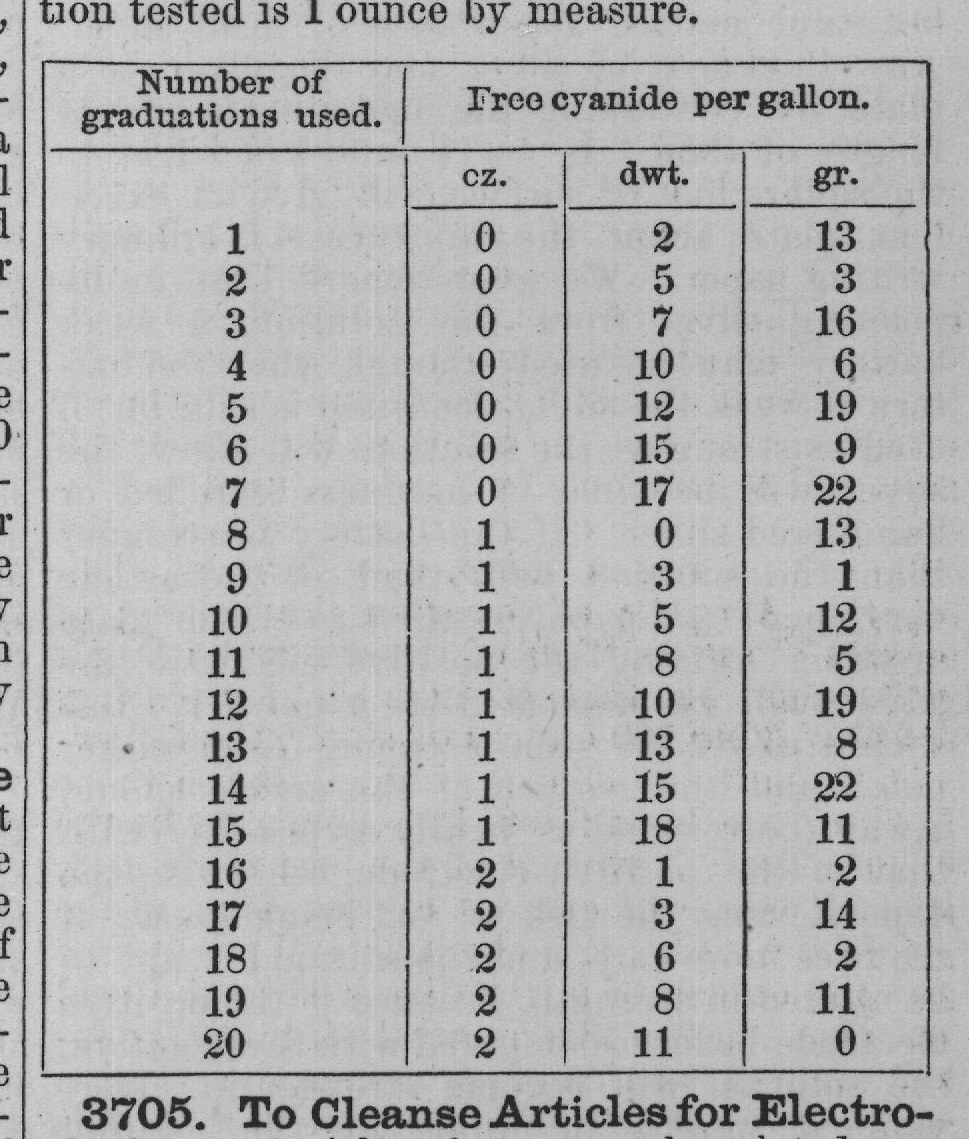
3699. To Dissolve Cyanide of Silver the silver precipitates as cyanide, but if hydroin Yellow Prussiate of Potash. Dissolve chloric acid be used, the silver will be prethe cyanide of silver by yellow prussiate of cipitated as a chloride; in either case the potash (ferrocyanide of potassium), 3 pounds solution should be diluted, or a portion of the of which are required to dissolve 1 ounce of precipitate will be redissolved. The precipisilver. This forms an excellent plating solu- tate is allowed to deposit, the clear liquor detion, and yields a beautiful surface of silver. canted, and the vessel filled with water to It must have a weak battery power, and con- wash the precipitate, which is afterwards colsequently the silver is very soft. The posi- lected upon a filter and dried, and then mixed tive electrode does not dissolve in this solution; with twice its weight of carbonate of potash, there is formed upon its surface a white scaly and fused in a Hessian crucible for 15 min crust, which drops off and falls to the bottom; utes, or until the fused fluid ceases to ef and the solution soon becomes exhausted of fervesce. On removing the crucible, ard silver, and will need to be renewed. pouring the whole into an iron ladle, when cool the silver will be found in the metallic is known by taking some nitrate of silver, state at the bottom of the ladle. In these dissolving it in distilled water and placing it operations, when pouring the acid into the in a common alkalimeter (see No. 82), graducyanide solution, great care must be taken ated into 100 parts. The proportion of the not to inhale the fumes given off, which are nitrate of silver in the solution is to be such very abundant and poisonous. The operation that every two graduations of the solution should be done in the open open air, and even then should contain 1 grain. A given quantity of it is bad. Instead of throwing down the the plating solution is now taken-say 1 silver by an acid, it is better to evaporate the ounce by measure, and the test solution of solution to dryness, and to fuse the product nitrate of silver is added to it by degrees, so as described; in which case the cyanide is an long as the precipitate formed is redissolved. cxcellent reducing flux, requiring no addition When this ceases the number of graduations of carbonate of potash, and saves the necessity of evolving poisonous fumes. 3703. Test for Free Cyanide of Potassium in Solutions. If we dissolve a small quantity of sulphate of copper and add to it an excess of ammonia, there is produced a deep blue color. Cyanide of potassium will destroy the blue color, in a fixed chemical proportion. To obtain this proportion, take is then noted, and the following equation gives the quantity of free cyanide. Every 175 nitrate of silver are equal to 130 cyanide of potassium in solution. Suppose 20 graduations were taken, equal to 10 grains nitrate of silver, then 175: 130 :: 10: 7.4 grains free cyanide of potassium. This, multiplied by 160, the number of fluid ounces per gallon, will make about 24 ounces. We have taken ten grains of pure cyanide of potassium and 2 graduations to 1 grain of nitrate of silver, dissolve in water; then take a certain quan- that the solution may be considerably dilute tity, say 100 grains, of sulphate of copper, and and less liable to error. The following table convert it into ammoniuret, the whole meas- is calculated at a half grain nitrate of silver to uring a given quantity, and pour from an the graduation, and will be a guide to the alkalimeter this blue liquor into the cyanide student or workman. The quantity of soluof potassium till it ceases to destroy the color, tion tested is 1 ounce by measure. then mark the number of graduations required, and that amount of copper solution will represent 10 grains cyanide of potassium-a quantitative test will thus be got for the full cyanide of potassium in the solution, and should be used as follows: Say that the color of 60 graduations of the blue solution was destroyed by the 10 grains of cyanide of potassium; then, to test the quantity of free cyanide of potassium in the plating solution, take 60 graduations of the blue liquor in any convenient vessel, and add to it from an alkalimeter the plating solution, till the color of the blue liquor is destroyed, then note the quantity which contains 10 grains free cyanide, from which the quantity in the whole solution may be calculated. 3704. Test for the Quantity of Free Cyanide of Potassium in Solutions. It has been already mentioned that the cyanide of silver, as it forms upon the surface of the silver plate, is dissolved by the cyanide of potassium. This renders it necessary to have always in the solution free cyanide of potassium. Were we to use the pure crystalline calt of cyanide of potassium and silver, dis- Number of graduations used.
Free cyanide per gallon.
CZ. dwt. gr. 1 0 2 13 2 0 5 3 3 0 7 16 4 0 10 6 5 0 12 19 6 0 15 9 7 0 17 22 8 1 0 13 9 1 3 1 10 1 5 12 11 1 8 5 12 1 10 19 13 1 13 8 14 1 15 22 15 18 11 16 1 2 17 3 14 18 6 2 19 8 11 20 11 0 3705. Το Cleanse Articles for Electro- 2 2 2 1 solved in water, without any free cyanide of plating. Articles that are to be plated are potassium, we should not obtain a deposit be- first boiled in an alkaline lye, to free them from yond a momentary blush, as the silver plate grease, then washed from the lye, and dipped or electrode would get an instantaneous coat- into dilute nitric acid, which removes any ing of cyanide of silver, and this not being oxide that may may be formed upon the surface; Cissolved, the current would stop. The they are afterwards brushed over with a hard quantity of free cyanide of potassium required brush and fine sand. (See No. 3381.) The in the solution varies according to the alkaline lye should be in a caustic state, which amount of silver that is present, and the is easily effected by boiling the carbonated rapidity of the deposition. If there be too alkali with slacked lime, until, on the addition little of it, the deposit will go on slowly; if of a little acid to a small drop of the solution, there be too much, the silver plate will be dis- no effervescence occurs. (See No. 101.) The colved in greater proportion than the quantity lime is then allowed to settle, and the clear deposited, and the solution will consequently liquor is fit for use. The lye should have get stronger. The proportion we have found about 1/2 pound soda-ash, or pearl-ash, to the best is about half by weight of free cyanide of gallon of water. The nitric acid, into which potassium to the quantity of silver in solu- the article is dipped, may be diluted to such tion; thus, if the solution contains 2 ounces an extent that it will merely act upon the of silver to the gallon, it should have 1 ounce metal. Any old acid will do for this purpose. of free cyanide of potassium per gallon. This In large factories the acid used for dipping before plating is generally afterwards em- thus dissolved will do for a long time, though ployed for the above purpose of cleaning. the liquor is used every day. When the
3706. To Prepare Articles for the mercury in this solution is exhausted, it is Decomposing Cell. The article being thor- liable to turn the article black upon being oughly cleaned and dried, has a copper wire dipped into it; this must be avoided, as in attached to it, either by twisting it round the that case it also causes the deposited metal to article or putting it through any open part of strip off. it, to maintain it in suspension. It is then 3708. To Preserve the Dead, Matted dipped into nitric acid as quickly as possible, Appearance of Silver after Electroplaand washed through water, and then immersed ting. If it is desired to preserve the surface in the decomposing cell containing silver solu- in this condition, the article must be taken tion, suspending it by the wire which con- out of the electroplating solution, care being nects with the zinc pole of the battery. The taken not to touch it by the hand, and imnitric acid generally used and found best for mersed in boiling distilled water for a few dipping has a specific gravity 1.518, and con- minutes. On being withdrawn, sufficient heat tains 10 per cent. sulphuric acid. The article has been imparted to the metal to dry it inis instantaneously coated with silver, and stantly. If it is a medal, it ought to be put ought to be taken out after a few seconds and in an air-tight frame immediately, or if a well brushed. On a large scale, brushes of figure, it may be at once placed under a glass brass wire attached to a lathe are used for this shade, as a very few days' exposure to the air purpose; but a hard hair brush with a little tarnishes it, by the formation of sulphuret of fine sand will do for small work. This brush- silver, especially in a room where there is fire ing is used in case any particle of foreign or gas. matter may be still on the surface. It is then 3709. To Remove the Chalky Apreplaced in the solution, and in the course of pearance of Silver after Plating. When a few hours a coating of the thickness of articles are taken out of the electroplating tissue paper is deposited on it, having the solution they are swilled in water, and then beautiful matted appearance of dead silver. put into boiling water. They are afterwards Any thickness of silver may be given to a put into hot sawdust, which dries them perplate by continuing the operation a proper fectly. Their color is chalk-white. They are length of time. 14 to 1 ounces of silver to generally weighed before being scratchthe square foot of surface will give an excel- brushed; that is, brushed with fine wire lent plate about the thickness of ordinary brushes (see Nos. 3381 and 3706), and old ale; writing paper. We may remark that, in de- beer, or water containing in solution a little positing silver from the solution, a weak gum, glue, or sugar, but the amateur may battery may be used; though when the bat- use a hard hair brush. It may be afterwards tery is weak the silver deposited is soft, but if burnished according to the usual method of used as strong as the solution will allow, the burnishing, by rubbing the surface with con. silver will be equal in hardness to rolled or siderable pressure with polished steel or the hammered silver. If the battery is stronger mineral termed bloodstone. Although this than the solution will stand, or the article very small compared to the size of the plate of silver forming the positive electrode, the silver will be deposited as a powder. Gas should never be seen escaping from either pole; and the surface of the article should always correspond as nearly as possible with that of the positive electrode, otherwise the deposit runs the risk of not being good; it requires more care, and the solution is apt to be altered in strength, because if the positive electrode be large compared with the negative, the solution will become stronger in silver, while if smaller in proportion the solution will become exhausted of silver. 3707. To Silver-plate Large Articles (such as those plated in factories), it is not always sufficient to dip them in nitric acid; wash and immerse them in the solution, in order to effect a perfect adhesion of the two metals. To secure this, a small portion of operation does not displace any of the silver, still, in taking off the chalky appearance, there is a slight loss of weight. The appearance after scratching is that of bright metallic silver.
3710. To Increase the Brightness of the Deposit. A little sulphuret of carbon added to the plating solution prevents the chalky appearance, and gives the deposit the appearance of metallic silver; the reaction which takes place in this mixture is not yet understood. The best method of applying the sulphuret of carbon is to put one or two ounces into a large bottle, then fill it with strong silver solution having an excess of cyanide of potassium, and let it repose for several days, shaking it occasionally. A little of this silver solution is added, as required, to this plating solution, which will give the articles plated the same appearance as if scratched. It is also found that the presence of sulphuret of quicksilver is dissolved in nitric acid, and a carbon prevents the solution from going out little of this solution is added to water, in of order; indeed, we have seen a solution that sufficient quantity to enable it to give a white has been constantly working from two to silvery tint to a piece of copper when dipped three years, while, generally, they were subinto it; the article then, whether made of ject to go out of order for a time, in less than copper, brass, or German silver, after being one year-although, after standing a time, dipped in the nitric acid and washed, is dip- they would recover-but these are curious reped into the nitrate of mercury solution till the surface is white; it is then well washed by plunging it into two separate vessels containing clean water, and finally put into the plating solution. This secures perfect adhe- tallic alloys, two solutions of silver are resion of the metals. One ounce of quicksilver quisite; the first, to whiten or fix the silver actions not yet investigated. 3711. To Insure Success in the Electroplating Process. In order to insure success in silver-plating upon metals and me to such metals as iron, steel, britannia metal, the vessel. The silver being removed, the and German silver; the second, to finish the article is well washed and then passed through work, as any amount of pure silver can be de- the potash solution, and finished for plating. posited from the second solution.
When the sulphuric acid becomes saturated