Important: Safety Warning
This page describes trade processes that use dangerously toxic materials such as cyanide solutions, mercury amalgams, or strong acids. These processes require training, equipment, and precautions far beyond what the text describes.
This information has been left in for historical purposes but should not be acted upon.
Home › Electrotyping › Electrotyping with a Battery
Electrotyping with a Battery
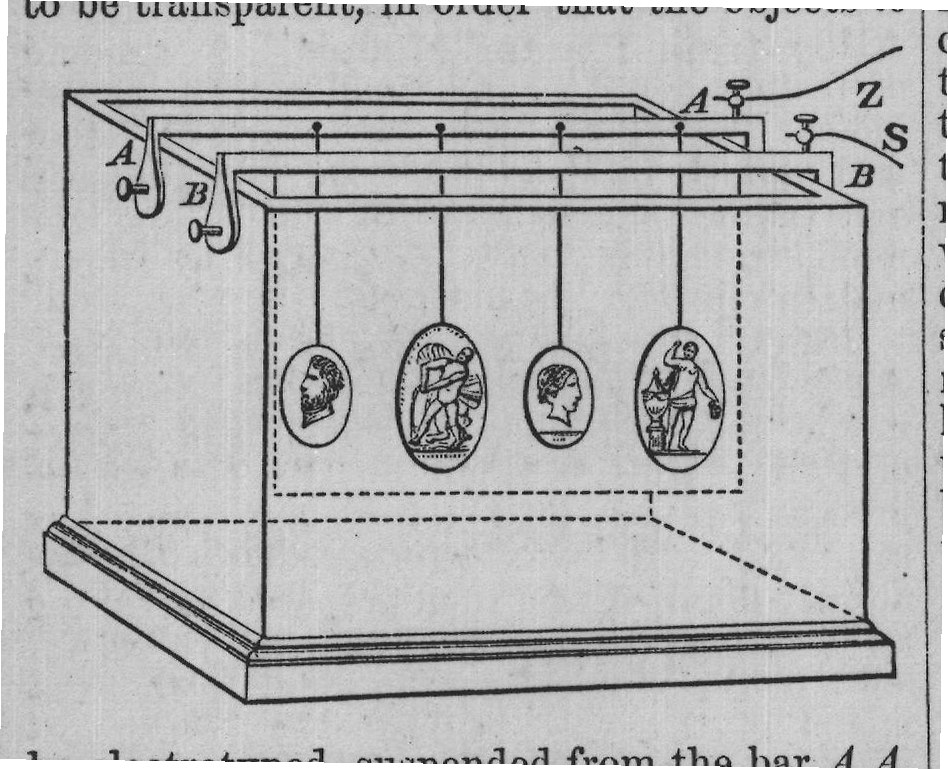
For this purpose a Smee's battery (sce No. 3667) is usually employed, in connection with a decomposing cell. (See No. 3664.) As the method for electrotyping, or coating with copper, is substantially the same as for other metals, a description of the first will suffice.
The decomposing cell being charged with a solution of sulphate of copper (see No. 3661), the object, duly prepared (see No. 3689), to be electrotyped, is properly secured in position, and connected with the cathode or wire leading from the zine plates of the battery. To the anode or wire leading from the silver plate, a positive electrode, consisting of a piece of the same metal as the solution contains (in this case, copper), is attached, and immersed in the solution, face to face with the object to be electrotyped; as the copper from the solution is precipitated on the object, the piece of copper is dissolved, and thus number of objects may be electrotyped in the same decomposing cell, provided that each is connected with the zinc pole of the battery, 3669. Electrotyping by the Single Cell Process. This is an adaptation of keeps up the strength of the solution. Any Daniell's cell to the purposes of electrotyping, and dispenses with any separate decomposing cell; in fact it is a galvanic battery and a decomposing cell combined in one, and is useful, and hangs facing a positive electrode. The for small objects, from its simplicity.
About usual arrangement for this purpose consists of fill a large jar (a preserve jar without any a water-tight trough of suitable size and neck is best), with a solution of sulphate of shape (usually obloug), to contain the copper is best), with a solution of sulphate of shape (usually oblong), to contain the copper copper (see No. 3661); insert in this a small or other metallic solution, and is provided tubular porous vessel of about the same with metal bars, long enough to reach the height as the jar ( these porous tubes can be length of the trough and rest on the upper found at any store where chemical apparatus edge at each end; the bars rest on dry varnished blocks of wood, and are laid pa- of one side of the coin. With care, any numrallel to each other at a distance of 3 or more ber of duplicates may be taken from this inches apart, according as the space between mould, if it be properly coated. them is required. Plates of copper of nearly 3673. Coating for Copper Moulds. the same length as the trough are suspended Take a gill of rectified spirits of turpentine, from the bars, and submerged in the solution and add to it about the size of an ordinary parallel with them. These bars, and conse- pea of bees' wax. When this is dissolved, wet quently the copper plates (which constitute over the surface of the mould with it, and continuous positive electrodes) are connected then allow it to dry: the mould is then ready with copper wire or ribbons to the anode, or silver pole of the battery. Alternately between these bars, other bars are placed, exactly similarly, arranged, but having small projections or buttons on one of their sides, to to put into the solution. Medals taken from moulds so prepared retain their beautifully bright color for a long time. But when fine line engravings are to be coated, the little wax dissolved in the turpentine may be obwhich the objects to be electrotyped are jectionable; so also is black lead, for both secured by a wire, and suspended in the solu- have a tendency to fill up the fine lines. In tion, face to face with its corresponding cop- this case, let the turpentine wash be wiped per plate. These latter bars are connnected off with a silk handkerchief, instead of drying with the cathode or zinc pole of the battery. it; but for ordinary medals this objection It will thus be evident that each contiguous will scarcely apply. pair of bars are mutually positive and negative electrodes, and the objects on the one must closely face the copper plate on the other. The accompanying cut will give some lowing manner: Put some common virgin idea of the arrangement of one pair of bars.
BB is the bar connected by the wire S with the silver pole of the battery, and supporting a plate of copper suspended in the trough. In the cut, the copper is supposed to be transparent, in order that the objects to A B Z B
3674. Preparation of Wax for Taking Moulds. Whether the bees' wax have stearine in it or not, it is best to prepare it in the folwax into an earthenware pot or pipkin, and place it over a slow fire; and when it is all melted, stir into it a little white lead (flake white), or black lead (plumbago), say about 1 ounce white lead to the pound of wax; this mixture tends to prevent the mould from cracking in the cooling, and from floating in the solution; the mixture should be re-melted s two or three times before using it for the first Stime. Resin has been recommended as a mixture with wax; mixtures of which, in various proportions, have been used with success; but when often used, decomposition cr some change takes place, which makes the mixture granular and flexible, rendering it less useful for taking moulds. When resin is used, the mixture, when first melted, should be boiled, or nearly so, and kept at that heat until effervescence ceases; it is then to be poured out upon a flat plate to cool, after which it may be used as described. be electrotyped, suspended from the bar A A, may be visible; they are supposed to be behind and closely facing the copper plate. The bar A A is connected by the wire Z to the zinc pole of the battery.
3672. To Obtain a Copper Mould of a Coin. A fine copper wire must be put round the edge of the coin and fastened by twisting. Then cover the back part, and the wire, upon which the deposit is not required, 3675. Το Take Moulds in Wax. The medal to be copied must be brushed over with a little sweet oil: a soft brush, called a painter's sash tool, suits this purpose well: care must be taken to brush the oil well into all parts of the medal, after which the superfluous oil must be wiped off with a piece of cotton or cotton wool. If the medal has a bright polished surface, very little oil is required, but if the surface be matted or dead, it requires more care with the oil. A slip of card-board or tin is now bound round the with bees' wax or tallow, or, what is better, edge of the medal, the edge of which slip imbed the back of the coin in gutta percha. should rise about one-fourth of an inch higher Have the fore part or face well cleaned, and than the highest part on the face of the the surface moistened with sweet oil, by a medal. This done, hold the medal with its camel's-hair pencil, and then cleaned off by a rim a little sloping, then pour the wax in the silk cloth, till the surface appears dry or, in- lowest portion, and gently bring it level, SO bring it level, so stead of oil, the surface may be brushed over that the melted wax may gradually flow over; with black lead, which will impart to it a this will prevent the formation of air-bubbles . bronze appearance. The use of the oil or Care must be taken not to pour the wax on black lead is to prevent the deposit adhering too hot, as that is one great cause of failure in to the face of the coin. The coin is now ready getting good moulds; it should be poured on to be subjected to the single cell process (see just as it is beginning to set in the dish. As No. 3669), by which means a perfect counter- soon as the composition poured on the medal part or mould of the coin is obtained. This is set (becomes solid), undo the rim, for if it mould may next be treated exactly as de- was allowed to remain on till the wax became scribed for obtaining it from the original coin, perfectly cool, the wax would adhere to it, and the deposit from it will be a fac-simile and would be liable to crack from shrinking.
Put the medal and wax in a cool place, and 3678. Το Take Moulds of Plaster in about an hour the two will separate easily. from Plaster Models. When a plaster When they adhere, the cause is either that mould is to be taken, the face of the model is too little oil has been used, or that the wax prepared differently to that described, in order was poured on too hot. 3676. To Take Wax Moulds from Plaster. If the object from which the mould is to be taken, which we assume to be a medal, be composed of plaster of Paris, and to prevent the adhesion of the two plasters.
The best substance for this purpose purpose is a mixture of soft soap and tallow, universally used by potters for preparing their moulds, and called by them lacquer. It is prepared in the the mould is to be taken in wax, the first following manner: 1/9 pound soft soap is put operation is to prepare the plaster medal. into 3 pints clean water, which are set on a Some boiled linseed oil, such as is used by clear fire, and kept in agitation by stirring; house painters, is to be laid over the surface when the mixture begins to boil, add from 1 of the medal with a camel's-hair pencil, and to 14 ounces tallow, and keep boiling till it is continued until it is perfectly saturated, which reduced in bulk to about 2 pints, when it is is known by the plaster ceasing to absorb ready for use. The surface of the medal any more of the oil. This operation succeeds must be washed over with this lacquer, allowbest when the medal is heated a little. The ing it to absorb as much as it can, when it medal should now be laid aside till the oil assumes the appearance of polished marble; completely dries, when the plaster will be it is now prepared with a rim of paper, and found to be quite hard, and having the ap- the mould taken as directed for taking plaster pearance of polished marble; it is, conse- moulds. (See No. 3677.) When hardened, quently, fit to be used for taking the wax they will separate easily. Wetting the plaster mould, which is done in the same manner as model with a solution of soap before taking we have described for taking a wax mould the cast will do, or, if the plaster model has from a metallic medal. (See No. 3675.) been saturated with oil or milk, it has only to Many prefer saturating the medal with wa- be moistened with sweet oil the same as a ter. This is best done by placing the medal metal model. back down in the water, but not allowing it 3679. Το Take Moulds of Fusible to flow over the face; the water rises, by capil- Alloy from Plaster Models. If a mould lary attraction, to the surface of the medal, of fusible metal be required from a plaster rendering the face damp without being wet. model, the plaster may be saturated either The rim being now tied on the plaster medal, with boiled oil (see No. 3676), or the soap the melted wax is poured upon it. This and tallow lacquer (see No. 3678), and the method is equally good, but liability to failures is much greater, caused generally by the wax being too hot. The plaster medal may be saturated with skimmed milk and then dried; by repeating this twice, the plaster assumes on the surface an appearance like marble, and may be used for taking wax moulds.