Home › Pomatums or Pomades › Filters for Syrups
Filters for Syrups
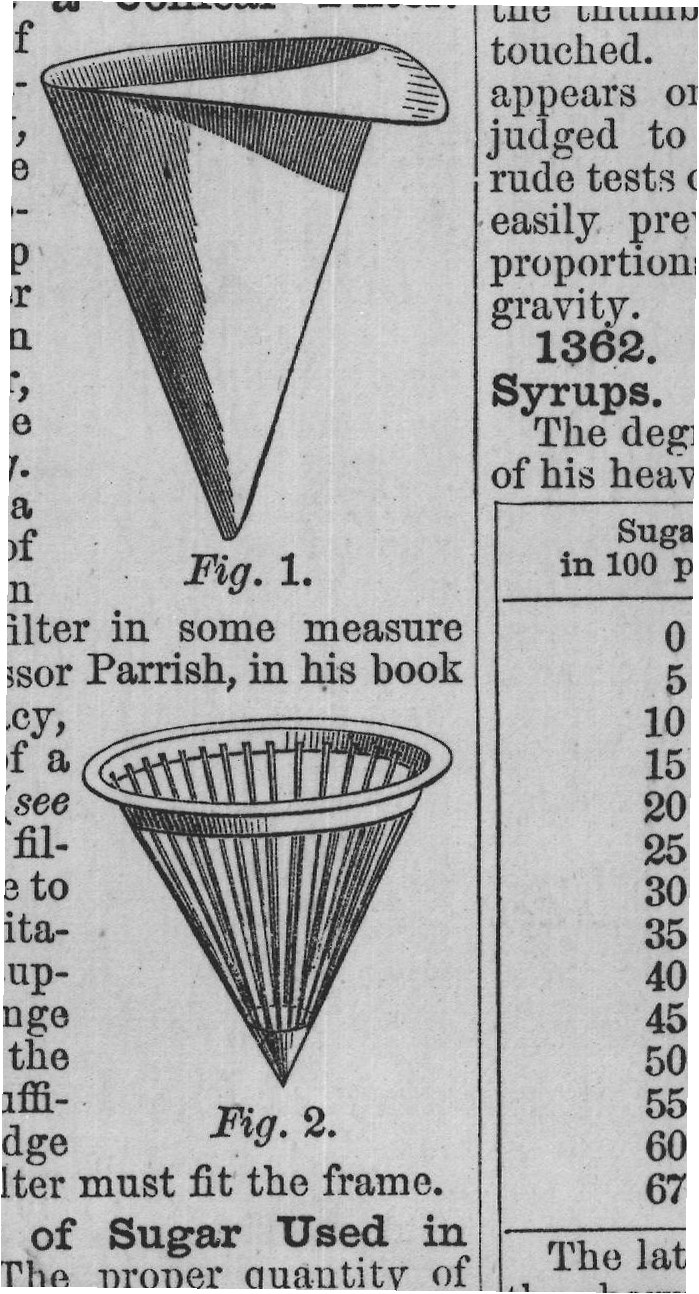
Syrups are should be checked after the lapse of one or usually filtered, on the large scale, by passing two minutes. When it is necessary to thicken them through creased bag filters; on the a syrup by boiling, a few fragments of glass small scale, conical flannel bags are usually should be introduced. in order to lower the adopted. Thick syrups filter with difficulty, hence it is a good plan to dilute them before filtering, and afterwards evaporate them to the required consistency. For small quantities clarification involves less trouble than filtration. (See No. 1359. To make a Conical Filter Take a square piece of flannel or Canton flannel, fold it diagonally, and sew two of the corresponding edges together with an over-lap seam, leaving the other two edges open; then fold the open edge over, sufficiently to make the opening level. (See Fig. 1.) This fold gives a considerable degree of stiffness to the open Fig. 1. end, preventing the filter in some measure from collapsing. Professor Parrish, in his book on Practical Pharmacy, unless it has been allowed to boil well; but if boiling point. In boiling syrups, if they appear likely to boil over, a little oil, or rubbing the edge of the pan with soap, will prevent it.
Syrups are judged by the manufacturer to be sufficiently boiled, when some taken up in a spoon pours out like oil; or, a drop cooled on the thumb nail gives a proper thread when touched. (See No. 1368.) When a thin skin skin appears on blowing upon the syrup, it is judged to be completely saturated. These rude tests often lead to errors, which might be easily prevented by employing the proper proportions, or determining the specific gravity. 1362. Table of Specific Gravities of Syrups.
The degrees of Baumé here given are those of his heavy saccharometer.
Sugar in 100 parts.
Specific Degrees Gravity.
Baum é. 0 1.000 0° 5 1.020 3 10 1.040 6 15 1.062 8 20 1.081 11 25 1.104 13.5 30 1.128 16.3 35 1.152 19 40 1.177 21.6 45 1.204 24.5 50 1.230 27 55 1.257 29.5 1.284 32 1360. Quantity of Sugar Used in Making Syrups. The proper quantity of sugar for syrups will, in general, be found to be 2 pounds avoirdupois to every pint of wa- The latter density is about the syrupus of the pharmacopœias; that of the U. S. Ph. Las a sp. grav. 1.317; that of the British Ph. is 1.330. recommends the use of a conical wire frame (see Fig. 2) to support the filter. The frame is made to fit into the top of a suitable tin bucket, being supported by a rim or flange around the top of the frame, projecting sufficiently to rest on the edge of the bucket. The filter must fit the frame.
Fig. 2. 1363. To Determine the Density of Syrup. A fluid ounce of saturated syrup weighs 577 grains; a gallon weighs 13 pounds avoirdupois; its specific gravity is 1.319 to 1.321, or 35° Baumé; its boiling point is 221° Fah., and its density at the temperature of 212° is 1.260 to 1.261, or 30° Baumé. The syrups prepared with the juices of fruits mark about 20 or 30 more on Baumé's scale than the other syrups. (Cooley.) According to Ure, the decimal part of the number denoting the specific gravity of a syrup, multiplied by 26, gives the number of pounds of sugar it contains per gallon, very nearly. dipped into it, and put directly into cold water, is not dissolved off, but turns hard and snaps.
The last stage of boiling reduces it to caramel sugar, and is proved by dipping a stick into the sugar and then into cold water, when, on the moment it touches the water, it will snap like glass. It has now arrived at a full candy height.
Throughout the boiling, the fire must not be too fierce, as it will discolor the syrup.
The best safeguard against this is the use of steam heat. Color may be given to the candy by adding the coloring matter to the syrup before boiling it. Flavoring essences must be added when the process is nearly complete.