Home › Photography › To Copy an Object
To Copy an Object
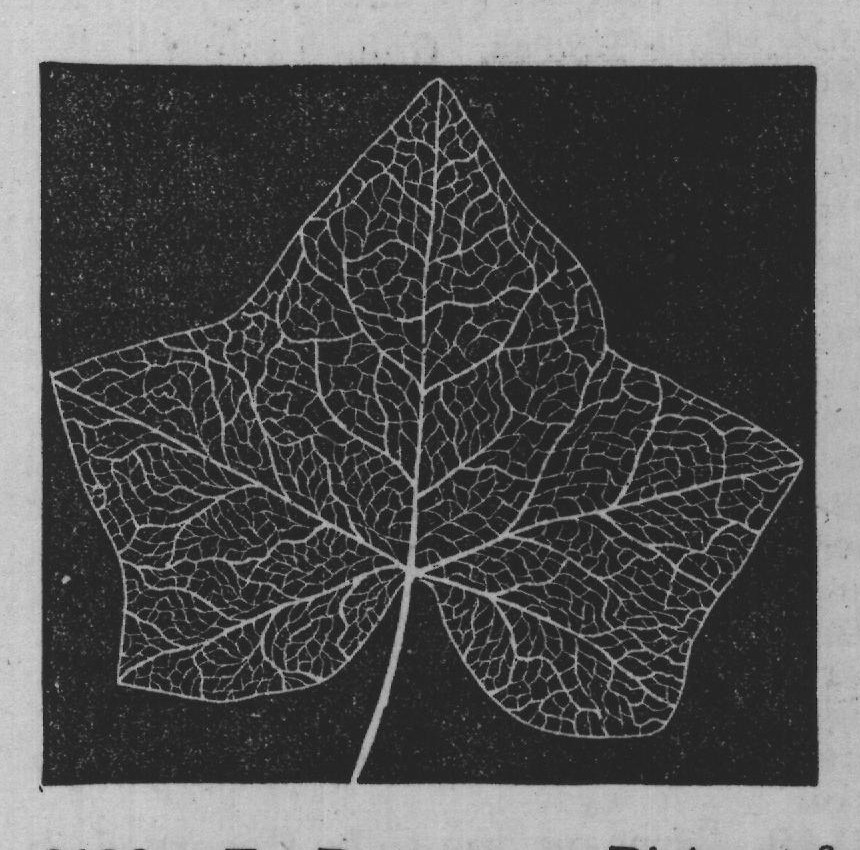
Having prepared, in a dark room, a sheet of paper as above, lay it upon a piece of glass; place upon the glass a leaf as translucent as can be found, and then above it, to hold it in place, another piece of glass, and at each corner a also as a stock solution; mark it as such:
Soda solution. When the prints have been washed as before directed, and are ready for toning, mix 1 drachm of the gold solution with 1 ounce of water, according to formula.
Pour into a tray, and drop in a small piece of blue litmus paper; it will become red. Render the bath alkaline by adding from the soda solution, drop by drop, until the paper begins elip, or a common spring clothes-pin. Now to change blue again. It is better to prepare the toning bath during the day, while the printing is being done, as the bath seems to work with more smoothness and uniformity.
It may be used, however, so soon as mixed. expose the plates so arranged, leaf side up, to the sun's rays. The paper will at once begin to darken, and in from 5 to 10 minutes, except under the leaf, be entirely black. If the plates are now taken into a dark room and separated, the image of the leaf, with all its delicate tracery and beautiful lines, will be found upon the paper, white, with black background. It would be well to put under the sensitive paper a few thicknesses of soft paper, or black cotton velvet. It serves as a pad or cushion, and tends to press the paper up into a closer contact with the inequalities of the leaf, lace, or object used as a negative or cliché. Small printing frames can be purchased at a moderate sum, which will enable when they are ready for immersion in a fixing the experimenter to examine the progress of bath, to render them permanent.