Home › Alcohol › To Filter Alcohol
To Filter Alcohol
The following method of filtering alcohol, or its solutions, is said to be very satisfactory, and is used extensively in North Germany, where it constitutes one of the secrets of the trade. Clean, times find it necessary to reduce or increase the strength of spirit, according as circumstances may require. To accomplish this, we give the following rules, which will be found useful to the dealer: multiply the number of gallons by the actual degree of strength sought to be obtained, and from the answer subtract 100; the amount thus obtained will show the quantity of water to be added to the spirit in order to reduce it to the degree sought. For example: suppose you have 100 gallons of spirit at 80° by Tralles' hydrometer, and wish to reduce it to unsized paper (Swedish filtering paper is the 50 or proof. Multiply 100 by 80, and divide best), is torn into shreds and stirred into the liquid to be clarified. The whole is then strained through a flannel bag, when the resulting liquid will be found to possess the utmost clearness and limpidity. A filter may also be made by spreading thin paper pulp evenly upon stretched flannel or woolen cloth.
When dry, the cloth so coated will be found to give better results than the felts, etc., commonly employed as filters. (Sce Nos. 714 and 811.) the amount by 50, then from the answer subtract 100; this will show that 60 gallons of water must be added to the spirit in order to reduce it to 50° Tralles', or proof.
Thus, Multiplied by Divided by Deduct 100 gallons 80 50)8000(100 100 60 1452. To Ascertain the Quantity of Pure or Absolute Alcohol in any Given 1448. To Test the Strength of Alcohol. Alcohol dissolves chloroform, so that when a mixture of alcohol and water is shaken Amount of Liquor. The quantity of alceup with chloroform, the alcohol and chloroform hol contained in any amount of liquor is unite, leaving the water separate. On this readily ascertained after testing the strength fact Basile Rakowitsch, of the Imperial with Tralles' hydrometer at 60° Fahr., by Russian Navy, has founded his invention. simply multiplying the figures expressing the The instrument he uses is a graduated glass quantity of liquor, by the ascertained strength; tube into which a measured quantity of for example a barrel of brandy containing 32 brandy containing chloroform is poured, and to this is added a gallons, 60° strong at 60° Fah., contains 19½ ., contains 19 given quantity of the liquid to be tested; gallons pure alcohol. Rule.-Multiply the number of gallons by the ascertained degrees | reduced. Divide the product thus ascertained of strength, and divide by 100. Thus: 32 gallons, 60° Tralles' at 60° Fahr. 19.20, or 19 gallons pure alcohol. 1453. Το Ascertain the Number of Gallons at any Required Number Below Proof, in any Given Number of Proof Gallons.
Multiply the given number of proof gallons by 100, and then divide the product thus obtained by a number found by deducting the required number of degrees below proof from 100. The quotient will be the answer.
For example: How many gallons, 25 below proof, are there in 35 gallons proof? 100 25 B. P. 75 35 gallons proof, 100 )3500(46) gallons 25 below proof.
We thus see by the above example that 35 gallons proof spirit is equal to 463 gallons 25 below proof. by a number to be found by adding the required proof to 100.
Suppose you desire to reduce 72 gallons how much water must you add ? spirit at 30 above proof to 10 above proof, 30, given strength. 10, required strength. - 20, difference.
Required strength, 10 100 72, No. of gals. 20, difference. 110)1,440(13 gals. lons spirit at 30 above proof to 10 above Thus it will be seen that, to reduce 72 galreduce 72 galproof, it is necessary to add 13tr gallons of water, making about 85 gallons in all. 1457. To Reduce Spirit of a Given Number Above Proof to a Required tion of Water for Spirit. Deduct the num- Number Below Proof, by the Substituber below proof from 100, and multiply the add the number which the given liquor is number of gallons by the remainder . Then above proof to 100, and divide the above product by the duct by the number thus obtained. The crease the degree of strength of a spirit, multi- quotient, deducted from the original number ply the number of gallons by the actual degree of high proof gallons, will give the answer of strength of the spirit, and divide by the required. All small fractions may be rejected. degree of strength sought to be obtained.
Suppose you want to reduce a cask of 40 1454. To Increase the Strength of a Spirit from any Degree to a Higher given Degree , or Percentage. To in- For example: suppose you have 100 gallons gallons spirit at 20 above proof to 10 halo of spirit at proof, or 50° by Tralles' hydrom- proof. eter, and wish to increase its strength to 80°.
Multiply 100 gallons by 50 and divide by 80; the answer will give you the number of gallons of spirit, 62 , to be added to the 100 gallons in spirit in order to increase its volume to 80° by Tralles' hydrometer.
Thus, 100 50 100 10 Multiply 90 by 40 Original number of gallons, 40 Deduct quotient, 30 - Answer, 10 gallons.
To 100 add 20=120)3,600(30 80)5000 62.4, or 62. 1455. To Reduce Spirit a Given be removed, and their place supplied with Thus it will be seen that 10 gallons should Number Above Proof to a Required water, in order to make the mixture equal to Number Below Proof, by the Addition 10 degrees below proof. of Water. Multiply the number of gallons of spirit by the sum of the given degree above Number Above Proof to Proof Spirit, 1458. To Reduce Spirit of a Given proof and the required degree below proof, and divide the product by a number to be found by subtracting the required proof from 100. The quotient will give the number of gallons of water to be added.
Suppose you want to reduce 40 gallons spirit 20 above proof to 10 below proof, how much water must be added to accomplish the result? 100 40 gallons.
Required proof, 10 30 90)1,200(13 gals. water.
It will thus be seen that, to reduce 40 gallons spirit 20 above proof to 10 below proof, it will be necessary to add 134 gallons of water, making 534 gallons in all. by the Substitution of Water for Spirit.
Multiply the number of gallons by 100, then add the number which the spirit is above proof to 100, and divide the above product by tient from the number expressing the original the number thus obtained; subtract the quoquantity of spirit, and the answer will give the number of gallons to be removed from the spirit and replaced with water, in order to reduce the high proof spirit down to proof.
Suppose you want to reduce a cask of 24 gallons of spirit 20 above proof to proof spirit.
Above proof, 20 24 100 100 120)2,400(20 Original quantity 24 20 Answer, 4 1456. To Reduce High Proof Spirit to a Required Lower Proof, by the Ada Required Lower Proof, by the Addition of Water. First multiply the number of gallons by a number expressing the difference in degrees of strength between the 4 gallons have to be taken from the spirit It will be seen by the above example that given proof of the spirit to be reduced and the same quantity of water added, to rerequired degree, or proof, to which it is to be duce it to proof.
Suppose you desire to raise a cask of 35 1459. To Raise Spirit of a Given Number Under Proof to a Required 1459. To Raise Spirit of a Given gallons spirit 15 above proof to 20 above proof, Required gallons spirit 15 above proof to 20 above proof, Strength Above Proof, by the Substitu- by the addition of spirit 30 above proof. 20 required proof, 15 given proof, - 5 difference. 30 35 number of gallons. 5 multiplied by difference. ! - 15 )175(11) answer.
Subtract 15 tion of High Proof Spirit. Multiply the number of gallons by the number expressing the difference in degrees of strength between the high proof spirit to be added and the reand the required degree to which it is to be raised. From to be raised.
From Divide the product thus found by a number to be obtained by adding the given number below proof to the number the high spirit is 1462. To Reduce Low Proof Spirit above proof; then subtract the quotient from the original number of gallons, and the re- to a Still Lower Proof, by the Addition and the reto a Still Lower Proof, by the Addition mainder will show the quantity of low spirit of Water. First multiply the number of to be removed and its place supplied by the gallons by the difference in degrees of strength addition of the same quantity of high proof between the given proof of the spirit to be spirit.
Suppose you desire to raise a cask of 40 gallons at 10 below proof to 15 above proof, above proof, by means of spirit 40 above proof: 40 number of gals. 25 multiplied by diff. 40 40 A. P. 15 10 в. в.
Diff. 25 50 )1000(20 40 gals. original quantity to be raised. 20 deduct quotient. - 20 answer.
The above example shows that 20 gallons should be taken from the low proof spirit, proof spirit, and the same quantity of spirit added at 40 above proof, to raise it to 15 above proof. above proof. reduced, and the required proof to which it is to be reduced. Divide the product by a numthe product by a number ascertained by subtracting the given proof from 100, and the quotient will give the numwill give the number of gallons of water to be added.
Suppose you want to reduce 40 gallons spirit 10 below proof, to 15 below proof.
Required proof 15 Given proof 10 - Difference 5 100 40 gallons 10 given proof 5 difference 90 )200(2) gals. water 1463. To Raise a Low Proof Spirit 1460. To Raise Spirit of a Given to a Higher Required Proof by the Ad- Number Below Proof to Proof Spirit, dition of High Proof Spirit. Multiply by the Substitution of High Proof the number of gallons by a number expressof High Proof the number of gallons by a number express- Spirit. Multiply the number of gallons by ing the difference in degrees of strength benumber of gallons by ing the difference in degrees of strength bethe number which the high proof spirit is above tween the given proof of the spirit to be proof, divide the product by a number to be raised, and the required proof to which it is found by adding the given number the spirit to be raised. Divide the product thus ascergiven number the spirit to be raised. Divide the product thus asceris below proof to the number the high spirit is above proof; subtract the quotient from the original number of gallons, and the remainder will show the quantity of low proof spirit to be removed, and its place to be supplied by the addition of high proof spirit.
Suppose you desire to raise a cask of 40 gallons at 5 below proof, to proof, by means of spirit 35 degrees above proof. 35 A. P. 40 number of gallons. 5 B. P. 40 )1400(35 quotient. 40 gallons, 35 quotient, - 5 answer.
It will thus be seen that 5 gallons should be taken from the low proof spirit, and the same quantity of spirit added at 35 above proof, in order to raise it to proof strength. proof strength. tained by the sum of the given proof, and the high proof spirit to be added, and the quotient will give the answer .
Suppose you desire to raise 40 gallons spirit 15 below proof to 10 below proof with spirit 10 above proof.
Given proof 15 Required proof 10 Difference - 5 Given proof 15 High proof 10 40 gallons 5 difference 25)200(8 gals. answer.
Essential Oils; Volatile Oils. The essential or volatile oils are an extensive and important class of bodies
1461. To Raise Spirit of a Given derived from the vegetable kingdom, and found in almost every part of the larger num- Number Above Proof to a
Still Higher found in almost every part of the larger num- Degree of Strength, by the Addition of ber of the plants which produce them, except the cotyledons of the seeds, which, in general, , by the Addition of ber of the plants which produce them, except High Proof Spirit. First multiply the the cotyledons of the seeds, which, in general, number of gallons by a number expressing the form the exclusive repository of the fixed difference in degrees of strength between the oils. It is the volatile oils which confer upon given proof of the spirit to be raised, and the woods, their peculiar and characteristic odors; to be raised, and the flowers, leaves, fruit, seeds , roots, barks, and required degree to which it is to be raised. woods, their peculiar and characteristic odors; Divide the product thus ascertained, by a but among these they are not equally disnumber to be found by subtracting the differ- tributed in the same individual, and are often altogether absent from some of them. To subtracting the differ- tributed in the same individual, and are often ence in degrees between the spirit to be raised altogether absent from some of them. To and the high proof spirit employed to raise them we are indebted for our most delightful it. The quotient will show the number of perfumes. and our choicest aromatics and gallons of a higher proof which must be added. spices. All of them, when perfectly pure, are colorless; though, before rectification, nearly | latter accumulates at a, and the water flows the whole of them have a pale yellow tint, over by the spout, b. The essential oil is oband some of them are brown, blue, or green . tained in this manner from the following:
They mix in all proportions with the fixed Anise, caraway, wormseed, cubebs, fennel, oils, dissolve freely in both alcohol and ether, pennyroyal, juniper, lavender, lemon, cinnaand are sparingly soluble in water, forming mon, peppermint, spearmint, horsemint, oriperfumed or medicated waters. (See Nos. 1080, ganum, pimento, rosemary, savine, sassafras, &c.) Their boiling point usually ranges be- valerian, &c. The empyreumatic oil of tois obtained by introducing the dry siderably higher than water.
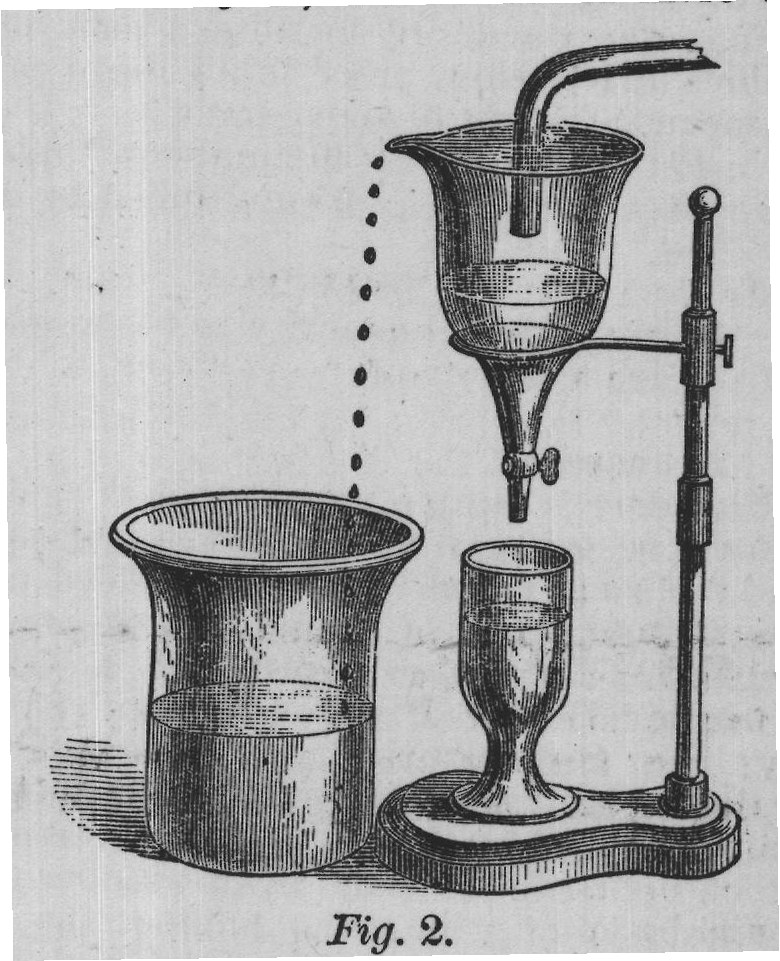
They resist leaves in coarse powder into a green glass resaponification and (excepting oil of cloves) tort, heating it in a sand-bath to a dull red do not combine with the salifiable bases. heat. Separate the oily liquid from the wa- Their density fluctuates a little on either side tery portion as it comes over, and keep for of water. The lightest oil is that of citrons use. (See No. 46.) The same receiver may (specific gravity 0.847), and the heaviest, that be employed for oils heavier than water, by of sassafras (specific gravity 1.096). When reversing the arrangement; but a glass sepacom- rator (see Fig. 2) will be found more conmon temperature of the atmosphere is sufficient for this with some of them, as the oils of roses and aniseed; whilst others require to be cooled below the freezing point of water before they assume the solid form. By exposure to the air they rapidly absorb oxygen, and become partially converted into resin. This is the cause of the deposit that usually forms in them (especially in the expressed oil of orange) when kept in an imperfectly stopped bottle. (Cooley.)
1465. Το Obtain Essential Oils. All essential oils which are more or less volatile can be obtained from substances by distilling the articles along with an equal weight (some use a larger proportion) of water; but some substances that give out their oil with difficulty, are first soaked for 24 hours in twice their weight of water, to each gallon of which 1 pound of common salt has been added, by which its boiling point is raised, and consequently the oil comes over more easily. In such cases a quick fire is used, and when one half the water has come over, it is returned venient. In this case the oil accumulates at into the still, and this is repeated until the the bottom of the vessel, and may be drawn distilled water ceases to come over mixed off by the cock. The oil of cloves and other with oil. The heat of steam or a salt water heavy essential oils are obtained by macerabath should be preferably employed; but if a ting 5 pounds coarsely powdered material for naked fire be used, the still should be deep 48 hours in 10 pounds water containing 1 and narrow, by which means the bottom will pound salt; and distilling until the product is be more perfectly covered when the quantity no longer milky. After the oil has deposited, of water becomes small, and burning prevented. When the distilled water is to be repeat- .
When the distilled water is to be repeatedly poured back on the ingredients, a very convenient plan is to so arrange the apparatus that, after the water has separated from the a Fig. 1. b Jil, it shall flow back again into the still, by which much time and trouble will be saved.
The separation of the oil and water is effected by allowing the mixed liquids to drop into a Florentine receiver (see Fig. 1), when the oil is lighter than water, by which means the Fig. 2. the remaining water is again distilled, and this repeated until all the oil has been extracted from the water. After 10 days, the oil is cleaned and clarified by filtering. The essential oil of cloves, cinnamon, rhodium-wood, sandal, calamus , aloes, &c., are thus obtained.
That of bitter almonds and of mustard are obtained by making a thin paste of the material with water; and, after 24 hours' maceration, distilling by steam-bath. The essential oils of lemons, oranges, and some other fruits, are chiefly obtained by submitting the yellow rind to powerful pressure; but in this way they are not so white, nor do they keep so well as when distilled. Volatile oils should be kept in well-closed and nearly full bottles, in the dark, and opened as seldom as possible, as by age and frequent exposure they become resinous. The process of distillation should oils collected soon after its separation from be done as rapidly as possible, and the light the water. ing Essential Oils. Substances yielding 1466. Special Directions for Distillvolatile oils are generally distilled with water, the proportion of which varies with each over.
ESSENTIAL OILS. article, but under all circumstances must be water will dissolve. This process is called sufficient to prevent the substance from burn- cohobation 1467. Millon's Method of Obtaining ing before the whole of the oil has passed
To prevent the risk of burning, it it has
Essential Oils. The flowers are placed in been recommended to suspend the substance a percolating apparatus (see
No. 41) and then to be distilled in a basket, or a bag of wire- ether or sulphide of carbon is poured over work, in the water, so as not to touch the bot- them. After leaving the flowers in contact tom or sides of the alembic; or to place the for 15 minutes the liquid is drawn off and substance on a perforated shelf in the upper a fresh supply added and drawn off in a part of the alembic above the surface of the similar manner. This completely dissolves water. Some substances, such as mustard, all the essential oil of the flowers, leaving bitter almonds, &c., which are mixed to a them quite scentless. The liquid is next disscentless. The liquid is next dispaste with water, are distilled by the action tilled, and the ether or sulphide of carbon, beether or sulphide of carbon, beof a current of steam heated to the necessary ing volatile at a much lower temperature than degree and admitted into the bottom of the the fragrant principle, is drawn over alone, alembic. An excess above what is necessary and leaves a residue containing all the pera residue containing all the peracts injuriously by holding some of the oil in fume of the flower. This residue, more or solution after the mixed vapors are condensed; less solid, is exposed to the heat of the sun on the other hand, if too small a quantity be until it loses the unpleasant smell of the employed, besides the danger of burning, the solvent used. No degree of natural heat is whole of the oil will not be distilled. Dried capable of altering the perfume or turning it plants require more water than the fresh and rancid. The product has a much finer odor succulent.
The form of the alembic has an influence over the quantity of water distilled, which depends more upon the extent of surface than the amount of liquid; by employing a high and narrow vessel the disadvantage of an excess of water is much obviated. The temperature should be equable, and regulated so as not to exceed the required degree of heat; and, as some oils are more volatile than others, an appropriate temperature must be obtained and sustained; the use of a higher temperature than is necessary being injurious. Any degree of heat can be steadily applied by the use of a bath, either of water or of some solution (weaker or stronger as required) of which the boiling point is known. (See No. 7.)
The more volatile oils pass freely with the steam into the neck of the receiver, but some that are less volatile are apt to condense in the head, and return into the body of the still; for these a still should be employed with a large and low head, having a rim or gutter inside, in which the oil may be received as it condenses, and thence led into the neck of the condensing tube (see No. 1077), which is better straight than coiled, for convenience in cleaning, as the alembic and all its appurtenances must be perfectly clean before distilling each kind of essential oil. Certain flowers, such as orange flowers and roses, yield little or no oil when dry, and must be preserved fresh, either with salt, or by means of glycerine, to keep them in condition for distilling their oils. (See No. 1349.)
The most of the aromatic herbs are usually distilled while fresh, although it is thought by than essential oil prepared by any other system.