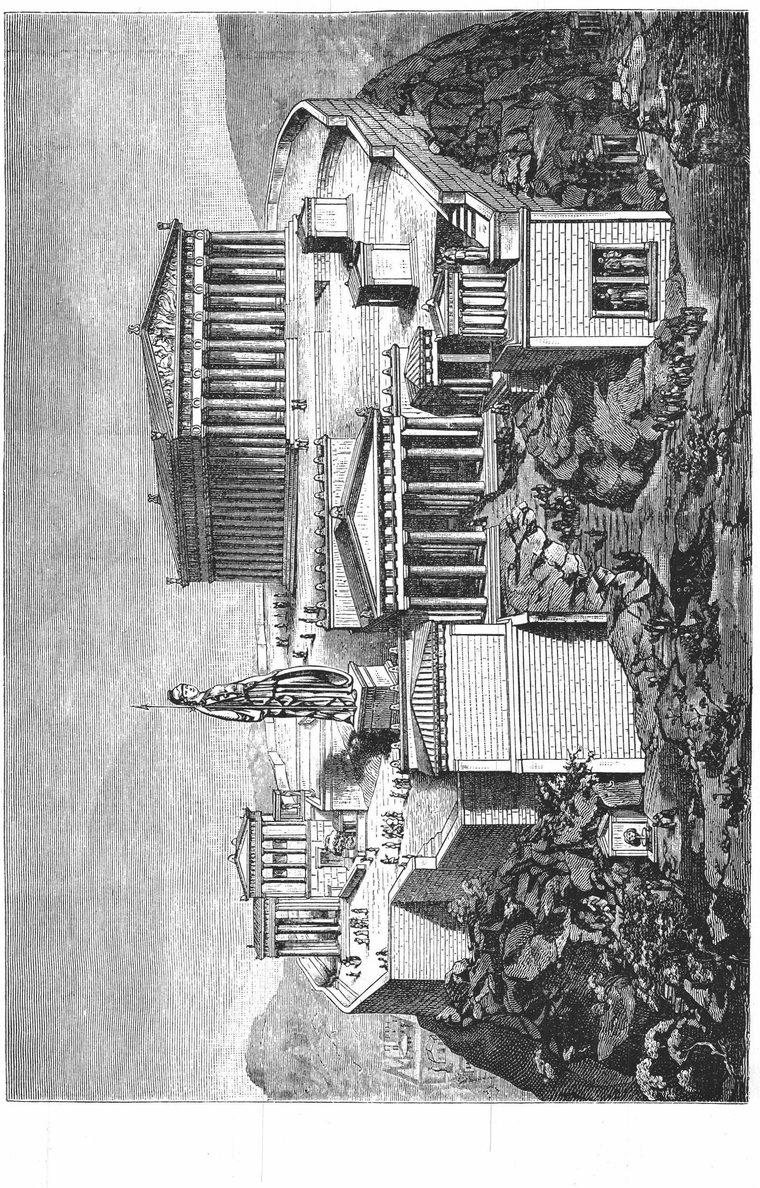
Acropolis
a-krop'o-lis, a Greek word signifying the high part of a city, the portion set on a hill. The name grew out of the fact that Greek cities were founded usually on an eminence which was fortified as a citadel. As the city grew, it spread to the lower grounds and was not infrequently surrounded by a strong wall; while the acropolis was made the site of the temple and other public buildings. This was the case of Argos, Thebes, and Corinth. The most noted acropolis is that of Athens. The acropolis of Athens is a table of rock about 260 feet high. It is a spur of Mt. Hymettus with precipitous sides except on the west, where a zigzag road was built, accessible by chariots. The summit was surrounded by massive walls. A number of notable buildings were erected here, the best of which were two temples, the Parthenon and the Erechtheum. The famous open air theaters of Athens were constructed on the sides of this acropolis. See Athens; Pericles; Parthenon
Into the center of the entire plain advances from the direction of Hymettus a group of rocky heights, among them an entirely separate and mighty block which, with the exception of a narrow access from the west, offers on all sides vertically precipitous walls, surmounted by a broad level sufficiently roomy to afford space for the sanctuaries of the national gods and the habitations of the national rulers. It seems as if nature had designedly placed this rock in this position as the ruling castle and the center of the national history. This is the Acropolis of Athens.--E. Curtius, History of Greece.