Parthenon
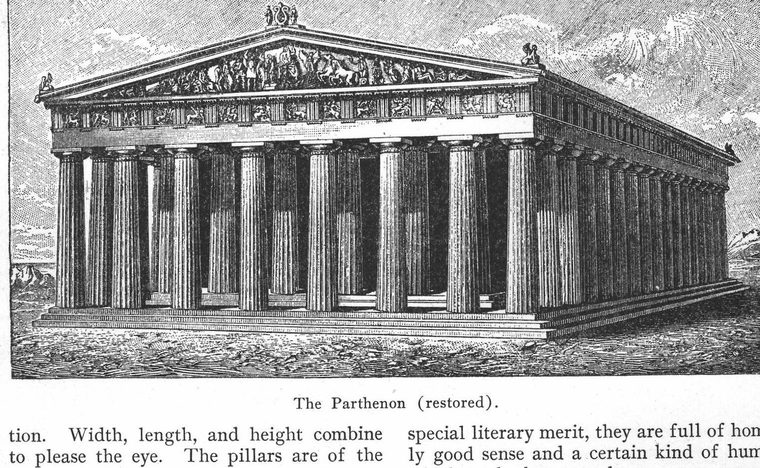
par'the-non, a temple in honor of Athena Parthenos. The word means the Virgin. The Parthenon was the chief temple of Athens, the most noted temple of antiquity. It stood on the Athenian Acropolis. The foundation was of limestone. The temple itself was wholly of marble. It rested on a rectangle of marble drawn in on all sides by three steps. The temple proper was 228 feet long, 100 feet wide, and 66 feet high. The architecture was Doric, the severest and the most chaste of the three Grecian styles. A lofty porch ran around the entire building. It was supported on a double row of pillars thirty-four feet in height. These pillars were six feet in diameter at the base and narrowed slightly as they rose. The outer row contained forty pillars, eight across each end and seventeen on a side. The frieze and gables were formed of richly carved marble slabs. From traces of color still left, it is known that rich paints--Tyrian purple, red, and blue--were employed to color the ornamental portion of the edifice. The interior was sacred to Athena and sheltered a statue of that goddess, the masterpiece of Phidias.
The general outline of the Parthenon was broad and flat, not unlike a barn, every line straight. There were no spires or projections of any kind; and yet it is regarded as the most perfect structure yet erected by man. Richness of material, faultlessness of sculpture, and the color scheme employed added charm, but the real beauty of the building lies in its massive simplicity and in the harmony of proportion. Width, length, and height combine to please the eye. The pillars are of the diameter, distance apart, and height to produce a pleasing effect. The belt of stonework resting on the pillars seems almost musical in the happy proportion of massiveness, width, and grace. The roof stands just right, rising beyond criticism. The groups of sculpture seem to fit naturally into their places, square in the frieze and triangular in the gables. There is no cramping of figures, straining of material, or overloading of stone anywhere. The general effect upon the eye is pleasing beyond all description. Whether the traveler approach by boat or by rail, his first glimpse of Athens is of the Acropolis crowned by the remains of the Parthenon, beautiful still and inspiring. See Athens; Athena; Phidias; Elgin Marbles; Architecture; Acropolis