Bat
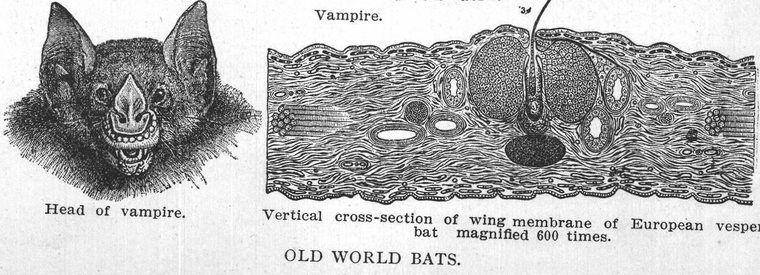
a flying animal difficult to classify. Its nature is indicated pretty well by the old English name of "flittermouse." The flying squirrel merely sails. The bat is the only mammal capable of genuine flight. The five toes of the hind foot, and the thumb of the front foot, or hand, are furnished with curved claws, by which it customarily hangs, head downward, from supports when it rests. The scientific family name signifies wing-handed. The entire arm and the four greatly elongated fingers are connected by a thick membrane, which extends along the flank to the hind leg. A similar membrane runs from the heel to the tail in some species. These membranes, or wings, enable the bat to fly with a swiftness and skill equal to that of the swallow. The membrane, which is more or less furry, is furnished with delicate nerves which apparently enable the swift animal to tell almost instinctively, probably by the increasing density of the air, when it is approaching an object that ought to be avoided. At all events, the bat can wheel and dart with perfect safety, and in utter darkness, amidst rocks, trees, rafters, and obstructions against which it might be expected to dash itself. The bones of the hand being especially long, the fingers are frequently longer than the body. They cannot be doubled into the palm, like the fingers of a person's hand. They simply close together and fold up the membranes like the ribs of a lady's fan. Large folds of skin about the mouth, and ears of extraordinary size, are extremely sensitive, and it is thought that the bat, whose flight is absolutely noiseless, can hear slight noises of which a person would be wholly unaware. Bats vary greatly in size. The common bat is no longer than a mouse. Certain Asiatic species have a wing stretch of five feet.
There are about 450 species of bats, divided into two main groups. The fruit eaters are confined chiefly to the tropics of the Old World. The insect eaters are distributed throughout both continents. The bats of cold countries are usually dormant in winter. A large New England bat migrates southward in the fall. The little brown bat, abundant everywhere east of the Rocky Mountains, has a small, fox-like face with a high forehead, and pointed snout, large ears, and naked wings. It has small, weak teeth and is harmless. It hangs upside down in the daytime in hollow trees, caves, and outbuildings, flitting at night about barnyards to catch mosquitoes, gnats, and other insect pests. The bat takes no pains to make a nest. One or two young are produced at a time. When hunting food, the little ones often go with the mother, clinging to her neck, or else she hangs them by their hooks on the branch of a tree while she seeks their supper. It seems unnatural for a bat to walk, and yet it can make some progress by hitching along, one side at a time, using its hind feet and the ends of its wings as best may be.
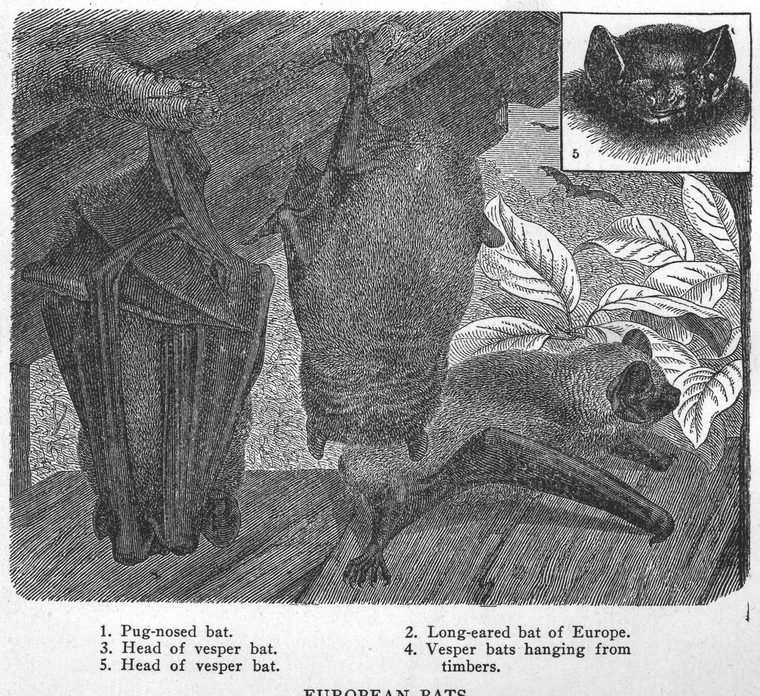
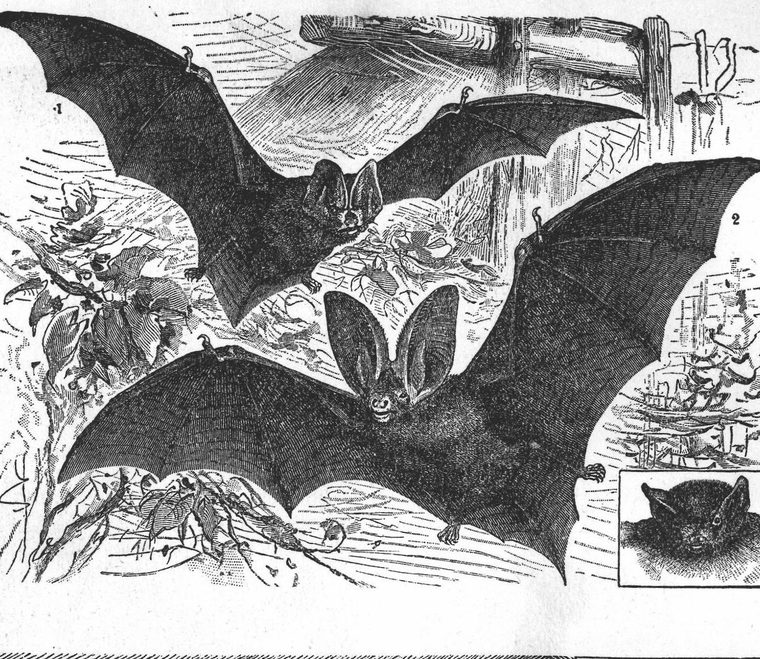
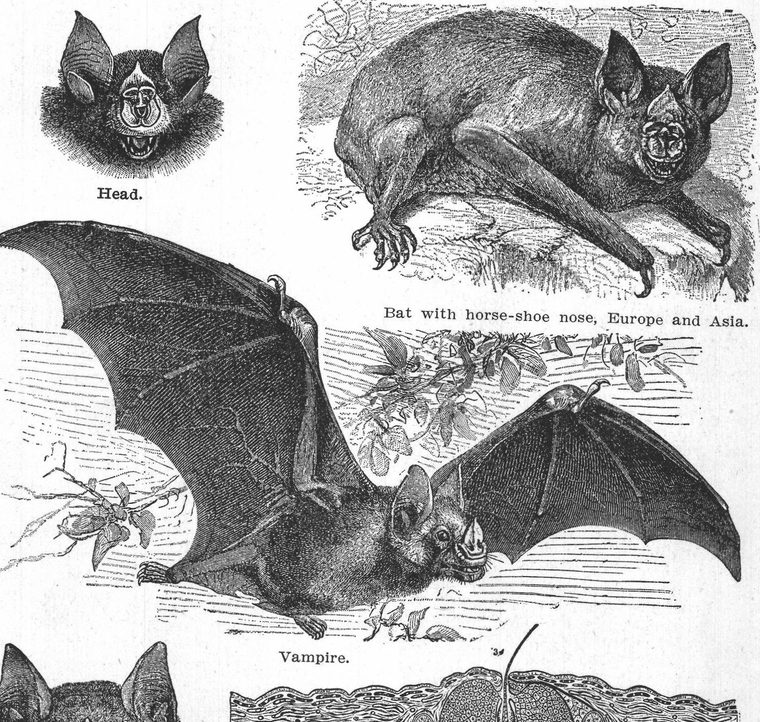
The common bat has small, noticeable eyes, as black as a jet bead. The popular saying, "as blind as a bat," is founded on accurate observation. The eyes of bats have been found to be imperfect in that the portion of the retina which is most concerned with perception of light is not well developed. As if to compensate for this, we find, in some species, the outer ear, in others the skin around the nostrils or on the lips and chin, developed into large outgrowths in which are many delicate nerves. One bat that lives in Europe has such long ears that they must be folded under the bat's arm while it sleeps. In another European bat, the skin grows out on the nose like a leaf in shape. By means of these outgrowths, a bat entirely blind, if let loose in a room in which numerous strings have been stretched, will fly about without touching one.
Limestone caves, like the Mammoth Cave of Kentucky, often contain large numbers of bats. Bats in enormous numbers inhabit lava tunnels and caves in Mexico. A contributor (H. L. Ward) to the Transactions of the Wisconsin Academy of Science vividly describes bat life in one of these tunnels:
As far as I could ascertain no one had entered the tunnel previous to my visit. My assistant and I let ourselves down by a rope which we tied to a piece of wood drawn across the opening (a hole about a yard wide) until we reached a conical pile of rocks in a large rotunda formed by the breaking down of the roof some thirty feet above. In one direction, a tunnel, twenty feet high and about the same width, extended for an indefinite distance. With lighted candles we proceeded into this tunnel. A few squeaks, now near, now far away, increasing in number as we advanced; the fitting of shadowy wings, and an occasional swish as one came near our ears, showed that the bats knew of our presence.
Shading our candles, we could see a short distance ahead, and there, clinging feet uppermost to the sides of the cave, from roof to floor, were bats as far as we could see. Those near by and on the lower levels, with heads thrown up, were standing on their wrists with bodies clear of the walls, ready to let loose and fly away at a moment's warning. The floor of the tunnel was covered a foot deep with the droppings from the bats, and huge spiders and other insects were plentiful on top of this. Four species of bats were present, each species disposed in a band some feet or some yards in width; then a slight vacant space, followed by a band of another species. A few shots from a pistol started the bats, and in a moment the air was filled with thousands of flying forms. Our candles were instantly blown out by the wind from their wings and we were continually struck severe blows in the face and body. For a moment it seemed impossible to stand against the storm of swirling, eddying bats that in their wild career seemed to have entirely lost their usual knack of avoiding objects. But the roar soon quieted, and we relighted our candles, and went on, time after time experiencing repetitions of the bat-storm. The squeaking would swell into a shrill piping echoed and re-echoed by the walls of the cavern; the scarcely audible swish of wings would grow into a roar; the zigzag flight would increase, then become blurred into a seeming stream of dark bodies, and then our lights and even our hats would succumb to the hurricane, until the wave swept by with its mad swirl of shrieking bats and we could light up again.
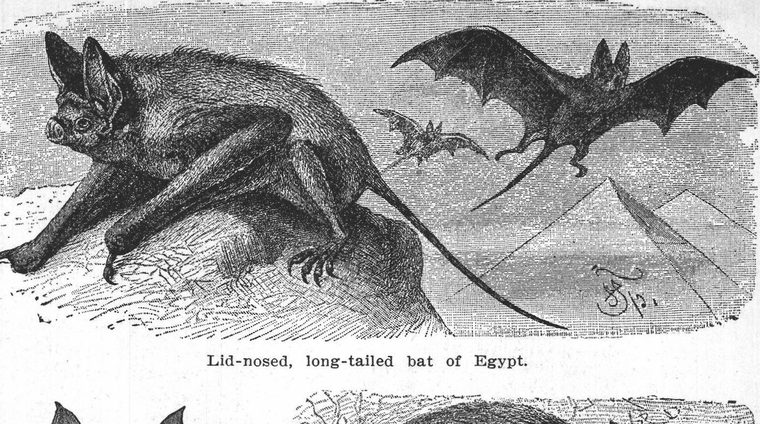
The flying foxes or fox-bats of India and Madagascar are the largest bats known. Allied to them is an African species which frequents the interior of the pyramids and dark ruins in Egypt.