Cocoa
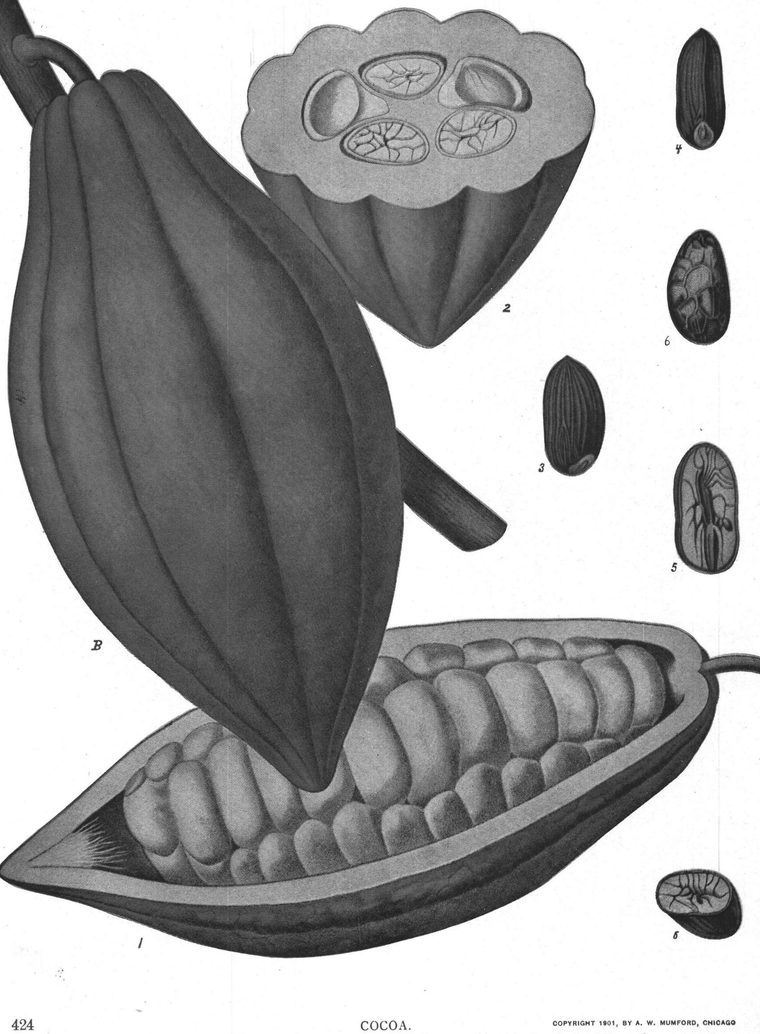
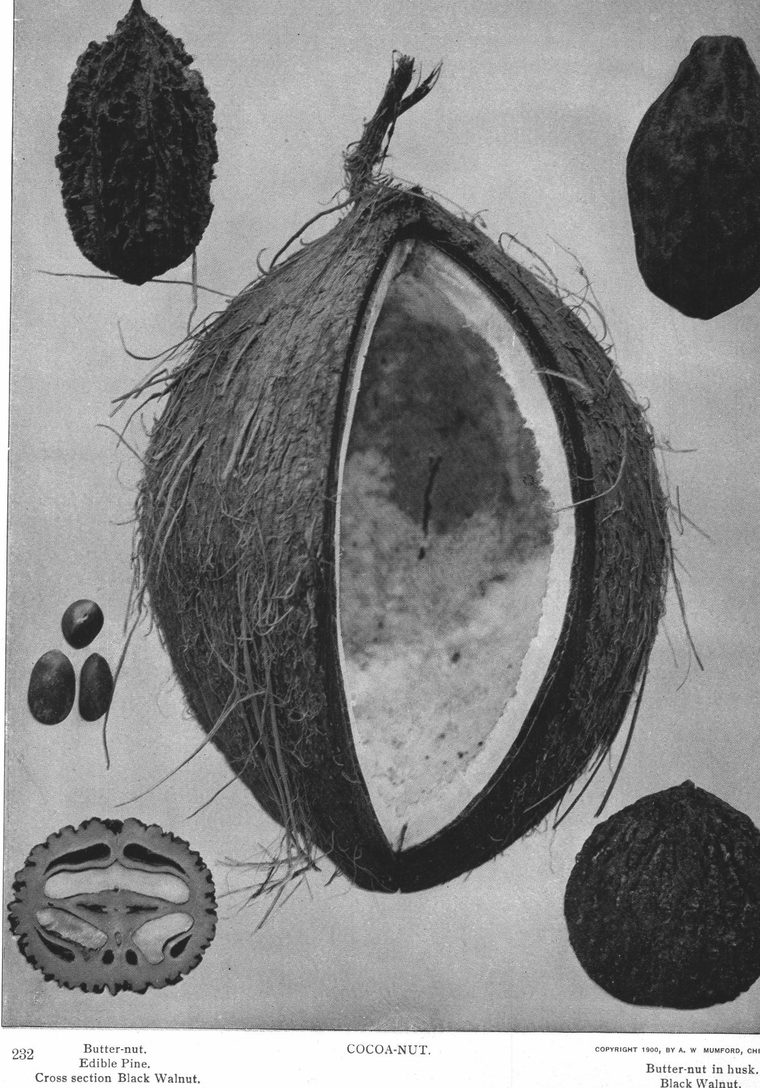
ko'ko, Cacao, or Coco, the seeds of a tropical tree. By right the name should be spelled cacao, which would also avoid confusion with cocoa-nut, a seed as large as a child's head, while cacao or cocoa seeds, or beans as they are frequently called, are more like shelled almonds. Cocoa must be distinguished also from coca. Several species of small trees produce cocoa beans. Our supply comes chiefly from one of them. It grows in Portuguese Africa, in tropical America, and the West Indies.
The tree which produces cocoa beans branches at the height of a man's head, and bears cucumber-shaped pods several inches in length, with a thick, warty rind. The pod contains a sweetish pulp, of the consistency of soft butter, and a handful of flat beans. The tree comes into full bearing in seven years, and yields two crops a year for thirty or forty years. The fruit is subjected to fermentation for a few days, often by burial in the earth, after which the beans are washed and dried.
Mexican Indians were users of cocoa before the discovery of America. Prescott tells of the vast quantities of cacao found growing along the Pacific coast by Pizarro and his followers, and of the use of cacao in Montezuma's household. "He was exceedingly fond of it, to judge from the quantity, no less than fifty jars or pitchers being prepared for his own daily consumption. Two thousand more were allowed for that of his household." Bags of cacao beans were used for money. The Mexicans called the beverage made from cacao chocolate, or cocoa water, whence our name chocolate.
Once the beans have been fermented, cleaned, and dried, they are ground. The fermenting takes the place of roasting for coffee. Pure cocoa goes on the market either in this form or as beans. Ground cocoa, even from the best houses, is likely to contain a judicious quantity of other material.
As ordinarily understood, chocolate is prepared by making a paste of ground cocoa, usually with sugar and such flavoring as cinnamon, cloves, or vanilla. The paste is compressed into cakes in iron molds and wrapped for the market. Chocolate is adulterated by putting in rice flour, starch, hazel-nuts, almonds, and cheap spices. The less gritty a cake of chocolate the purer the chocolate. The loose, dry powder is sold as cocoa; the sweetened cakes as chocolate. The world's annual production of cocoa is about 300,000,000 pounds. Of this amount the United States consumes a fourth. The demand is increasing rapidly. Ecuador leads the nations in the production of cocoa. The importers of Hamburg, Havre, and New York are the largest buyers.
Consul-General Herman R. Dietrich, in a report from Guayaquil, says that the principal product of Ecuador is cocoa, of which it furnishes nearly one-fifth of the world's production. Mr. Dietrich furnishes the following particulars:
The cacao tree grows on the warm lowlands and in the valleys tributary to the coast. The valleys adjacent to Guayaquil produce the greatest quantity of any district in the world. In 1900 there were 4,827 cacao plantations or farms in Ecuador, with a total of 58,551,142 trees. The yearly production, in pounds, was: In 1900, 41,134,900; in 1901, 51,311,700; in 1902, 53,621,300; in 1903, 49,921,300; in 1904, 61,339,600; in 1905, 47,225,400, and in 1906, 52,690,500.
Guayaquil cocoa has a specialty of its own, both in shape and aroma, and is easily distinguished from the cocoa of other districts. The lower grades are very strong and coarse in flavor, while the better grades contain a larger percentage of theobroma, making them more valuable. Here the cocoa is divided into two classes, viz., upriver (arriba) and down river (abajo); to the latter class belong the grades known as Machala, Balao, Naranjal, and Tenguel. The cocoa coming from the plantations situated in the upriver district is far superior and always sells at a higher price.
Ecuador's annual exports, in round numbers, amount to $8,000,000, two-thirds of which is cocoa, an article for which a world-wide demand exists and in the production of which Ecuador enjoys a high reputation. The planting and cultivating of the cacoa tree is being carried on more extensively here every year, as it is the general opinion that the article has a splendid future and that the present production is not sufficient to meet the growing demand or consumption. The plantations here are mostly in the hands of natives, many of whom have amassed sufficient fortunes to make Paris their future home. On some of the large plantations there are very fine residences.
See Vanilla; Coca; Cocoanut, etc.