Copper
a hard, reddish metal. Pure copper is one of the chemical elements. Symbol, Cu., atomic weight, 63.6; density, 8.9. Copper is one of the most useful metals. It is rolled or hammered into thin sheets, and may be drawn into slender wire of great strength. A copper rod one square inch in section is capable of sustaining a weight of 80,000 or even 90,000 pounds. Copper does not tarnish in dry air, but in moist air it becomes covered with a coating of green. Copper forms poisonous compounds. Vegetables of all sorts may be boiled safely in a copper kettle, but should on no account be allowed to stand in it. Vinegar should not come into contact with copper. The green rust which forms on the surface of copper kettles and on copper coins is a carbonate of copper. It is formed by the carbonic acid and oxygen of the air, which act upon moist copper. It is very poisonous; hence naked copper vessels would better not be used at all in cooking. Although copper is a poison, the human system seems to require a trace of it. Bread and nearly all ordinary foods contain from two to four parts of copper to the million. The tissue of the human liver contains thirty parts to the million. Copper is found usually in compound with other elements. In union with carbon it forms a beautiful mineral known as malachite; with sulphur and iron, it forms copper pyrites. It occurs also as an oxide, and in combination with sulphur. In these cases it occurs in fissures or veins in rocks. Masses of copper occur in conglomerate rocks and in sandstones. This is the case in the Superior region and to some extent in Montana.
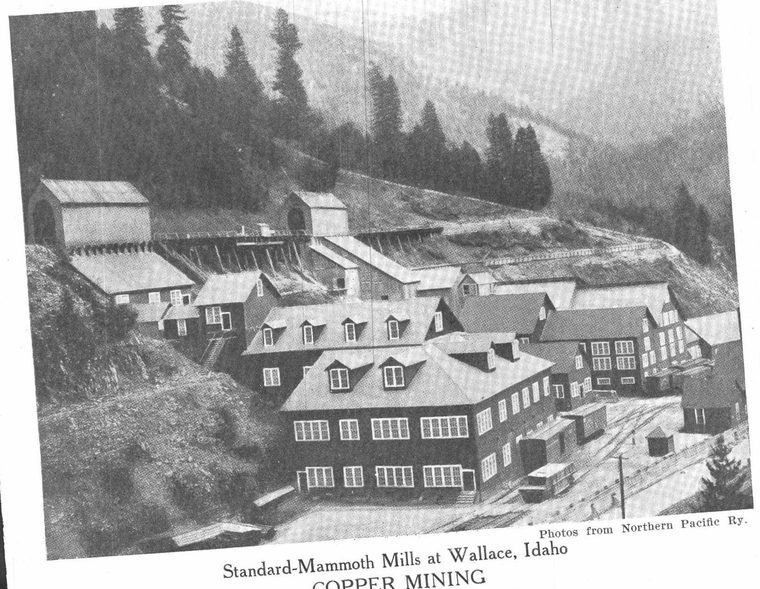
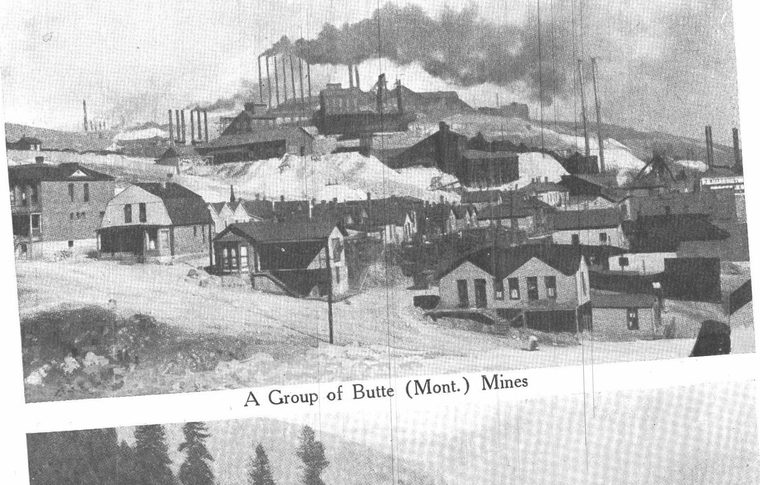
Copper is distributed widely, but is found in paying quantities in few localities. The first American copper was found in Connecticut. Montana, the upper peninsula of Michigan, and the mines of Arizona furnish half the world's copper. The Michigan copper mines appear to have been visited by the American Indians in prehistoric times. Shallow pits were found by the white man from which the aborigines had apparently dug copper. Large blocks of pure copper had been detached and left by them. Copper ornaments, bracelets, rings, and anklets, implements, knives, awls, and axes, made, apparently, from Lake Superior copper, have been found in Indian graves and old dwellings. The most celebrated copper mine in this region is the Calumet and Hecla, which has already reached a depth of over 4,000 feet, and has yielded as high as 63,000,000 pounds of copper in a single year. The Anaconda mine of Butte has reached a depth of 1,000 feet. An entire granite mountain is seamed with copper and silver veins. It is the source of wealth on which the city has been built up. Montana has a reputation for having produced over 340,000,000 pounds of copper in a single year. Utah, California, Oregon, Colorado, and New Mexico have deposits of copper, and even Vermont produced 1,200,000 pounds of copper in 1892. About one-sixth of the world's copper is refined by a single plant in Brooklyn. Of old world mines the most famous are near Seville, where a series of copper veins crosses the boundary line between Spain and Portugal. Russia, Norway, Sweden, and Austria produce copper. Italian veins were worked by the ancient Etruscans. The ancient supply of Great Britain was drawn chiefly from Cornwall. Copper is also produced in Mexico, Nova Scotia, the province of Quebec, Cape Colony, Chile and Australia. A rather remarkable mine is found in Japan. The world produces about 500,000 long tons of copper a year. The United States produced 1,000,000,000 pounds in 1906, nearly twice as much as was obtained from all other countries.
Bronze of apparent Asiatic origin containing a little tin, was in use in Homeric times. Tools of copper in the form of bronze have been found in the lake dwellings of Switzerland. Although both copper and tin are soft, an alloy of these metals is hard. Cannon are made of an alloy of ninety parts of copper and ten of tin. Bronze statues are made usually of copper, tin, and zinc. There are over one hundred grades and kinds of bronze. Brass is also an alloy of copper with zinc, much used for builder's hardware and for ornamental purposes in machinery. Copper was once in great demand for sheathing the keels of vessels, but it has been supplanted largely by iron and by the substitution of copper paint. Copper is still used for plumbing and for roofing. Copper wire is strong and is an excellent conductor of electricity. An immense amount is used in the manufacture of telegraph and telephone wires. Copper oxide is used to color glass a ruby-red tint. The annual consumption of copper for all purposes has increased faster than that of any other metal, and it is now estimated that the United States alone uses (1906) 720,000,000 pounds a year.
The price of copper has been subject to extreme fluctuations. During the past fifty years it has ranged from nine cents to sixty cents per pound, but of late the few really considerable copper mines have passed into the hands of owners who cooperate under an agreement as to quantity and prices. For some years the price of copper has been substantially from twelve and one-half cents to eighteen cents per pound.
The North American production of copper for 1908 is estimated by the Engineering and Mining Journal:
| Pounds. | |
| Alaska | 5,300,000 |
| Arizona | 288,900,000 |
| California | 37,500,000 |
| Colorado | 15,000,000 |
| Idaho | 9,000,000 |
| Michigan | 221,500,000 |
| Montana | 255,400,000 |
| Nevada | 11,300,000 |
| New Mexico | 5,700,000 |
| Utah | 75,300,000 |
| Wyoming | 2,500,000 |
| Other States | 24,500,000 |
| --------------- | |
| Total for U.S | 952,395,477 |
| Canada | 53,500,000 |
| Mexico | 84,000,000 |
American manufacturers import also from South America. Twenty-three million pounds were imported from Peru alone in 1908. The entire importations for the year from all countries were 162,000,000 pounds. The world production of copper for 1907 was:
| Pounds. | |
| United States | 879,241,600 |
| Spain and Portugal | 111,034,000 |
| Chile | 59,646,400 |
| Japan | 109,379,600 |
| Germany | 45,799,600 |
| Mexico | 134,479,400 |
| Australasia | 92,202,000 |
| South Africa | 15,043,600 |
| Canada | 46,248,400 |
| Other localities | 101,323,200 |
Total of the world . . . . . 1,592,375,400
See Aluminum; Brass; Butte; Alloy; Mining; Vitriol; Bordeaux; Typhoid; Waste