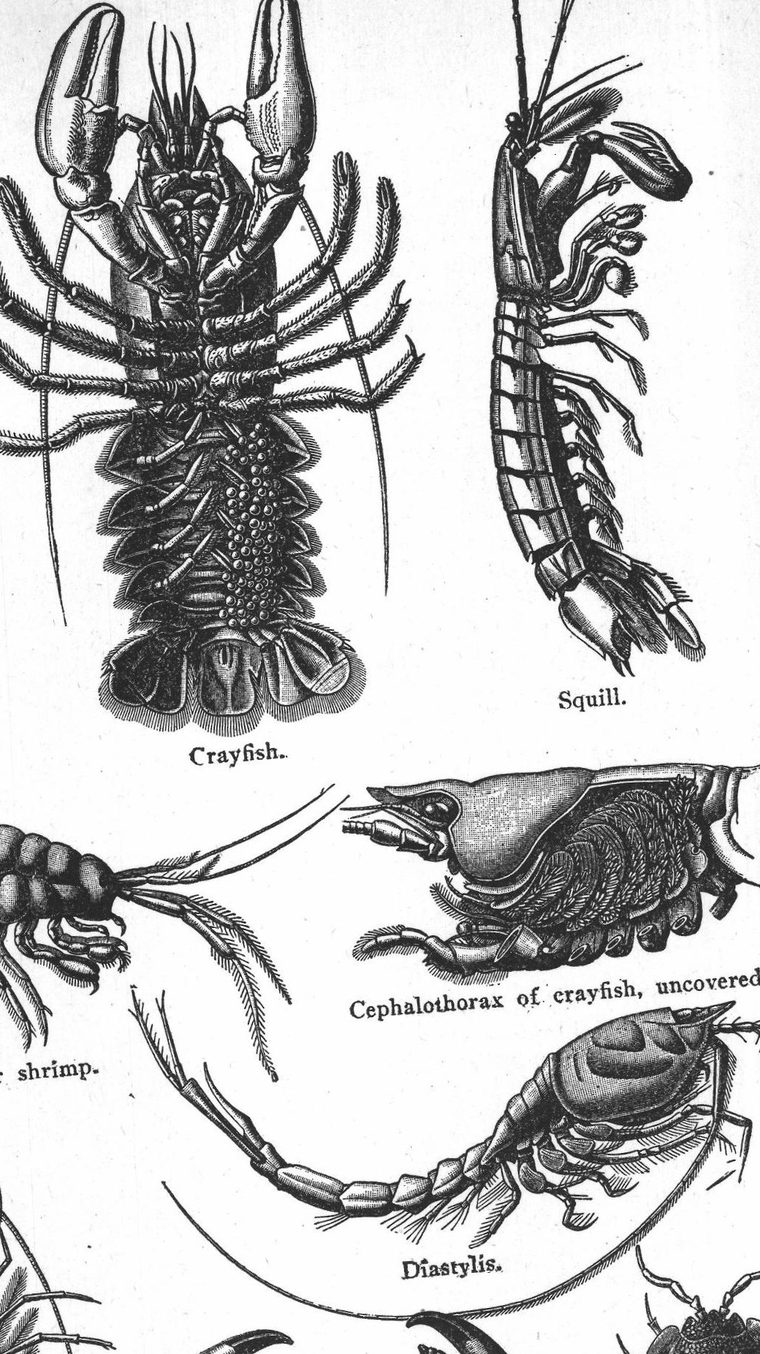
Crayfish
a familiar fresh-water relative of the lobster and the crab. The crayfish crawls about at night on four pairs of legs, either forward, sidewise, or backward, examining muddy bottoms for worms, larvae, snails, etc. The huge pincers, or modified fifth pair of legs which he carries, are useful in crushing weak shells and in tearing food into pieces. When alarmed he brings his fan-shaped tail under his body with a vigorous swoop that causes his body to dart backward with great swiftness. A repetition of the movement and the raising of all the mud he can are his means of escape from the prowling fishes that would gladly give him a nightly shelter. When water is low and his mudflat is exposed the crayfish sinks a well which he constantly deepens as the waters recede, heaping up a ring of marble shaped pellets about the entrance. It is said that a hungry raccoon inserts his paw in the burrow and churns the water up and down. When the crayfish comes up to see what the commotion signifies, the wily coon flips him out, and the burrow is ready for another occupant. At all events, boys in search of "crawfish" bait run an arm up and down in the burrow, churning up mud. A pair of fingers are held in the muddy water at one side of the burrow until first a pair of feelers, and then a pair of stalked eyes appear cautiously at the surface. A quick motion at the critical moment and the crayfish is out. Otherwise, once he sees the baitcatcher, a flip of his tail takes him down to stay down till times are more propitious.
The crayfish is hatched from an egg, and is several years in attaining his full growth. Whenever his shell becomes too small, which occurs several times the first year, he molts it and grows a new one.
Crayfish are common in North America and in Europe, Madagascar, Australia, and Japan, but are found seldom in Asia and South America and not at all in Africa. The shores of New England are too rocky to favor crayfish. On the lower Mississippi, they cause great damage by perforating the dikes or levees, and giving the surging floods a start at breaking through.
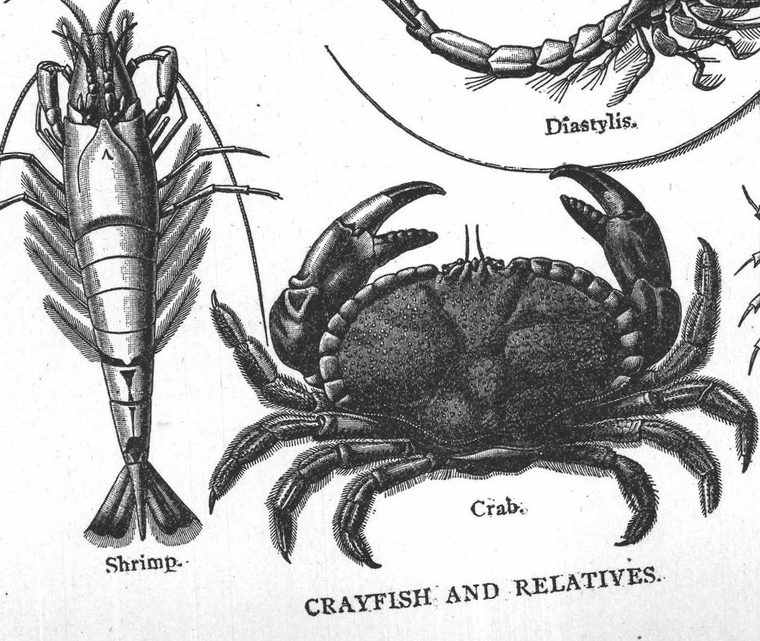
See Crab