Dove
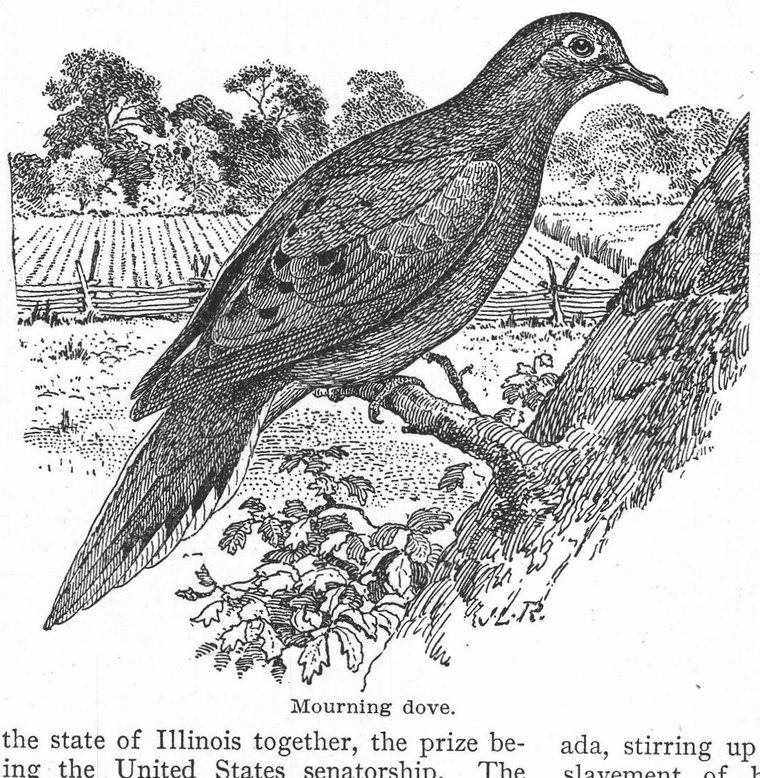
a bird not readily distinguished from the pigeon. The most prominent American species is the common mourning dove. It breeds from Cuba to Manitoba, and winters from the Ohio River southward. This dove is about twelve inches long, colored much like a wild pigeon. The name comes from the peculiarly sweet, mournful, cooing call of the male which corresponds to the drumming of the partridge and the booming of the grouse. "The soft, melancholy cooing of the mourning dove, whose voice," says Roosevelt, "always seems far away, expresses more than any other sound in nature the sadness of gentle, hopeless, never-ending grief." The dove seems quite at home in the small groves of farmsteads. It builds a careless, flat nest of loose twigs at the end of a spreading branch from five to fifteen feet above the ground. Eggs, two, beautifully white, about an inch long. An examination of the stomachs of several mourning doves showed that their food consisted of seeds of sorrel, spurge, ragweed, sunflower, pigeon-grass, violet, smartweed, buckwheat, and wheat.
The dove of history is necessarily an Old World species. It is the emblem of innocence and gentle affection. Noah sent a dove forth from the ark to see whether the waters were abated. The turtledove was offered by the Israelite as a burnt offering. King David exclaimed, "Oh, that I had wings like a dove! for then I would fly away, and be at rest. Then I would fly away and remain in the wilderness." Christ, it will be remembered, overthrew "the seats of them that sold doves" in the temple. In ecclesiastical art, the dove is the symbol of the Holy Ghost. In Matthew iii: 16, we find "Lo, the Spirit of God descending like a dove and lighting upon him." In heraldry the dove bearing an olive branch is the emblem of peace.
See Pigeon