Pigeon
pij'un, a general name given to any species of the dove family. The distinction between pigeons and doves is one of name merely. There are several hundred species. The order includes the extinct dodo of Mauritius and a pigeon as large as a hen turkey still found in New Guinea. Cuvier classed the pigeons and doves with the grouse, which indeed they resemble. There are a number of differences, however. The pigeons are swift, graceful, easy flyers. The toes are on the same level; they drink until satisfied without raising the bill; two and two they mate for life; the male assists in building the nest and in keeping the eggs warm; the female lays but two eggs for a sitting; the young are without feathers and are helpless--"mere squabs."
Our domestic pigeons or doves are derived from the rock pigeon of the Old World. This wild pigeon is uniformly twelve inches in length. Its prevailing color is bluish. It nests in the rocks and caverns of Great Britain, especially in the Orkneys and Hebrides. It is found also in great numbers on the rocky islets of the Mediterranean and as far east as Japan. Its domesticated descendants, however, exhibit a remarkable diversity of color and size--white, bronze, blue, gray, and even black, in every imaginable combination and marking, while in size there is an equal degree of variation. The fan pigeon has an immense fan-like tail which it displays with a proud strut. The tumbler has a way of turning or tumbling in its flight. The monk has a feathered head; the pouter inflates its crop till its head seems insignificant. Fortunes have been spent by pigeon fanciers in breeding fancy types. By Scottish law, no person is permitted to erect a dovecot unless he holds lands sufficient to afford reasonable feeding ground. One who breaks into a dovecot is held at the level of a chicken thief.
The domestic pigeon begins to breed at nine months and produces a pair of young every month unless interrupted, as in the north, by severe winter. The hairless young are called squabs. They are fed by regurgitation, that is, the old bird raises milky food from her stomach with which to feed her young. The business of raising squabs for market is extensive.
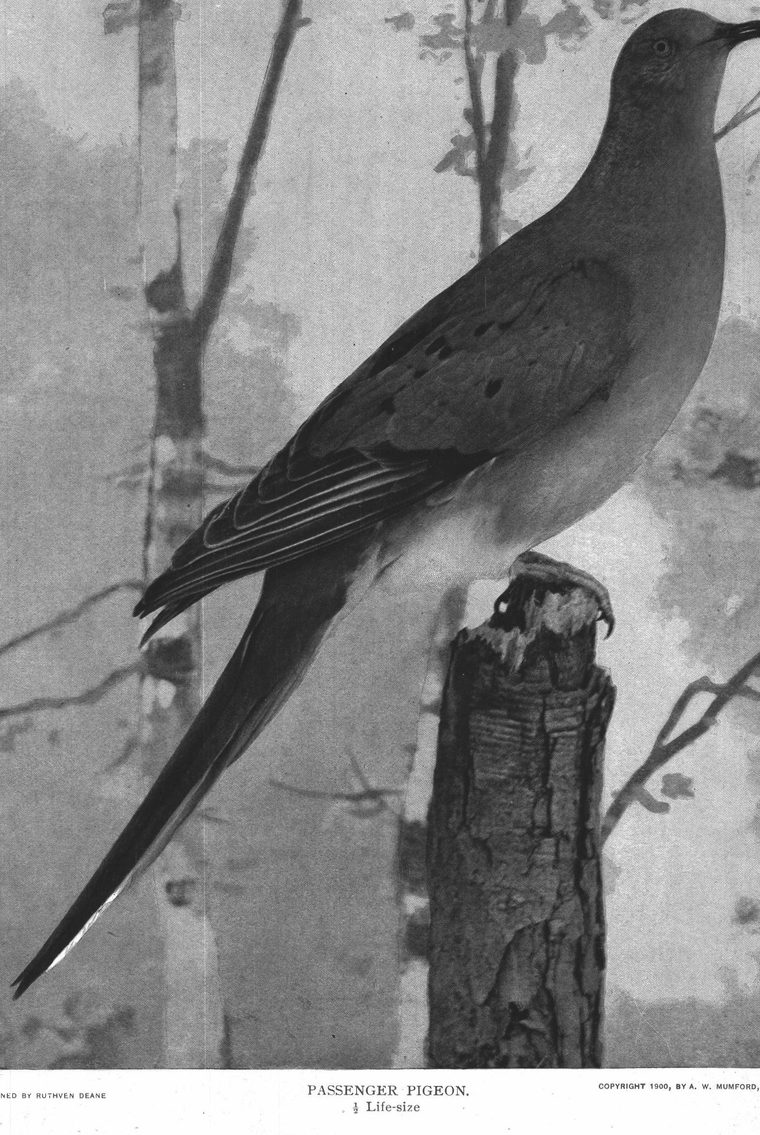
The characteristic native species of America is the passenger pigeon, once numerous but now almost extinct. This wild pigeon is about sixteen inches in length, with bluish slate-colored upper parts, and light brown or white parts beneath. A flock seen from above flashes with a blue metallic lustre in the rays of the sun. Seen from beneath as the birds pass overhead, there is a beautiful commingling of blues, wine color, and white. In the days of Audubon and Wilson, and until recently, the pigeon was accustomed to migrate, feed, roost, and nest in colonies. Wilson describes a flock observed, 1808, near Frankfort, Kentucky, which he estimated to contain 2,220,272,000 birds, and which he further calculated would need to devour 17,424,000 bushels of beech nuts per day.
This seems incredible, but a flock is recorded as roosting in Michigan as late as 1876 which occupied a strip of forest twenty-eight miles long and three miles wide. At daybreak columns of pigeons numbering thousands poured out of the roost and winged their way with inconceivable rapidity to feeding grounds hundreds of miles away in every direction. At nightfall the detachments came pouring in to the roost with a roar of wings like a tornado, which at a distance of a few miles was softened like the noise of a waterfall. They settled on the limbs of the trees in such numbers that the overloaded branches not infrequently broke with the weight. Such was the confusion and crowding that the camp was not quiet until far into the night. The present writer visited a temporary encampment of pigeons in a forest on the banks of the Minnesota in 1875. The birds thronged the trees covering possibly five acres of woodland.
In earlier days these spring encampments were expected as regularly as the running of fish in the streams or the migration of wild ducks. From Minnesota to Kentucky night raids with torches, lanterns, guns, long poles, and bags were made on the crowded roosts. The birds were so confused and dazed by the glare of the lights that they could be swept from the lower limbs like chickens from a perch. People drove a day's journey to have their part in the nightly slaughter, and literally wagon loads were carted off for market or to be thrown to the hogs. Under such persecutions, and the destruction of their nesting places by clearings, countless millions of birds have been reduced to small bands or scattered pairs that no longer attract attention. It is believed that a few pairs, or very small flocks, are still alive, and the American Ornithologists' Union has offered a series of rewards for the person finding and reporting such nests without disturbing birds or eggs. Leaflets have been prepared, describing and picturing the birds, giving their nesting habits and other information, for their identification, and giving a list of the rewards offered and the conditions of winning them. The sums to be distributed already amount to some $3,000. Mr. Charles K. Reed, Worcester, Massachusetts, will send these lists and information upon receipt of six cents in stamps.
An exceedingly interesting feature of bird life has passed, but such flights were to be dreaded by the settlers. A flock of pigeons, numbering anywhere from a few dozen to a million was likely to swoop down on a newly planted clearing, and devastate it. The movement of a feeding band was peculiar. In the open the flock flew noiselessly. The front birds dropped at the first sight of food, the others settling beyond them in regular order, the last birds settling farthest to the front. By the time the last birds were feeding the first to settle followed them to the front flying above the feeding flock. The rear birds in this fashion were constantly flying to the front and the entire flock seemed to revolve like a cylinder, or roll like a lady's muff from one side of a field to the other, when the whole flock bounded into the air to seek food elsewhere. From a bird lover's point of view this swiftly rolling flock was a brilliant scene, but the heart of the settler sank when he saw his seed grain devoured by these handsome, hungry, agile, and audacious possessors of quick eye, foot, and wing. Nor was it easy to defend a field. Even though an entire family was out firing shotguns and beating tin pans, gusts of birds would sweep in and off again. The present writer has seen acres of seed wheat snatched from the soil under the very muzzle of his shotgun.
The corresponding species of the Rocky Mountains and Pacific coast is the bandtailed pigeon. It is marked by a conspicuous white collar and a square tail ending in a two-inch band of dull white. The head is purplish; the under parts are a fading pink. The prevailing color of the upper parts is a grayish blue.
See Darwin; Dove; Carrier Pigeon; Dodo; Photography
Now ye are lighted--lovely to my sight
The fearful circle of your gentle flight,
Rapid and mute, and drawing homeward soon;
And then the sober chiding of your tone
As there ye sit from your own roof arraigning
My trespass on your haunts, so boldly done,
Sounds like a solemn and a just complaining!
--Charles Tennyson Turner.