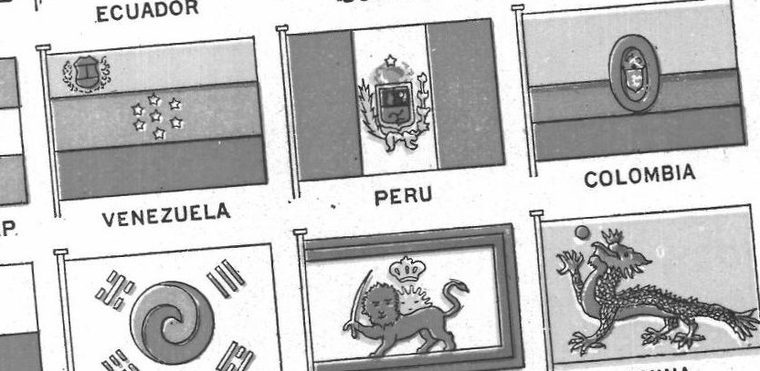
Flag
a plant. See Iris; Sweet Flag Flamingo, a family of wading birds allied to the stork, the ibis, and the curlew. The legs are long and stilt-like. The feet are completely webbed. There are eight species, all tropical. Our species, forty-five inches in height, has rosy, vermillion plumage and black wing coverts. It is resident in tropical and subtropical America. It is found at times near Cape Sable, Florida, and occasionally along the Gulf as far as Texas. The flamingo has a long curved beak of such a shape that, when its head is down and the bill in the mud, the point is turned backward and upward under the neck. The bird wades in the water and feeds on the bottom. The sides of the bill are provided with "strainers," like those of the shoveler duck, through which water and mud are forced while snails and small shellfish are retained. Flamingoes frequent the mud flats of the seashore and the inland waters of Cuba, the Bahamas, and South America. They breed in colonies. Mr. Frank M. Chapman speaks of 2,000 mud nests on a level mud flat near a shallow lagoon on one of the Bahama Islands. In nesting the flamingo heaps up a cone of mud and muck ten or twenty inches high. It deposits its two whitish eggs in a hollow at the top. Despite the repeated assertions to the effect that the bird straddles this cone in hatching, it folds its long legs bird-fashion, like any other self-respecting wader. So much has been written about the flamingo straddling the nest that the following account written by Henry A. Blake for the Nineteenth Century is worthy of perusal:
The flamingoes are very shy, and are only found in the remote and rarely-visited lagoons. When seen in flocks of some hundreds standing in long lines, they look at a distance like battalions of British troops on parade, their brilliant pink plumage showing up well against the dark-green mangroves with which the lagoons are generally fringed.
In May they begin to repair the old nests, or to raise new ones, which is done by scooping up the surrounding mud with the beak, while they stand on the nest and pat it into shape and proper consistency with the foot. It is no mere treading on the mud, but one foot is used at a time, and the sounding slaps with which the cones of mud are got into shape can be heard at a considerable distance.
The nests are always grouped close together, sometimes as many as four hundred being found in a "rookery." They stand from three to four feet apart, the area occupied by each nest being about twelve square feet. The birds do not always return to the same breeding-place, and if disturbed much while breeding, or if the very young birds are taken from the nest, they will probably breed next year in some other rookery, many of which are to be found in the least accessible parts of the great stretches of swamps.
Having settled upon their breeding-ground for the year, the old nests are at once taken possession of by the oldest or strongest birds, who proceed to repair them by adding to the top the inch or more washed off by the rains since last tenanted. If the nest is very low, four or five inches may be added, and sticks, shells, or anything else that may be lying about the base, are scooped up and worked in without any apparent arrangement, just as if the soft mud with the debris contained in it were lifted with a trowel and placed on the top. No preparation is made for the new repair of the old nest, and, if an addled egg remains, it is simply covered over with the fresh stuff and built into the cone. I measured some scores of nests. The highest was fifteen inches, the lowest eight inches, the latter being the height of the nests in the first year. The nests were about eighteen inches in diameter at the bottom, and nine to eleven inches on the top. The concavity was very slight. In a few cases about half a dozen feathers were found on the nest, but in general the eggs were laid on the bare mud. I said "eggs," but, out of some hundreds of nests examined by me in June, there were not half a dozen which contained two eggs, one being the usual number. As some of those taken at the time were in an advanced stage of incubation, it is probable that at each breeding-season but one egg is usually laid.
At length, having crawled under the roots of the dwarf mangroves that covered the slob like a network of croquet-hoops, we found ourselves at the edge of the marl, and within one hundred and fifty yards of the birds, who were still undisturbed. Here, with my glasses, I could see every feather, note the color of the eyes, and watch every movement. There were, we calculated, between seven hundred and a thousand birds, and a continuous low, goose-like cackling was kept up. Never did I see a more beautiful mass of color. The male birds had now all got together, standing about five feet high, and with necks extended and heads erect were evidently watching events, preserving in the mean time a masterly inactivity. Now and again one would stretch out his great black and scarlet wings, but the general effect was the most exquisite shade of pink, as the feathers of the breast and back are much lighter than those of the wings.
The hens sat on the nests, and some were sitting down in the muddy lagoon. I watched them carefully for nearly an hour, and looked at every nest to see if the legs were extended along the side. In no case did I see a leg. I saw the birds go on to the nest and sit down. I saw them get up, and step down from the nest. In every instance the legs were folded under the bird in the usual manner. In my opinion my observation settles the point as to the mode of sitting; for even if, as I had been assured, the birds sit both ways, it is improbable that among the hundreds then sitting not one would have extended the legs. Remembering the great length of the flamingo's legs, it is evident that on a new nest, not more than eight inches high, the hen could not thus sit, nor would even the highest nest allow of the legs being extended while the bird sat upon it.
After having watched the birds for the time named, we showed ourselves; but whether they had observed us before, and become somewhat accustomed to our presence, or that when sitting they are more easy to approach than I thought, the only effect was that the hens left the nest, and, joining the male birds, prepared for eventualities, nor did they take wing until we had begun to walk up to the rookery. While we were examining it, the birds flew around us within forty yards, so that we could have shot them easily. Of course, we did not do so. To prevent the destruction of flamingoes and pigeons by their wholesale slaughter during the breeding-season, the Bahamas Legislature passed in 1885 a Wild Birds' Protection Act, from which I hope for good results.